
For cryptomine, workforce housing development
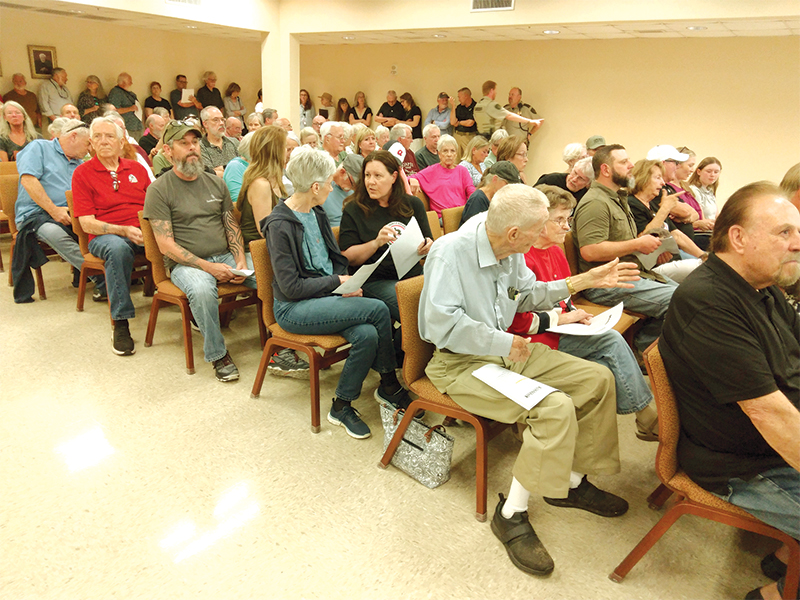
An April 18 meeting of the Gilmer County Planning Commission often resembled a sporting event minus the actual athletic contest.
Numerous attendees repeatedly cheered the side they supported and booed those with whom they disagreed. Crowds lined up throughout the courthouse to hopefully snag a seat in the jury assembly room. When all seats filled up, dozens lined the walls or stood outside the room to hear the proceedings. Catcalls were prevalent, and at least one attendee was asked to leave after the zoning board had reminded the crowd to be respectful.
Many were there because of two big agenda items — a proposed rezoning from C1 (commercial) to CT-1 (new commercial technology zoning recently adopted by county commissioners) for a cryptomining facility on Eller Road and a proposed rezoning from R1 (residential low density) to R5 (residential multifamily high density) for a workforce and senior housing development on Yukon Road.
In the end, the board comprised of acting chairman Jim DuPont, Dorothy Logan, Lamar Walker and Carl Hill recommended denial for most of the rezoning requests for both projects, but not before extensive public comment was heard.
The planning and zoning board does not approve or deny the actual rezoning requests. Instead, they make recommendations to the Gilmer Board of Commissioners, which has the final say on whether or not to rezone properties.
Cryptomine questioned
Attorney Terry Lee Wilson and Kenneth Ashley, the prospective cryptomine operator, were among those who represented rezoning requests for two parcels on Eller Road where cryptocurrency mining is the intended use.
Two 2-acre portions of an almost 12-acre parcel belonging to Wayne C. Ashley, Kenneth’s father, were requested to be rezoned for the cryptocurrency server farm, while two other portions were requested to be rezoned to R2 residential for a new home to be built and an existing structure to be used as a residence. Wilson noted the property had formerly been used for a paintball field.
Cryptomining, also referred to as Bitcoin mining, requires a chain of constantly running computer servers to record Bitcoin transactions and create new cryptocurrency.
Wilson said the proposed crypto site would be a different type than in Murphy, N.C., where cryptomining has drawn national attention due to facilities’ proximity to homes and the amount of noise they produce.
“It’s sad for Murphy. They went through this in a bad, bad way,” Wilson said. “They had no zoning. They had an out of state company come in and put servers out in the middle of a field, not in a building. They put them in metal boxes and put big fans out there to cool them and did nothing else. That is not what this is. This is a family owned operation. The family will be living right next to it.”
Wilson described the liquid cooling process planned for the proposed Eller Road facility as being initiated by “a biodegradable synthetic fluid.” He did not name the specific chemicals involved, but compared them to vegetable oil.
“It’s in a long horse tank. You take the servers and put them in there. It sounds like a fishtank,” he said.
As for any noise the constantly running computer systems and assorted equipment could generate, Wilson said there would be one fan only for the building, and the noise level would not exceed the set limit of 60 dBA by day and 50 dBA by night.
“You won’t be hearing the servers,” he added. “I don’t want and nobody else wants what happened in Murphy. This is going to be something you’re not even going to be able to notice as you drive by.”
The potential for excessive noise, hazardous environmental effects and a drain on the power supply were among the concerns voiced by those who spoke against the CT-1 rezoning. Public comment was overwhelmingly against the cryptomine, although a very small number did express support.
Several had concerns about the liquid that would be used to cool the machines and how it could affect the land and water around them.
“This particular chemical has a rating of may be fatal if swallowed and enters the airwaves,” said Dr. Craig Ajmo, who has a dental office on Eller Road.
“My home is right at the base of Mr. Ashley’s property,” said neighbor Peter Lloyd. “We have, in the front, a protected trout stream that runs downs Stone Road. Above my house, there is a large reservoir that drains onto my property, into the stream and into (the neighboring) property. One big concern is the chemical. If that gets loose, it’s into my property and everybody’s property. It’s in the stream, and it goes into a major river downstream.”
Many were also skeptical that the cryptomine wouldn’t produce a substantial, constant noise that would exceed the set noise ordinance.
Debra Christian, who also lives near the proposed site, said she’s spoken with several people in other states “who’ve experienced this.” Some of them in northeastern Pennsylvania are involved in a lawsuit against a cryptomining company. That cryptomine is six times smaller than what’s being proposed here, Christian noted.
“They’re seeking compensation and punitive damages from the crypto company for public and private nuisance for water, air and environmental pollution,” she added.
Christian is concerned about people here being subject to the same “lack of sleep and associated health issues from the constant high decibel noise and vibrations, (which) have affected the humans, farm animals and wildlife.”
“They have experienced this mine for just under a year. They speak of a 5-8 mile radius from that site,” she added.
Cindy Roberson told the board she and her husband moved to Gilmer County from Murphy to get away from cryptomines. She did not expect to see one pop up here.
“I’ve heard all this before. They expand immediately,” she said.
Kenneth Ashley spoke late in the meeting, but did not offer much information to alleviate the concerns that had already been raised. Ashley said he grew up in Gilmer County, then moved away to pursue a college education and later came back here to live.
“I set up, configure and maintain servers for companies across the U.S. I see firsthand that, to a lot of people, technology is very scary. I believe in the technology, and I want to continue to live here,” he said.
The zoning board recommended denial for rezoning one of the two parcels where cryptomining is the intended use. The other parcel was withdrawn before decisions were made. The board recommended approval for the two R2 rezoning requests related to homes on the property.
Workforce housing debated
Joe Collums, of developer Georgia Communities Inc., represented the rezoning request for 25.5 acres on Yukon Road and 1.49 acres on Old Bennett Road where building high density multifamily housing is the intended use.
Collums said his company was brought in by Gilmer’s Georgia Initiative for Community Housing (GICH) team, which is enrolled in a community housing improvement program offered by the state Department of Community Affairs.
“Single family housing has become unattainable in large part for your workforce. Cherokee County is the only place I’ve seen that has had a more acute housing problem in the 43 communities we’ve worked in,” Collums said. “They also did not have an adequate multifamily housing stock. They relied a lot on their single family homes. What happened (there) is what is happening here. It was very difficult for them to retain their school personnel, their everyday workers in retail and restaurants and health care workers.”
Collums said the development planned at 85 Yukon Road, which will be called Cartecay View if built, would include 50 multifamily housing units. It would also qualify for state and federal low income housing tax credits.
“This has no HUD involvement. It’s not a public housing authority initiative. There’s no vouchers,” Collums said. “This is a program that was created under the Reagan administration to give communities like this a tool that would help hard-working people find a place to live.”
The amount of additional traffic the development could create was the main concern given by those who spoke against the R5 rezoning.
East Ellijay Public Safety Director Larry Callahan and Ellijay Police Chief Edward Lacey were among those who addressed the potential for excessive traffic in their comments.
“We strongly oppose this zoning request,” said Callahan. “We know the need for housing, and we’re very sympathetic of that. As a city government, our responsibility is to our current residents and the people who use East Ellijay. We have to keep them safe and keep them a quality of life that is good. That includes having safe roads to drive on.”
Callahan said neither Yukon Road, nor the streets that would accommodate outgoing and incoming traffic from the proposed development — Ridgehaven Trail (an East Ellijay city street) and Old Bennett Road — are equipped to handle the added traffic. Ridgehaven Trail was built for the purpose of serving a small number of townhomes at the end of the road, not for ingress and egress from a large development, he noted.
“Yukon Road is full. For years, we’ve built schools and athletic fields. We’ve pushed a lot of traffic out on Yukon, but we’ve never done anything to the road,” Callahan said. “The road is no different than it was 75 years ago.”
David McAnally is among several Old Bennett Road residents with similar concerns. “(Old Bennett) is very narrow,” he said. “It doesn’t even have enough room for two cars. The roads need to be corrected first before you talk about anything (like this).”
Tiffany Watson, Gilmer Family Connection director, made an appeal for more affordable housing options for local families and young people.
“We are scrambling to find housing for our youth once they graduate or come back from college. A few weeks ago, a one bedroom studio apartment went for $1,800 a month,” she said. “We have teachers living in basements, and our largest employer, Pilgrims, is bussing in employees every day because we don’t have options. There are very few sites that have the infrastructure for water and sewage and meet the criteria for this type of development. The need is great and we must take advantage of this rare opportunity.”
Others, like Talitha Rogers, who said she runs a nonprofit that helps families with various needs, questioned the target income range for the workforce housing and how many locals would actually have an opportunity to live there.
“Most of my families, their income does not fall into that category unless you take the husband and wife and split them up,” she said. “Their income is well over $30,000 because they’re both working. The $30,000-$49,000 income range, if we’re going to approve something like this, we’ve got to fix those numbers because what’s going to happen is people from other counties (who qualify) are going to come here, and we’re still going to be stuck with the same problem.”
The board denied both rezoning requests for the housing development. The potential traffic issues were mentioned as a reason for that decision.