
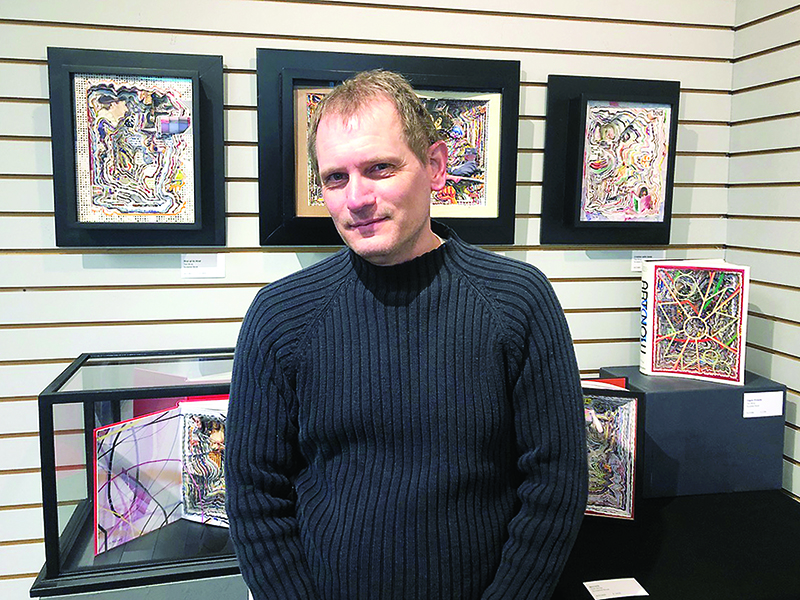
Books bound for the recycle bin or dusty shelf corners become enlivened canvases in the hands of a local artist who works in the genre of book sculpting.
Ted Wray enjoyed painting and drawing for most of his life before trying his hand at book sculpting, in which layers of cutting and re-arranging turn soft and hardcover books into three-dimensional canvases.
His first exposure to the craft was through the work of Brian Dettmer, a contemporary artist who uses existing media like books, cassette tapes and maps to create sculptures.
“His book sculptures are remarkable, but quite different than mine,” said Wray, who’d worked in different areas of the print industry and as a professional musician before arriving at a career crossroads.
“I was burnt out in my career, so, basically, I got on my knees and prayed for guidance. I went to bed and Dettmer’s work entered my mind. I started thinking about how I could bring my own fingerprint to book sculpting. The idea arrived out of nowhere, like ideas do, to stop dreaming and start cutting,” he recalled.
Assorted volumes that Wray was unable to trade at a used book shop were used for his first forays in sculpting.
“I started chopping up these used books that were basically waste. It wasn’t long before I realized that something pretty cool and interesting could be done here,” he said. “Now, a lot of my inventory comes from a friend who’s a manager at a used book store. She passes on books to me that have no market value and she can’t sell, but she doesn’t want to throw them away.”
Wray said it took a good three years to cultivate his own unique style of book sculpting or “book excavation,” in which cutting reveals the pages and pictures of a book in multiple layers.
“In order to make a unique fingerprint, I had to pioneer my own approach and there was a lot of trial and error. From 2014-2017, I was looking for my voice in book sculpting. In 2017, I finally discovered my own particular style,” he said.
Wray’s primary tool is an X-Acto knife, and it’s essential for the artist to have patience with the many delicate cuts and angles.
“I cut into the cover as if it’s the frame, and each page becomes the frame for the next page. Sometimes there’s a pattern and sometimes it’s intricate curves and waves. The first few cuts take the longest unless I’m just cutting straight lines. Each layer is a page that already exists in the book. I don’t add anything to them. Everything you see was there before I started. I search for interesting books, preferably ones that are very colorful,” he said.
“I sit with the books awhile and flip through the pages to get a preview of what’s inside. As I’m working, not only am I trying to bring a new style or design to each thing, I’m also seeing how the book reveals itself. I may cut one page and move onto other things, then come back to it. There have been books that (take) 16 hours almost without interruption. I keep promising myself I’ll step away, but once I get into it, I get into it,” Wray added.
One of the artist’s goals is for those who view his work to see everyday mundane objects in new ways.
“There’s only so much real estate on the pages, and I don’t like to have a tremendous amount of white space. I want people to spend time exploring what’s in there. I’m not giving the world something new. I am giving them something that always was, just in a different way. Yeah, it’s an ordinary book. But you haven’t seen it like this before,” Wray said.
First place winner, first time entrant
Wray currently has six pieces featured in a juried art exhibit on display for public viewing at the Gilmer Arts Gallery.
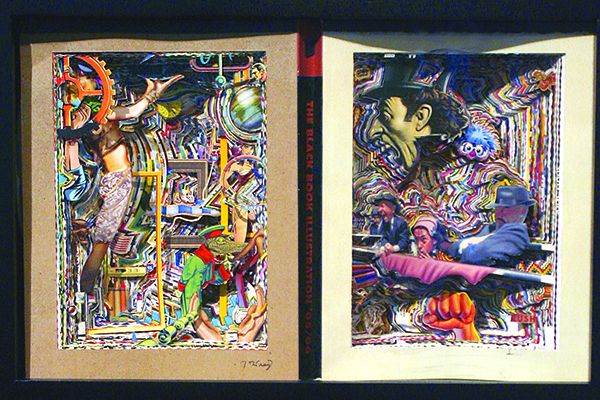
One of those pieces, a two-panel sculpted book called “The Spectators,” was awarded first place in the competition’s 3D division. That category also includes such genres as wood inlay, pottery and ceramics, stained glass and wood carving, said the gallery’s manager, Pam Burns.
Wray used an illustration source book to create the winning piece in which madcap figures, animals, machinery and layers of intricately cut pieces converge in an animated shadowbox display.
“Ted’s display has become a very popular destination for our gallery visitors. When he brought this relatively new art medium to us, we really were in awe of the work and precision his pieces require,” said Burns.
Wray said this was not only his first win at a juried art show, but also his first time entering a competitive exhibit of any kind. Before moving to Ellijay from Florida, the guitarist and singer held down a career playing regular gigs around the Tampa Bay area.
He’s been working as a full-time artist since 2019 and now, with a first-place honor under his belt, he hopes this will be the year in which his book sculpting is revealed to a wider audience.
“I launched my Instagram (TedWrayArtist) and Facebook (TedWrayArts) accounts and have grown my following there quite a bit. This year, I’ll launch a website where people can buy my work,” he said.
Just recently, Wray found out that one of his pieces will soon appear in another juried exhibit.
“I was invited by a place in Maryland called the Annmarie Sculpture Garden, which is an affiliate of the Smithsonian, to show in their upcoming book and paper show. It starts Feb. 19,” he said.