
‘You try to plan, but you don’t even know how to’
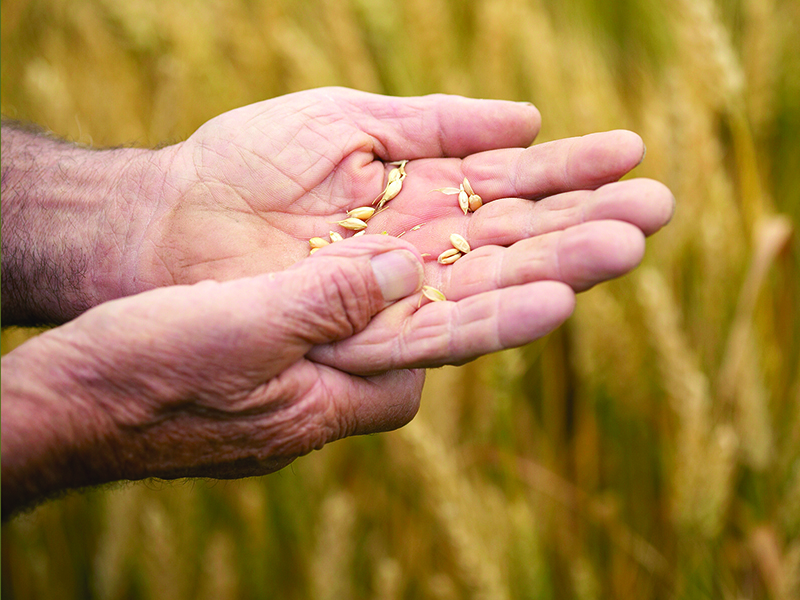
Now is when local corn growers would usually be getting set to plant their crops.
Because of the COVID-19 pandemic, as well as the closures and restrictions it continues to bring, this year’s growing and harvest seasons are rife with unknowns.
“We’re usually in full swing getting ready right now, but I’m at a standstill. We’re having to change our plans and go with a different situation,” said Scott Jones about how the national health emergency is affecting planting at his Ellijay farm.
‘A food chain break’
A decrease in gas consumption and a lower demand for farmed produce are both contributing to that uncertainty, Scott noted.
“What’s happened is 40 percent of the nation’s corn crop goes into ethanol. People aren’t driving (as much), so all that extra corn is being dumped back onto the market and it’s depressing prices. Small operators who don’t rely on the government are having to pretty much shut down because of that. The small producer really has to watch that price, which has gone down at least a dollar a bushel,” he explained.
Gilmer Farm Bureau President Darrell Jones, a longtime local crop and poultry grower who’s of no relation to Scott, said two concerns on the minds of many farmers right now are what to plant and how much.
“One of the things we have questions about is what to do if this thing don’t lift. I look for it to, but there’s the uncertainty of not knowing what to plant and how much of it. You try to plan, but you don’t even know how to. You always take a chance every year as a farmer because you don’t know what the market (will do). This year, it brings a bigger challenge because you don’t know if people will be able to get out this summer,” he added.
“I used to run a roadside (stand) with late crops like cabbage and collards. I don’t plant those like I used to, but I do in smaller volume. I may plant some sweet corn, but you don’t know if you’ll be able to move it because you don’t know if folks (will be able to) get out and go to the markets and the roadside stands.”
Both farmers noted how the continuing pandemic is causing disruptions in the nation’s food supply chain, which is supported by agriculture.
“Take tomato farmers in Florida. They’re taking a beating because they don’t have anywhere to go with their tomatoes (and) the restaurants are closed. Restaurants consume a ton of food. A restaurant uses a tomato in nearly everything they cook. Other products may not see so much of a demand or shortfall, but it’s closing down some avenues we normally would have,” Darrell said.
“We’ve got a food chain break here and it could really turn into something bad if things don’t get halfway back to normal or if the government doesn’t step in. The grocery distribution system has been overloaded with demand from the stores and they can’t handle the volume. The supply is there, but they just can’t get it to the customer,” Scott said.
“We hope it will fix itself. If it don’t, I hope the government might step in and try to fix some of these problems. (You’ve got) milk and vegetables being dumped because schools aren’t open. That would be a good avenue for the government to spend money on -— to divert it so people in line (at food banks) can get it. We can’t have people going without food.”
Ashley Hoppers, UGA Extension Agent for Gilmer and Fannin counties, said, so far, the heartbreaking decision to discard large quantities of produce or milk is mainly affecting bigger farming operations in other parts of the state, rather those in Gilmer County. However, crop surpluses could result here if consumer channels don’t open back up.
“It kind of depends on what your market is. Wholesale selling to grocery (stores) or shipping out of state and locally selling to the consumer are two different models and the approaches are going to be different. Obviously, COVID-19 is affecting a lot of industries and the food and ag sector has been one of the hardest-hit segments in the U.S. economy as a whole. The primary reason for that lies in the combination of household food expenditures, perishability and labor use,” Hoppers explained.
“Perishable products like fruits, vegetables and milk are being hit hardest. A lot of the uncertainty and concern is you just don’t know how long this situation is going to go on, which makes it very difficult to plant. I don’t think anyone really knows what the best recommendation is going to be,” she added.
Scott said his farm has been in the family for generations and a Georgia feed company is his primary outlet for field corn. He usually plants about 65 acres in spring, but that will be scaled back considerably this year.
“I’m (considering) planting 20 percent of what I’d normally plant in field corn and planting sweet corn to sell and maybe some other vegetables. I’ve also considered just sticking with my broiler chickens. I’ve always tried to have two or three things I could make money on in case one of them didn’t do too good during the year,” he said.
Darrell noted how cattle prices are also being affected.
“With fed cattle that’s ready to slaughter, it seems like they’re bringing a pretty good price. With feeder cattle -— calves coming off of cows — the market is tight and the prices have went down because they can’t move the end product,” he added.
Other avenues affected
Cancellation of public gatherings could also reduce agritainment avenues utilized by some farmers.
“Agritainment is up in the air right now,” Scott said. “I’ve had a corn maze and pumpkin patch in the past, but not (in the last few years). That kind of venture would be in question if I planned on having it this year. You wouldn’t know how to plan for it.”
The Ellijay Farmers Market, which usually opens the last Saturday in April and is held weekly till the first Saturday in October, could provide a sales outlet for crop growers if it can be held at all.
“The farmers market has been the brightest thing I’ve seen for small farmers in this community and it’s been growing very good, but I’m not sure if they’re even going to open this year,” Scott said.
“If it doesn’t open, I’m looking into setting up on the farm and having a drive-thru or pick your own to where you regulate the traffic and people aren’t crowded. That seems to be the way some farmers might be leaning. I don’t know if I will do that, but I’m looking into it. This is uncharted territory for me, so I’m going to (adjust) in small ways and see how it turns out.”
Hoppers said the extension office is trying to get the farmers market open while figuring out what procedures need to be taken to make that happen. The market is managed by the Gilmer Master Gardener Extension Volunteers. An official opening date had not been determined by press time.
The extension office is also looking at putting together a listing of Gilmer farmers who want to sell their crops locally.
“In cooperation with the chamber, we’re trying to create a list of folks who want to sell fresh and make sure our local consumers are connected to that,” Hoppers noted. “We want to get connected to individuals who have produce and want to sell it. We just need to make those connections. It’s something I’d rather go ahead and start doing now than wait till June and our growers have crops rotting in their fields.”
Though the local extension office remains closed to the general public, agents are still trying to get information out and provide services to the local agriculture community, Hoppers confirmed.
“This is my first growing season here and I was hoping to get out and meet all the local growers. This would (usually) be my busiest time,” she added. “I can still do site visits to support growers and we still have research going on, such as screening for key pests and diseases that affect production during the growing season. We’re still offering critical ag services like consultations and lab analyses like water testing and soil sampling. It just takes a little more coordinating to make sure we can be there to pick up samples and get them shipped.”
Darrell said he’s farmed through bad economic times and recessions before, but he’s never seen unknown factors quite like the coronavirus and the uncertainty it’s causing.
“As far as something like this, I sure haven’t (lived through it before). I’ve never experienced a pandemic. My mother was born in 1919 and that (flu pandemic) hit in 1918,” he said. “Hopefully we’ll be open back up by fall. I’m going to go ahead and hope for the best.”
Got produce to sell?
Anyone interested in contacting the Gilmer County UGA Extension Office about being listed to sell their farm-grown produce can email the office at uge1123@uga.edu or agriculture extension agent Ashley Hoppers: aahoppers@uga.edu or family and consumer sciences agent Jessie Moore: jessmoor@uga.edu. Email is the best way to reach the extension office at this time.