
GHS, Georgia Tech grad places in national competition
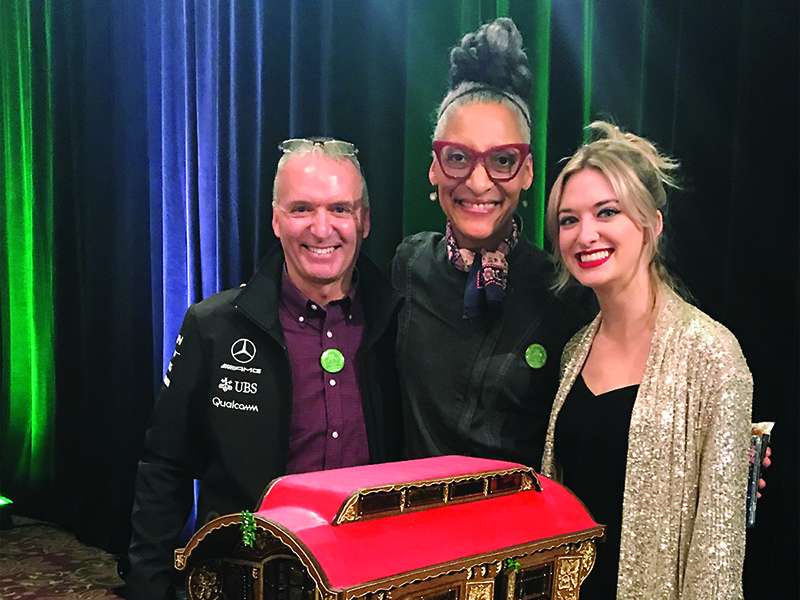
Nailing down a strong and edible adhesive was among the challenges met by a young woman with Ellijay roots who recently entered and placed in her first gingerbread house competition.
The first contest for Julia Vorpahl, 23, was no minor-league event.
Julia and her dad, Larry Vorpahl, a local resident, shared third-place honors in the National Gingerbread House Competition held at the Omni Grove Park Inn in Asheville, N.C.
“This was the 27th annual competition,” Julia said. “They have four different divisions — toddler, youth, teen and adult. They give out first, second and third place in each division and the adult division is usually where all the professional bakers compete.”
Laser-cut caravan
Julia, a 2014 Gilmer High School graduate who also attended elementary and middle school here, confided that she’s not a professional baker. However, she was able to put her engineering skills to good use when designing a Romani Gypsy caravan made from gingerbread and other edible construction material.
A 2018 Georgia Tech grad, she works in the field of automotive and industrial design.
“My main focus (in college) was mechanical and electrical engineering design. I just finished a contract where I was designing 18-wheelers,” she explained. “Mainly, I did (the contest) for my grandmother, who is German and loves (baked goods like) gingerbread, which also happens to be from Germany.”
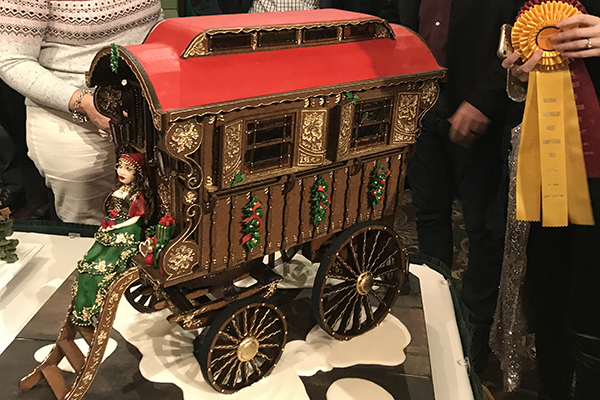 While baking and building their creation, the father-daughter team had to stick to competition rules which stipulated all houses must be made using edible materials and be comprised of at least 75 percent gingerbread.
“Everything above the wooden base has to be 100 percent edible, so you actually could eat everything on our wagon. We got nerdy and did a lot of research, so the undercarriage of the gingerbread wagon is pretty accurate to an existing Romani Gypsy wagon,” Julia said.
“I used a laser cutter for all the gingerbread on the caravan. Usually they are owned by large design firms, but it was a tool we were trained to use at Georgia Tech. You can cut anything that doesn’t melt (including) gingerbread.”
There are “serious differences” between making gingerbread cookies and a gingerbread house, Julia pointed out.
“Gingerbread cookies tend to have a rising agent which makes them soft and more likely to break,” she said. “I did the design, painting and cutting, but my dad’s job was to keep the wagon from breaking. I think it took him five days to glue all the pieces together.”
For the magic adhesive that was both edible and strong enough to hold the pieces together, the Vorpahls used a diabetic-friendly sweetener, isomalt.
“That’s how we kept it all together. Isomalt is a sugar substitute that you can melt and it becomes very structural,” Julia said.
The two also had to keep the fragile pieces intact on the hilly route to Asheville.
“We transported it in two separate pieces — the top of the wagon and the undercarriage attached to the base. We drove really slow and it probably took an extra hour or so to get there. We made sure to go really slow over speed bumps,” Julia said.
“The first time we put it all together was at the competition. They have a place they call the triage area where people go and fix their gingerbread houses. We put it together there and just prayed it wouldn’t break.”
Longtime gingerbreader, first-time entrant
Julia said she first started making gingerbread structures at age 19 and has done so each year since during the Christmas holidays.
“I got bored not having projects to work on when I was home for the holidays. It’s always interesting seeing people build things (with food). I love baking and this was a way for me to test the structurability of (things that I) bake,” she said. “I made smaller houses my first two years, which were more like something you’d put on a dinner table. Last year, I made a 4-foot cantilevered castle. That’s when my friends told me I should enter the national competition.”
According to the event’s website, the National Gingerbread House Competition has grown from a small array of houses built by community members in 1992 to one of the nation’s most celebrated and competitive holiday events. Per the Asheville Citizen-Times, 225 hopefuls entered this year’s contest.
As a first-time entrant, Julia learned a few things about the world of competitive baking.
“One of the big things I learned is that there’s a whole gingerbread community out there I didn’t know even existed. They’re called the Gingerfriends. (It’s a way for) all the people who enter these competitions on a national level to talk about gingerbread,” she said.
“Another thing I learned is that you can use (a material) called gingerclay, which is actually fondant made out of gingerbread.”
As third-place winners in the competition’s adult category, the Vorpahls were awarded a $1,200 prize and one free night with meals at the historic Asheville inn.
They also met an array of celebrity judges who are well-known in confectionary circles. For the occasion, celebrity and established chefs judged contest entries in the categories of overall appearance, originality and creativity, difficulty, precision and consistency of theme.
“Carla Hall, who was one of the Food Network judges, was probably the biggest personality (there). She has a bunch of cookbooks and is a professional cake decorator. She also judges the (Food Network’s) Haunted Gingerbread Showdown. She is also very tall in person,” Julia said. “Nicholas Lodge, who was also a judge, is the owner of the Sugar Academy in Atlanta and is a master cake decorator.”
Julia isn’t sure if her good first showing in this year’s contest will lead to a return entry next year.
“Perhaps. I’m hoping to get a job in Europe, so we’ll see,” she said.