
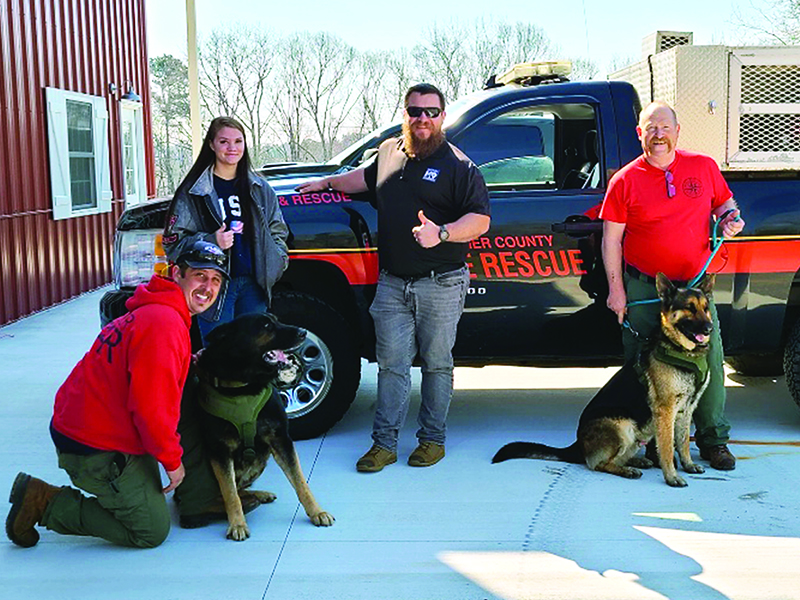
Four recent graduates of a national certification course for search dogs and handlers comprise a team that can be used in a variety of search and rescue situations.
Two German shepherds, Axel and Duke, completed the level 1 certification course along with their handlers, Mike Dempsey and Mikey Bramlett, both of Gilmer Fire and Rescue.
“These two dogs can do what it takes five or six people to do in tracking. It takes a lot of manpower to do these searches, and they can cover so much more ground quickly. Their senses are a lot better than ours,” said Dempsey, Axel’s handler.
Shayne Schettler, who administered the 40-hour course, said his company, Georgia K9 National Training Center, works with several other police and fire departments in Georgia and across the country.
“In Georgia, we work with Cobb County, Forsyth County and Statesboro Police. We do a lot of courses all over, and we also have a facility in South Carolina. We do courses there, and we’ve worked with departments everywhere from California to Florida to New York, as well as working with international law enforcement and military. Our biggest vendor is probably the Marine Corps. We do at least six schools a year with their multipurpose canine program,” he added.
The course Schettler taught here is designed to teach the handlers how to work with their dogs in a way that maximizes their chances of success while building up the dogs’ ability to track scents over time and distance.
“Our philosophy is centered around that the canine is a better natural predator than the human will ever be. If you think about it, tracking and trailing is nothing but hunting for the dogs,” he added.
“We try to remove the human out of the picture as much as possible.”
Dempsey said the course was taught at several locations around the county and partly in Waleska. The Georgia office of the canine training center is based in Canton.
“We worked in the county at places where we would possibly go (including) Rich Mountain Archery Range and Oak Hill out Highway 382. We were in a lot of woods, which is the kind of terrain we’d actually be working in,” he added.
For the level 1 certification test, dogs and handlers embarked on a 650-meter “double blind” missing person drill.
“They have to find them within 20 minutes,” Schettler said.
Double blind, Schettler explained, means nobody, even him, knows where the person being searched for is actually hiding.
“Honestly, that’s how all their real search and rescue cases are because they don’t know where the people are (located),” he added.
“Myself, the handler and anyone else who comes along has no idea where the person is, so we don’t accidentally influence the dog one way or another.”
Dempsey said the handlers learned a lot about how to respond to the dogs’ nonverbal communication signals.
“We learned how to read our own dogs. Every dog is different and has subtle hints of what they’re doing, and Shayne was really good about training us to be able to pick those things out,” he added.
“They can’t tell you what they’re doing, but (you can read) their mannerisms like how they wag their tails harder or pull harder.”
The dogs can pick up a scent from a “scent article,” like a piece of clothing, or other objects that have been handled by a search subject, Dempsey noted.
“A lot of times, you don’t have a scent article, so it could be something like a water bottle or the handle of a car door or a bench that someone was seen sitting at. It’s amazing to watch those dogs pick up a scent,” he added.
The certification means the dogs can now be used for multiple search purposes, which could include lost or missing children, campers or hikers and persons with Alzheimer’s or dementia, Schettler noted.
“They are available to any of the local fire or law enforcement (agencies) who need them,” Dempsey said.
Schettler said he grew up in police search dog training as the company he now helps operate was started by his dad, Jeff.
“When I was 10, he started working a bloodhound in California. I was doing trails at 10 years old,” he added.
Dempsey said the two search dogs are also a father and son team. Axel, 2, is the son and Duke, 5, the dad. Both started being trained for searches as pups and Duke has achieved nine finds thus far, Dempsey noted.
“These two dogs have a lot of really good potential. If they keep their training up and the (handlers) keep pushing themselves and their dogs further, they have the potential to be a really good pair of (search) dogs,” Schettler said.