
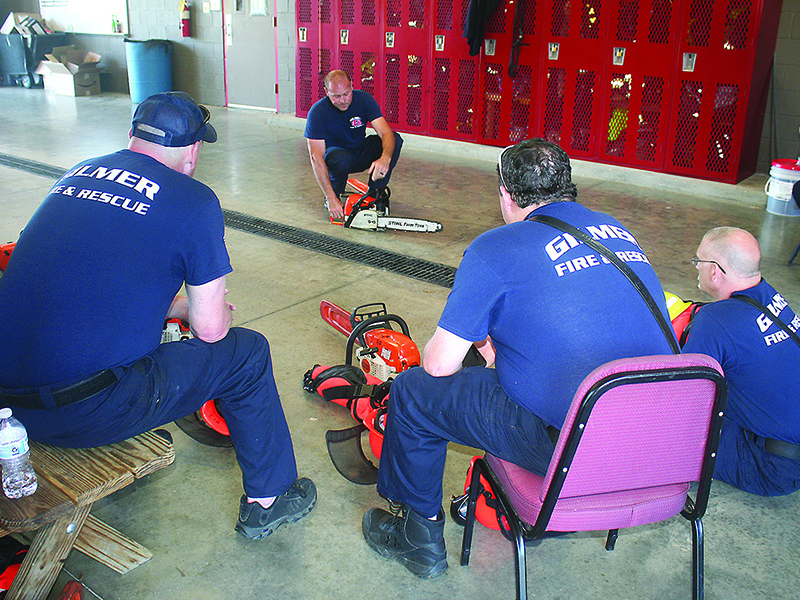
Gilmer Fire and Rescue personnel got a timely primer on safe chain saw operation during recent in-house training.
The class covered chain saw maintenance, repair and proper operation, as well as cutting techniques that can be used in various scenarios, confirmed Battalion Chiefs Aaron Freeman and Mike Dempsey.
Both new and longtime employees participated in the training session, Freeman noted.
The department uses chain saws in all seasons, noted Dempsey. Summer storms with high winds are among situations in which power saws would normally have to be used.
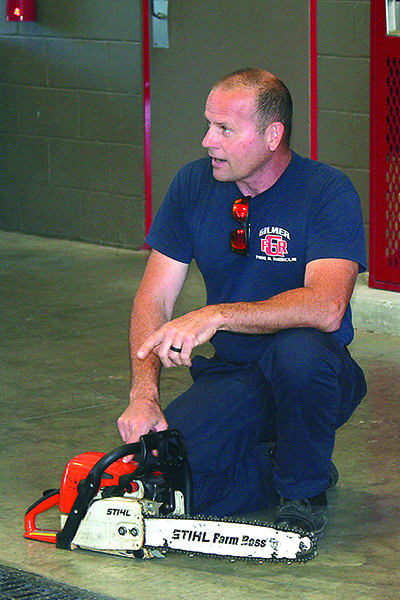 “We use chainsaws in several different ways. If we’re using chain saws, it usually means the conditions outside are bad or have been bad, and our highest volume of chain saw calls comes during weather events. It could be raining, storming, ice or snow,” Dempsey said.
“It seems that, most of the time, it’s at night. We use these saws at times most people wouldn’t even think of cutting wood.”
As he led the safety class, instructor Roger Jarrard, a Gilmer Fire and Rescue firefighter/EMT, offered tips for those new to handling a chain saw, including how to avoid flooding them with fuel, a common mistake that renders the tool temporarily unusable.
Gilmer EMS Chief Russell Brown said many assume that all firefighters already know how to drive a fire truck or ambulance and run a chain saw, but that’s not always the case. That’s where training comes in.
“In my day, it was, ‘There’s the ambulance, here’s the keys and go,’ but we take a lot of extra safety precautions now. The chain saws are the same way,” he added. “A lot of people (may have) helped cut trees before, but there’s a big difference when you’re trying to remove a tree from the roadway. It’s really dangerous.”
Fire and rescue crews often use the saws for tree clearing, but also when responding to structure fires, noted Dempsey.
“Of course, we use them to cut trees that fall in the road or on houses, but we also use them to cut holes in roofs. This allows heat and smoke to vent and improve conditions for firefighters to complete their tasks,” he added. “We have a lot of homes in our community that have wood walls and ceilings, as well as true log homes. The saws allow our crews to make quick openings to get to hidden fires in void spaces that would be difficult to access without them.”
Freeman said brush fires can also require using chain saws, which are carried on all of the department’s frontline fire trucks and brush trucks. That is a requirement for certification as a fire department, he added.
“They’re used to remove trees or limbs that might hinder extinguishment of the (brush) fire,” Freeman said.
This is the first time this particular chain saw safety class has been given at the department, noted Freeman.
“We try to (train) new people as we get them,” he said.
Dempsey asked those who have to use a chain saw to be careful when handling them.
“If you’re not familiar with your saw, take time to read the safety manual or go online and watch a safety video. Please be careful if you approach a downed tree. There may very well be charged power lines hidden in it. Also, please be patient with crews out there getting the roads cleared. We’re usually out there in bad conditions, so stay alert and look out for (emergency) personnel,” he added.