
‘I went to work, I didn’t have a job’
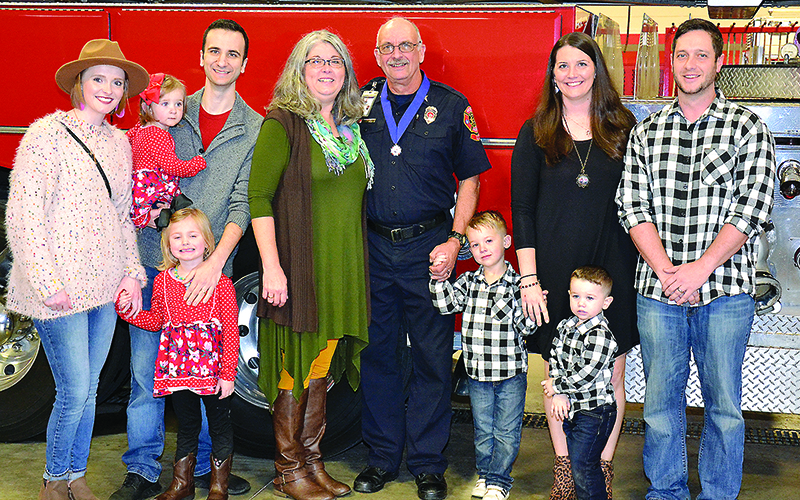
Perhaps the biggest takeaway a retiring Gilmer County firefighter/EMT has from a 40-year career in public safety is the level of dedication the work requires.
“It’s a 24-hours-a-day, 365-days-a-year type of thing,” said Mike Sales.
“When you leave the station, it’s already running through your mind what you’re going to do when you get there because we already have some information on what the call involves — chest pain, somebody passed out, etc. You don’t start the call when you get on the scene, you start when you leave the station.”
Ellijay native Sales, 62, was working construction for a telephone line company when he first began volunteering for the county fire department and ambulance service in 1980.
“It was called Gilmer County Emergency Services back then and we were all cross-trained. After I started volunteering as a firefighter, I went and got my rescue specialist (certification). I went to fire school to get certified for the fire department, then got my EMT (certification) in 1982. Gene Jones, who was the EMA director then, hired me on full time that September and I’ve been there ever since,” he said.
The challenges of working in the public safety field appealed to Sales, as did the opportunity to help people in distress.
“I tested the waters for a little while and just fell in love with it. It was something new every day and every shift. There wasn’t anything repetitive about it,” he said. “The entire paid staff at that time was 12 people and we had a lot more volunteers. At one time, I think we had up to 80 volunteers. When I started, we had three people on a shift and a secretary. We worked 24 hours on and 24 off. If you had a run and two people left the station, you had to call in two more to come take their place.”
Had to know main roads and back roads
Sales remembered how local firefighters and ambulance drivers really had to know their way around the main roads, and particularly the back roads, of the mountainous, largely rural county decades before GPS technology became a standard convenience.
“That was before the 911 system came into effect, so you answered your own calls. You got the directions and went from there. We would be writing it down while they were telling us and you had to pick out your landmarks. Churches were the main landmarks, but you’d also have calls where the person told you to turn at Hubcap Road or look for the cow skull on the barn,” he said. “It was challenging, but it helped that we knew where most people lived because we either knew them or knew of them. You still had to dial 635-9111 then. When it went strictly 911, we got (our first) dispatcher.”
Jerry Goble, a Gilmer firefighter/paramedic who partnered with Sales many times through four decades of fire and emergency medical calls, noted some of the ordeals that went along with navigating a county heavy on winding, unpaved roads, but light on road signage.
“Crossroads Grocery and Crossroads Church, for example, are on opposite sides of the county. New Hope (Baptist Church) is on Chatsworth Highway and East New Hope (Baptist Church) is (miles away) off Roy Road. There were seven churches in the county with the word ‘pleasant’ involved, so you better know which one you were going to,” he explained.
“In the ‘70s and ‘80s, most of the roads weren’t even named and there weren’t any addresses on a lot of them. There were just individual mailboxes with numbers. There were those times where we’d have to look for a mailbox with something like a horseshoe on it, then make a left. There was no radio communication and no way of calling people when you left the station. You just had to find them. Now we have things like GPS and map books. People give us their address and it takes us right to their door.”
Goble said, although he and Sales have been close friends for years, they were somewhat of an “odd couple” tandem in terms of their personalities. Goble was actually in the driver’s seat when Sales made his first ambulance run as an EMT.
“I told him to sit down, be quiet and hold on. We were both still kids at that time,” Goble remembered.
The ambulance blew a tire just short of the accident scene on Highway 52 East, but that didn’t stop the two from reaching the scene.
“We had an old single axle, box-type ambulance and it blew the right rear tire on the curb at Aaron’s Apple House. We could see the wreck ahead and he didn’t let up. Luckily, nobody was hurt. That old ambulance probably came out on the worst end of the deal,” Sales said.
As the county’s population has grown exponentially over the last four decades, so has the number of fire and rescue calls received by the county public safety agency.
“When I first started out, if we ran 30 calls a month that was considered busy. I think there was about 12,000 people living here then. Now, it’s closer to 30,000 and we might run 300 calls a month,” Sales said. “We have a lot more manpower now. There are more people on one fully-staffed shift now than we had in the whole paid department back in the early ‘80s. Now, all the med. units are 4-wheel drive, so we’re more capable of getting around in bad weather.”
Weather a regular obstacle
Emergencies caused by a variety of inclement weather events made for lasting memories, from tornadoes and floods to snow and ice storms.
“Floods were pretty common and we would have to evacuate people. On days like that, you’ve got to be a jack-of-all-trades. If it was a fire, you went. If it was an emergency medical or a search and rescue call, you went,” Sales noted. “There have also been bouts with cold weather where it got below zero for days and put hardship on a lot of people. We would go help them by bringing fuel and things they needed. Whenever it snowed or iced, the volunteers really stepped up to the plate. They’d bring their personal 4-wheel drives in and help out any way they could. If it wasn’t for them, we couldn’t have done it.”
Sales remembers one of the toughest weather obstacles being the Blizzard of 1993, which brought not just inches, but feet of snow to the area.
“I was working in short-sleeve weather that Friday. I went to bed and they called me at about 3 a.m. Saturday morning and said, ‘Can you come in to work?’ I did notice that the power was off. I said, ‘Sure, I’ll be there in just a minute.’ They said, ‘No, we’re coming to get you.’ I couldn’t get out of my front door (because of all the snow),” he said. “I went in early Saturday morning and got home Thursday night. The main fire station was at the Civic Center at that time and we slept there when we could.”
The extended blizzard, after which National Guard troops were called in to assist multiple north Georgia public safety agencies, provided an icy backdrop for almost every type of emergency call.
“Fires were actually one of the things we didn’t really have that many of (during the storm). We were getting calls about everything else — trees down, medical calls, wrecks,” Sales recalled.
“We had one 4-wheel drive van and some 4-wheel drive surplus trucks that we could retrofit with stretchers so that’s what we did. We put chains on the firetruck and tried to get to there the best we could. Up on Doublehead Gap, I got up to Dee Long’s Store in an old deuce-and- a-half, which is a 6-wheel-drive military truck. I was pushing snow up over the hood and the snow got so packed up you couldn’t steer it because the front wheels were coming up off the ground.”
With 24 hours on call spanning traditional first, second and third shift schedules, Sales worked plenty of nights with full moons. Those, too, were often filled with unpredictable events.
“We had this saying, ‘Full moon, look out!’ It always seemed to hold true. If anything was going to happen, it would happen on full moons. That includes babies being born. You would have deliveries happening on the way to the hospital,” he said. “I’ve signed, I believe, three birth certificates, which you have to do if you’re helping with (the delivery).”
‘Honest, reliable, levelheaded’
Sales, who’s earned such accolades as Northeast Georgia Region 1 EMT of the Year, as well as Gilmer County’s EMT and Firefighter of the Year, emphasized that, no matter the circumstances, he genuinely enjoyed his chosen profession.
“I told somebody the other day I’m probably one of the most blessed people alive because I went to work, I didn’t have a job. I enjoyed it for 40 years. A lot of people can’t say that. I’ve made lifelong friendships and I know if I needed anything, those people would drop what they were doing and be there,” he added. “We’ve also had a good relationship with law enforcement and we back each other up. If you’ve never been in public safety, it doesn’t matter what uniform you wear. It’s all camaraderie.”
That level of camaraderie is apparent in comments made by Sales’ coworkers and supervisors.
Gilmer EMS Chief Russell Brown said the two first met years ago when Brown was flying a medical response helicopter.
“I never saw Mike panic. He’s a level-headed guy who’s, hands down, one of the most honest and reliable people I’ve ever met. He’s always someone you can count on to give great patient care,” Brown added. “I also have to say I never got sick when he drove the ambulance to the hospital! I could be in the back concentrating on patient care and not have to worry about the driver. It was always a smooth ride and he got us there in a timely, safe manner.”
Goble described his longtime friend and colleague as “a quiet person who’s first in and last out.”
“Not to butter his bread too much, but that’s the way he is. He’s always been a very good person and a churchgoing person,” Goble said. “We’ve fought so many fires together and worked on the med. unit together for so long, to pinpoint one or two stories would be pretty hard. I do remember the Ace Hardware fire in downtown Ellijay, which was an all-nighter, was probably one of the biggest fires (we fought). It was a very hot and long-lasting fire that finally got knocked down that morning. We had some time to get our composure, then had a fire alarm go off and went running to that (call).”
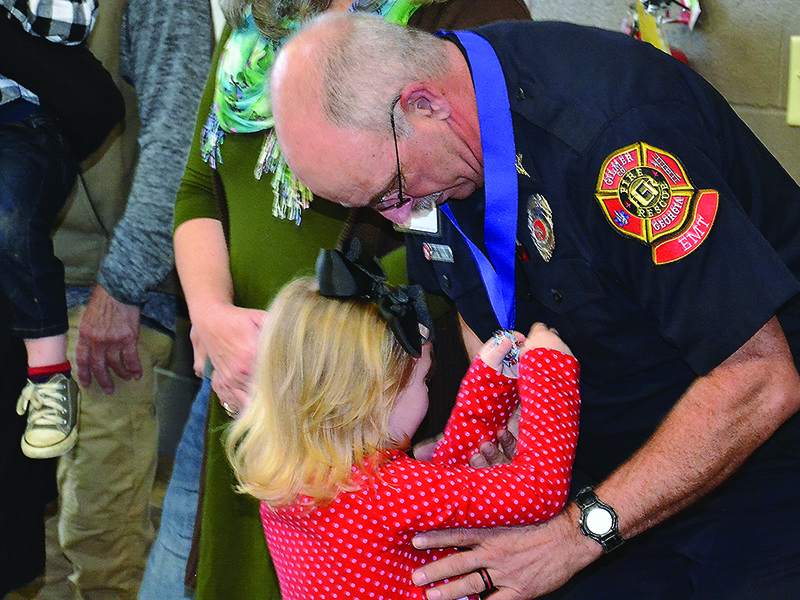
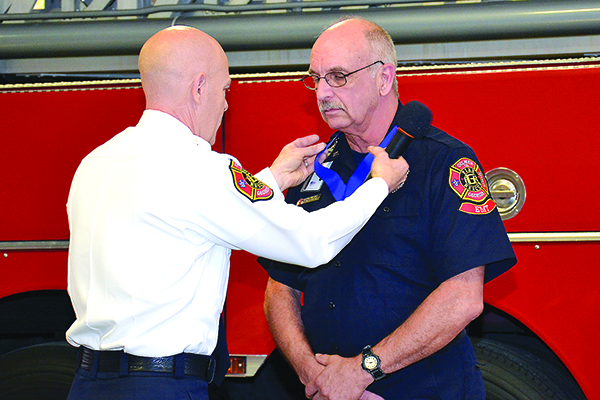
During a retirement ceremony held last month at Gilmer Fire and Rescue headquarters, Sales was presented with a Medal of Honor, as well as a display shadow box filled with patches and uniform garb from his entire career.
“I was very appreciative and humbled by all of it. I really didn’t think I had done that much good for folks,” he said, almost having to wipe away a tear.
Fire Chief Daniel Kauffman said Sales’ radio dispatch number, 933, was retired and a multivehicle procession led by the department’s 1976 American LaFrance fire truck carried the retiring first responder home from the ceremony.
“Mike Sales has honorably served the residents of Gilmer County for 40 years. You don’t find many people with that kind of loyalty to an organization. That’s what makes him so special to all of us,” Kauffman said.
It was a special opportunity, added Sales, to have been able to do that kind of work for so long.
“I can’t count the times we’ve held somebody’s hand just to comfort them,” he confided. “We’ve cried with them and prayed with them, talked with them and laughed with them — whatever you had to do to try and make the situation better.”