
Marie Holt raised large family, earned college degree while teaching
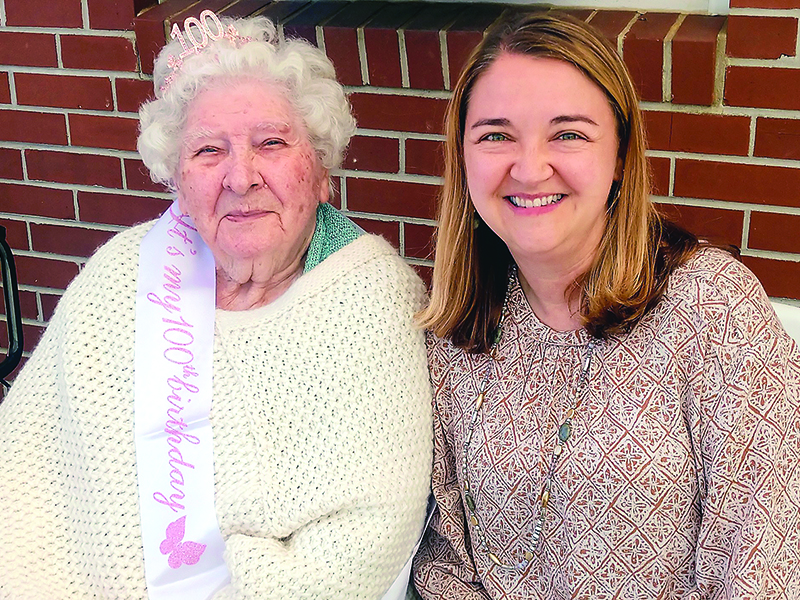
Marie Holt
An Ellijay woman who recently turned 100 has a simple explanation for her longevity.
“Hard work, clean living, and a strong faith in God,” have been cornerstones for Marie Holt, who marked the big occasion April 7.
Education was always important
Holt was born, and has lived nearly all her life, in Gilmer County, mostly in the Tails Creek community where she still resides.
“I was born here at a place called Stegall Mill on the Ellijay River (and) I’m the fifth of 10 children,” she said. “I’ve lived here all my life and raised my family here with the exception of a short two-month period when I accompanied my first husband, Herman Sanford, to New Jersey.”
That was because Herman was bound for the European Theater of World War II, where heavy fighting spanned the continent. Sadly, he was killed in France, said son, Dan Sanford, Holt’s first born and only child with her first husband.
“I was not quite a year and a half old,” Sanford said.
Sanford said his mother later married Norman “Hap” Holt, who cut hair at the City Barber Shop for many years. Just as she came from a large family, Holt also raised one.
“I birthed six children of my own, one with my first husband and five with my second husband,” she said. “I raised my six, as well as Norman’s son and stepdaughter by his first wife for a total of eight children.”
Holt worked as an educator for 30 years, which included teaching and being a principal at Tails Creek School. She also taught at the old Ellijay Elementary School.
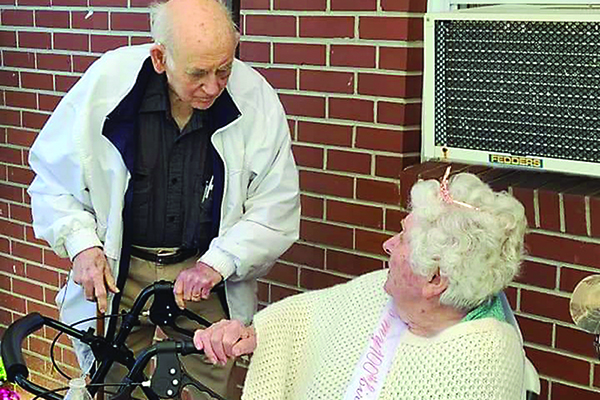
Sanford said his mother’s career in education lasted from 1940-1983, but she took time off in between to raise children.
“I started teaching in a small two-room school at Crossroads School with only a high school education at the salary of $40 per month,” Holt remembered. “There was only seven months of school per year and no summer pay, but I was able to save enough out of that salary to pay for my way to Reinhardt College in Waleska for spring quarter.”
Holt continued her education at North Georgia College in Dahlonega, where she earned a Bachelor of Science in Education.
That was no easy feat in those days, Sanford noted.
“She drove to Dahlonega and usually had riders that helped with the expense. They were teacher friends who were (also) working toward their degree as they were teaching. That was permitted in Georgia in those days. It was a way the state could build a qualified teacher base,” he added.
Holt was able to finish college through a combination of Saturday classes, summer school and correspondence classes, which Sanford described as a forerunner to today’s online classes.
“In those days, there was no internet, no computers or word processors. Her lessons were completed with a pen or pencil and paper and sent through the mail,” he said.
“School work also had to be fitted in among the chores that went with being a wife, mother and homemaker in those days. She planted a garden, raised the food and canned and preserved it. She (also) helped with the butchering the meat animals.”
The school calendar was a lot different back then with the school year starting in late July and ending in March, Holt recalled.
“We always took about a two-week break (around) September for fodder pulling. This was so the children could help with the fall harvest chores,” she noted.
The schools, themselves, were also much different. Today’s students might have a hard time imagining the school day with no electricity or indoor plumbing.
“With no indoor plumbing, rest rooms were in the form of an outhouse or pit toilet, and heat was provided by a wood-burning stove in the classroom,” Holt remembered.
“The schools (also) had no running water or lunchrooms. Everyone brought their lunch from home, mostly in a tin bucket, usually a saved lard bucket with holes punched in the lid for a vent. Many children who were in the same family would pack their lunches together in the same bucket. Drinking water was provided in a bucket. (Everyone) used a common dipper with a handle to dip the water into their drinking cups and glasses, most of which were glasses in which snuff had been purchased by the family.”
Before retiring, Holt taught the second and sometimes third generations of many local families.
“As a teacher, I always enjoyed seeing the light in the children’s eyes when they discovered something new or they answered a question right,” she said. “As a principal, I appreciated having more control over the way the students in the school were treated.”
Because most schools were located near community churches then, it was expected of teachers to bring children to church revivals, Holt remembered. She said her place of worship has long been Ellijay First United Methodist Church.
Granddaughter, Amanda Payne, said she grew up next door to Holt and education was always important to her grandma.
“Growing up, I remember books being everywhere. She would quote poems or different things she remembered from teaching all those years,” Payne said.
‘This is home’
Holt described some of the many changes she’s seen in her hometown over the years.
“East Ellijay (used to be) just a wide place in the road with a few buildings and a metal span bridge where the concrete bridge is (today). The only way to Dalton was over Fort Mountain or down to Talking Rock and over to Fairmount and up to Chatsworth or Calhoun. It was a hard three to four hour drive to Atlanta. Steam-powered locomotives ran regular on the tracks, and passenger service was a regular way of travel. I remember the actual building of Old Highway 5 and them using a steam shovel to dig one of the mountains, I think Talona Mountain, off to make the roadbed,” she recalled.
In her junior year of high school, Holt lodged with a friend at downtown Ellijay’s historic Tabor House to avoid the near four-mile walk to school. Now a historical society museum, the house was still a private residence at the time and rooms on the second floor were rented to school-age children.
She used the term “batching” (a colloquialism for finding a temporary place to live) to describe that experience.
“There was no bus system then. You just rented the room and had to furnish your own meals by whatever method you could,” she noted.
Sanford said his mother remains mentally sharp, and she’s just scratching the tip of the iceberg with some of the memories contained here.
“I feel like she’s doing remarkably well for the years and the miles. I really think keeping the mind active (helps),” he added.
He admires the determination it took for his mother to not only raise a large family, but also work outside the home and put herself through college.
Of the eight children she raised, three went on to be teachers and one each a postmaster, an educational parapro and a veterinarian. Sanford said he is a registered nurse.
“She also took care of her oldest brother, a veteran, who had a mental breakdown in the service. She assumed full responsibility when her parents passed and was his caregiver,” Sanford said.
Payne, an Edward Jones financial advisor in Blue Ridge, called her grandmother an inspiration. Holt now has both great and great-great-grandkids, she noted.
“She’s definitely one who should inspire,” Payne said.
“She’s just very solid and the person who made one statement, but you always knew where she stood. She worked hard and her values were there. Even people I see now that she taught in school (say) it didn’t matter who you were, she was very fair.”
Holt was able to celebrate the big 1-0-0 at a small party with close family and friends. She enjoyed seeing those who took time to drive or stop by and say happy birthday.
“It was very tiring, but a good kind of tiring,” she said.
When asked what keeps her busy these days, Holt said she enjoys reading, watching TV (The Andy Griffith Show, Jeopardy and Dancing With the Stars are favorites), putting together jigsaw puzzles, and doing word search puzzles. She also really enjoys watching “them Dawgs” play football.
After all these years, she’s still proud to call Gilmer County home.
“I’ve buried two husbands and four of my children in Gilmer County, so this is home,” she said.