
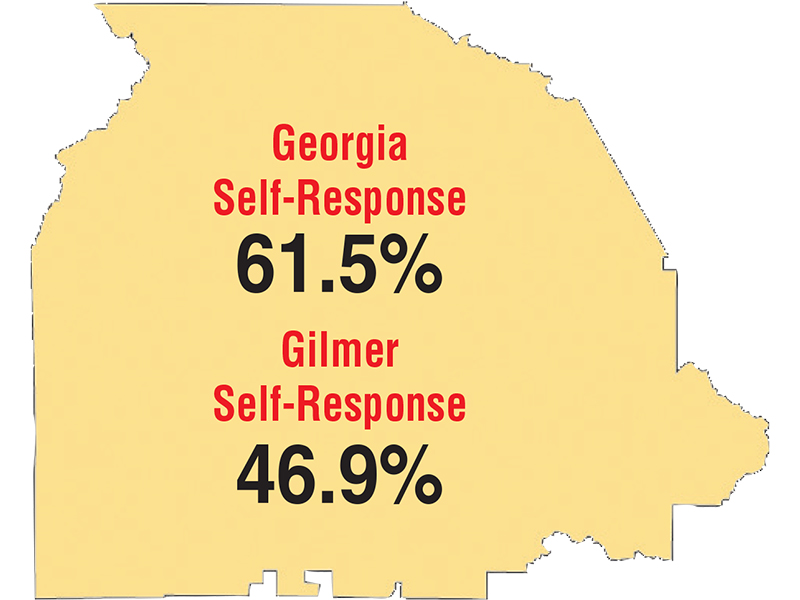
Less than half of Gilmer County has responded to the U.S. Census count.
In 2010, Gilmer County had a response rate of 46 percent, according to the website 2020Census.gov.
This year, the county has a response rate which is marginally better at 46.9 percent.
Nationally, the average response rate is 66 percent, according to the website. Georgia’s response rate as a state is 61.5 percent.
Gilmer County leaders are urging people to respond to the Census online at my2020census.gov or by calling 844-330-2020.
Counting ends this month.
Gilmer County Chairman Charlie Paris said the Census is a competition.
“It’s hurting us,” he said of half the county not responding. “I can’t think of any parts of life the Census doesn’t touch on.”
From representation at the federal level to roads and bridge funding, the number of people counted affect Gilmer County’s funding and representation.
Paris said no one is checking on the citizenship status of those responding to the Census. He encourages everyone living in Gilmer County to respond.
Responses to the 2020 Census will drive decisions on the allocation of more than $675 billion in federal funds to states and communities each year for the next 10 years. That includes money for school programs and services such as special education, free and reduced-price lunches, class size reduction, classroom technology, teacher training and after-school activities, according to census.gov.
“In 10 years, our current fourth graders will be high school graduates,” said Gilmer County Schools Superintendent Dr. Shanna Downs. “Imagine the changes these students will see over the next 10 years.”
Researchers suggest that more than half of the jobs that will exist in 2030 have not even been invented yet, she said. Ten years will also be the amount of time that passes before the next Census.
“As a community, we have an opportunity to support our students,” said Downs. “It is imperative that everyone in Gilmer County be counted in the 2020 Census, since these counts are used to determine the funding for education for the next 10 years.”
Gilmer County Chamber President Paige Green Hutto said citizens need to be aware of the consequences to the county and respond to the Census.
“It is imperative that every citizen take the 7-10 minutes required to complete the census,” she said. “It is a few minutes, every 10 years, that has long lasting repercussions on our community.
“The funding and representation alone makes this one of the most important actions we can take in support of our community. Additionally, businesses and industry look at census data to help them in making decisions on bringing or keeping jobs in a community.”
Joint Development Director Kent Sanford said Gilmer County has until Sept. 30 to get this right.
“In total, over 300 federal programs allocate tax dollars based on population data, and good or bad, we will use these numbers for the next 10 years,” he said.
Finally, Georgia House Speaker David Ralston added his two cents.
“The census was envisioned by our founders and enshrined in our Constitution as a way to accurately and fairly allocate representation and resources,” he said.
“Participation is important and it is easy —taking no more than a few minutes. I encourage everyone to respond to the Census so that our region receives the funding our growing communities deserve.”