
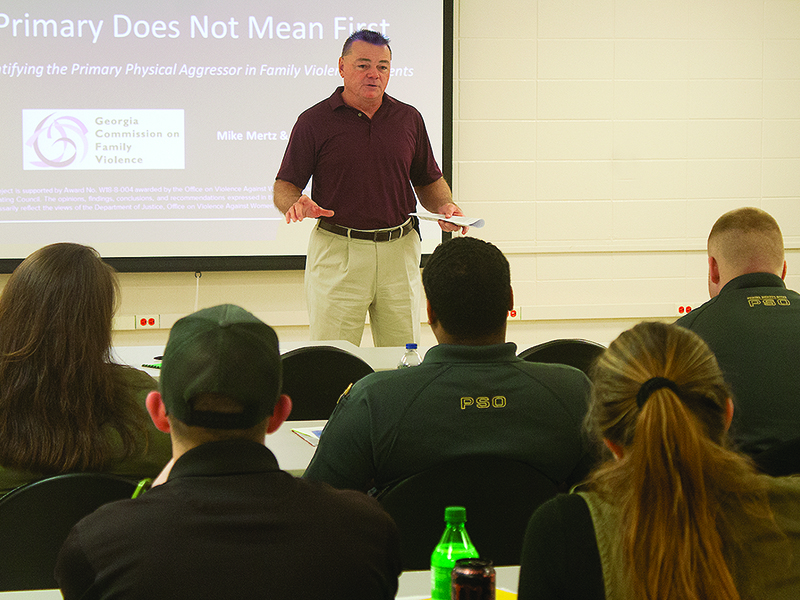
Police officers from numerous north Georgia and metro Atlanta agencies received training focused on domestic and family violence investigation during a daylong session held last Friday.
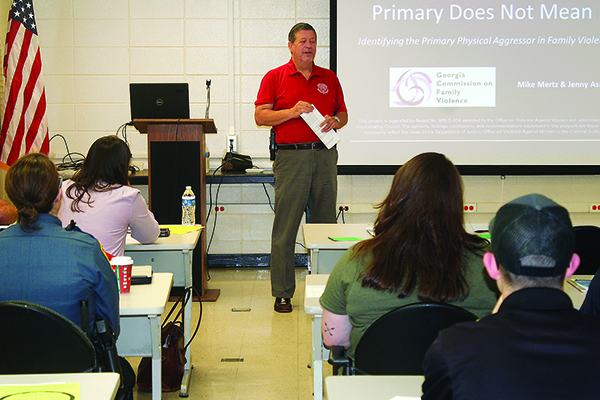 The law enforcement personnel converged at the Georgia Public Safety Training Center (GPSTC)in Pickens County to participate in the course led by Mike Mertz, a Bibb County deputy sheriff, and Jenny Aszman, program manager with the Georgia Commission on Family Violence.
‘Primary does not mean first’
Presented under the heading “Primary Does Not Mean First,” the interactive class dealt with correctly identifying the main aggressor in a domestic or family violence incident.
Mertz, who said he’s worked in law enforcement since 1982, has long been involved in setting up domestic-family violence police units dating back to the 1990s when he was employed by the Forsyth County Sheriff’s Office.
“We created and ran one of the first family violence intervention units in the state. We had pretty much everything that everybody else didn’t want (including) domestic violence, sexual assault and child abuse cases. I left there in 2001 to go around the country setting up family violence units and helping them write protocol and do training,” he said.
Aszman said she and Mertz typically give 15 of the classroom-oriented training sessions a year.
“There’s not a lot of domestic violence training available to officers and law enforcement (in Georgia) outside of what Mike has been doing,” she told those in attendance.
Last week’s session was sponsored by the North Georgia Mountain Crisis Network. The nonprofit assists victims of physical and sexual assault in Gilmer, Pickens and Fannin counties.
“One of our main findings is that law enforcement is in contact with victims of domestic violence at a high risk of being killed by their partners more than any other system we have in place. Eighty percent of domestic violence victims who were killed by their partners were in contact with law enforcement within five years prior to their deaths, while less than 20 percent of those same victims were in contact with a local domestic violence (assistance program),” Aszman said.
Both Mertz and B. Morris Martin, an assistant district attorney for the Appalachian Judicial Circuit, discussed how firsthand accounts from witnesses and victims can change over time.
Martin spoke about how domestic violence can be among the most difficult offenses to investigate and a big challenge faced by police officers responding to such calls is identifying the core abuser in disputes, which can be recurring between the same parties.
“Make sure you get contact information for everybody on the scene. You wouldn’t believe how many times I know, from the description, who was there — the mother-in-law, the neighbor, the friend — and that’s all I know about them, that they’re a mother-in-law, a neighbor or a friend. I don’t know their names or what their address is. If you’re on the scene and talking to someone, get their full name and address and a number to contact them,” he advised.
Mertz said initial evidence statements from witnesses and victims are likely to vary between incident and trial preparation.
“Everybody who’s a witness to something wants to tell the story. They want to be the person that knows. What (often) happens between the time you’re there and get a statement from them and it goes to the prosecutor’s office is they’ve changed their mind about talking about it or they’ve embellished it,” Mertz said.
“What we know about domestic violence cases is about 85 percent of the time, the victim is going to recant their testimony.”
That can often be the result of long-term “grooming” by an abuser, he noted.
“You can’t investigate a family violence incident based solely on that (one) incident. You have to investigate considering the totality of that incident and what has happened in the past,” said Mertz.
“I have empathy for the adult victims of family violence, but the folks I really have empathy for are the little guys. They simply do not get a vote.”
Crisis network a resource for police, assault victims
Kim O’Neal, director of the North Georgia Mountain Crisis Network, said the outreach group often hosts collaborative training for law enforcement agencies in its three-county coverage area. The primary aggressor training was previously offered three years ago in Fannin County with the same instructors, she added.
“We got really good feedback on this (most recent) training. Mike went through lots of scenarios and things he’d encountered (including) things that had happened in cases that officers could have done differently, which would have made them more successful or not caused the cases to get dropped. They also had a pretest and a post-test at the end,” O’Neal said. “We had (representatives) there to learn what he was teaching the officers and we also worked to bring the training back to this area.”
Gilmer County Sheriff Stacy Nicholson said no local sheriff’s officers attended this particular training session, but several have attended past courses offered by the crisis network.
“That’s in addition to the training we give our officers on those topics, as well,” he noted.
Nicholson identified the crisis network as a needed support resource for assault victims and confirmed that responding to domestic violence calls is a regular occurrence for the local sheriff’s office.
“It’s very common. Domestic violence calls are probably 35-50 percent of our calls. They are a large portion of calls for law enforcement in general,” he added.
O’Neal said, in one way or another, the crisis network staff works with law enforcement agencies in Gilmer, Pickens and Fannin on a daily basis in regard to sexual and physical assault cases.
“Our legal advocate works with them daily in getting police reports or temporary protective orders. We work with them on any sexual assault calls they may get where they will call in and ask for an advocate to assist the victim(s). In domestic violence cases, if they’re looking for shelter for a victim, they will reach out for that reason,” she said.
“We operate a safe shelter in Fannin and give service throughout the Appalachian Judicial Circuit. We have adults and children in our shelter on a regular basis and we accept victims from anywhere. We’ve actually had victims come from overseas into our shelter before.
“We also operate a hotline (706-632-8400 or 1-800-33-HAVEN), which we answer 24/7.”
O’Neal said the crisis network hopes to offer more police training classes in the coming year.
“We like to take every opportunity that we have (to provide classes), but our goal is to sponsor law enforcement training quarterly throughout 2020. We try to offer them in each county to make it convenient for officers to attend at least one of them,” she added.