
Be aware of vaccine scams
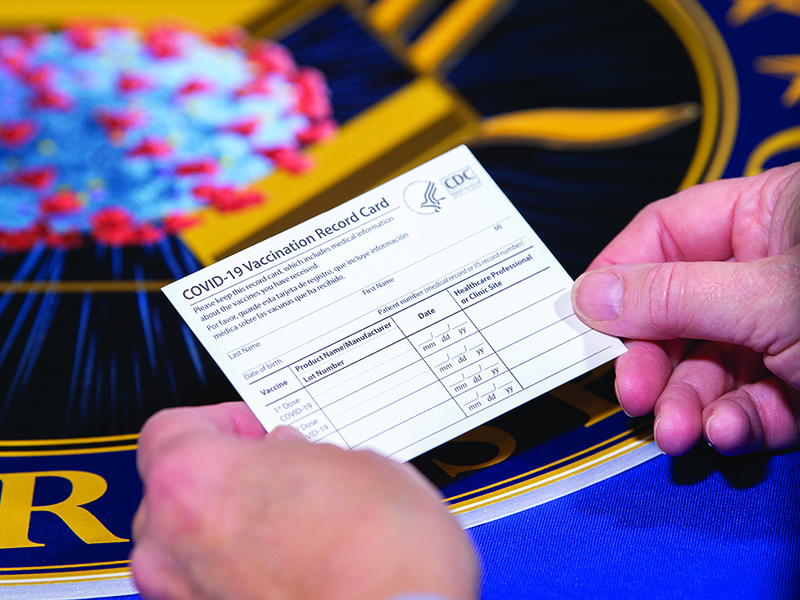
As COVID-19 vaccinations continue to be given nationwide and in Georgia, those who receive the vaccine are handed a white paper record card showing when and where their first and, later, second doses were received.
With the vaccination effort still in its early stages, it might be wise to hang onto that CDC-issued card, some in the health care field are suggesting.
“I would suggest they hold on to the card in case it is needed for travel,” advised Dr. Zachary Taylor, North Georgia Health District (NGHD) director.
One of the scenarios that’s been discussed during the vaccine rollout is that, at some point, a “vaccination passport” may be needed to do such things as board an airplane or attend a large event.
“It is unknown right now to what extent the COVID-19 vaccination cards may be used. For now, the best advice is to hang onto the card and be prepared to present it if requested,” said Jennifer King, NGHD public information officer.
“It could be useful for travel since having the card would be easier than searching immunization registries, but that would depend on whether it’s an acceptable form of vaccination verification by the people who may require it,” she added.
The card should also be kept on hand when receiving a second dose of the Moderna or Pfizer vaccine. A current shortage of vaccine in Georgia increases the likelihood of someone getting their first and second doses from different providers.
“It’s definitely helpful to have the card when receiving the second dose to ensure the same brand of vaccine is being administered, especially if the second dose is being given by a different provider,” King said.
Gilmer County EMS Chief Russell Brown confirmed he’s also recommending that those who receive the vaccine hang onto their card, just in case. County fire station 1 was recently used as a Georgia Public Health immunization site where first responders, health care workers and eligible employees of the Gilmer County Courthouse could get the vaccine.
“I’m telling everybody to definitely keep up with it as proof of immunization. Everybody who has their second dose here, we’re laminating their card for them,” Brown said.
Pickens County Fire Chief Sloan Elrod shared that he’s passing along similar advice to people getting vaccinated there.
“I can’t prove that (you’ll need it later) because that will be a federal government thing, but, from my understanding there’s already been a few airline companies that have said if you don’t have your card toward the end of the year, you may not get on our plane. I envision when the cruise lines open up, you probably won’t get on a cruise if you don’t have that card,” he added.
King confirmed that COVID-19 immunizations are being recorded in the GRITS (Georgia Registry for Immunization Transactions and Services) database by vaccine providers.
You must have special clearance to access that information, Brown noted.
“When they pull you up, it will show that you’ve had the first and second dose of COVID-19 immunization,” he added.
According to the Georgia Department of Public Health, proof of that one has received the COVID vaccine should first be requested from the healthcare provider or location where the shot was given.
If a provider is not able to provide the document, a vaccination record can be requested by completing a form located at DPH.Georgia.gov under the Immunization tab.
Vaccine scam advisory
A recent advisory from the office of Georgia Attorney General Chris Carr warns the public to be aware of COVID vaccine-related scams that have arisen since the vaccination effort began in December. They include calls, texts or emails that ask for payment in return for receiving a vaccination, scheduling an appointment or having one’s name put on a waiting list.
“Sadly, during this time of heightened emotions, scammers are once again trying to make a buck by capitalizing on people’s health concerns. It is critically important that Georgians remember that the COVID-19 vaccine is free for everyone, and there is no registration fee,” stated Carr.
According to the Attorney General’s Consumer Protection Division, no one should be asked by legitimate sources to pay to get their name on a vaccine waiting list, get early access to the vaccine, buy a COVID-19 vaccination through the mail, online or in stores or provide a Social Security number, bank account or credit card number in order to be vaccinated. The Department of Public Health will not call to verify your Social Security number, Medicare, Medicaid or insurance over the phone, and Medicare will not call to offer COVID-19 related products, services or benefit reviews, the Consumer Protection Division also advised.
King said, so far, the North Georgia Health District has not received any reports of these types of scams within the region that includes Gilmer, Pickens, Fannin, Murray, Whitfield and Cherokee counties.
“If anyone in our counties has seen it, they have not mentioned it to us. We get hundreds of emails, texts and phone calls each week. Unfortunately, there are people who will try to take advantage of others in these situations,” she added.
King said that Georgia health departments are asking for proof of health insurance or Medicare when giving the vaccine, but, if someone doesn’t have insurance or can’t present their card, the health departments do not charge the patient for the vaccine.