
Hiring crunch affecting local law enforcement agencies
By Michael Andrews
Mountain Life Editor
While Gilmer County’s population continues to grow, it’s become harder to fill vacancies at all three local police departments.
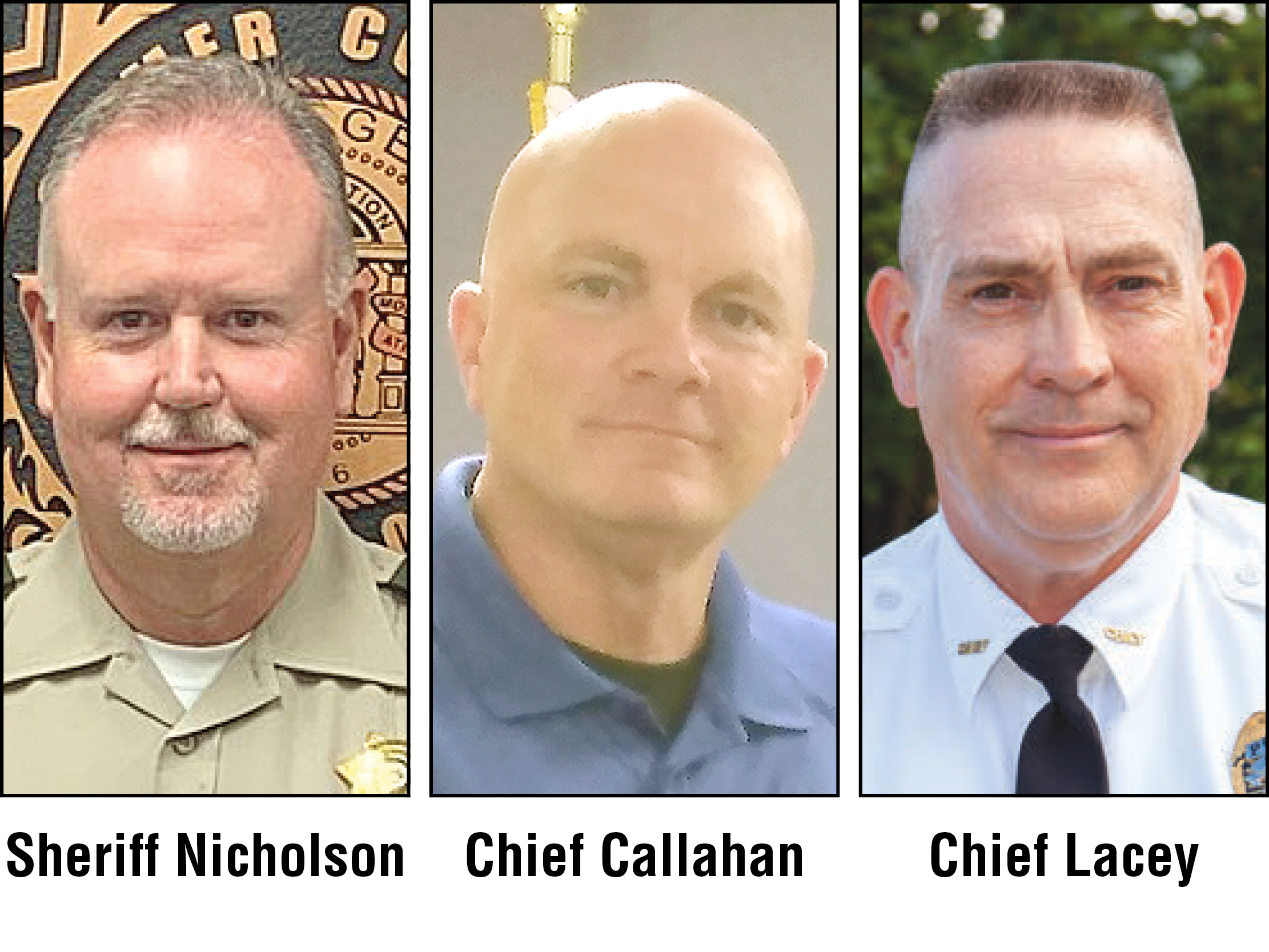
Sheriff Stacy Nicholson, Ellijay Police Chief Edward Lacey and East Ellijay Police Chief Larry Callahan mentioned various factors — including competing with larger departments (many of whom are also short staffed), highly publicized incidents in Georgia and across the U.S. involving police officers and less interest in the job from a younger generation — as reasons for the hiring crunch.
“It’s just not a career that anybody wants right now. It’s strictly supply and demand. There’s not much supply, but there’s a whole lot of demand,” said Callahan at a recent East Ellijay City Council meeting where he discussed the possibility of having to raise pay for that city’s police department.
‘Everybody’s struggling’
Smaller police departments have always had to compete with other agencies in terms of pay and benefits, which hasn’t changed, confirmed Callahan. What has changed is the number of applicants, particularly since early 2020. Callahan said law enforcement has become an “unattractive” career option for many in today’s workforce.
“I think it’s just the times we’re in. A lot of people have started looking down on law enforcement,” he said.
“There’s plenty of jobs available, but not a lot of folks that want to fill them,” added Nicholson. “Honestly, I think a lot of it is (because of) a year-long demonization of this profession — by politicians, the media (and others) including the Defund the Police (talk). That’s not the sentiment we get from Gilmer County citizens. We feel totally supported by this community, but for people who are thinking about getting into the profession, that has been a deterrent. We used to have applications on file and not many openings. Now, we’ve got openings, but not many applications. That’s been in direct correlation to 2020.”
Callahan said his department is down two officers at the moment. One officer recently resigned on good terms, while another is on leave from an injury. “We’re two short with one opening,” he said.
Not long ago, there would’ve already been enough interest for that vacancy to be filled pretty quickly.
“We used to be able to literally fill an opening in a day because we would already have a stack of applications. If you had an opening, you could call the other agencies around here, and they’d (also) have applications stacked up. Now, every department I’ve called has said we’ve got (however many) openings. Everybody’s struggling,” Callahan said. “I had a guy call me back (recently) and say, ‘Chief, I’ve had four job offers this week. To be honest with you, I just picked the one closest to home.”’
Lacey said the Ellijay PD is fully staffed right now, but was down up to four officers at various points the last two years.
“We went for about nine months at a very critical staffing rate. We lost (some) officers because their wives had job changes, and they had to move, those types of things,” he added. “The reasons we lost officers was not necessarily because of pay. It was other life circumstances.”
The Gilmer Sheriff’s Office, the biggest agency of the three in employment and jurisdiction, currently has six deputy vacancies.
Nicholson said that’s actually an improvement, since the department had up to 11 openings within the past few years.
“We are currently full in patrol, but I do have positions open — from detectives to court services to school resource officers, as well as several openings at the jail,” he added. “It’s an honorable profession, and I think it’s coming back, but it’s coming back slowly. In the meantime, law enforcement agencies have got to have people working and be able to hire people to meet the demands we currently have.”
‘Astronomical’ growth
According to the 2020 Census, Gilmer County’s population rose by just over 3,000 in the last decade — from 28,292 in 2010 to 31,353 in 2020. That increase makes Gilmer the 58th most populated out of 159 counties in Georgia, per the 2020 Census.
Of course, the most recent Census numbers don’t include 2021 and 2022, in which the county’s population grew even more.
“I think it’s probably much more now than (the 2020 Census population),” said Nicholson. “Everyone who moves to Gilmer County has to obtain an address under 911 addressing, so I keep (an eye) on the number of people requesting addresses. Those numbers have been astronomical over the last two years.”
More tourists, visitors and part-time residents have also increased the demand put on local police agencies, noted the chiefs and sheriff.
“We added 300 short-term rentals in a year, which means our daytime population automatically (increased),” said Lacey. “Let’s say, on average, you’ve got three people (staying at each of those). That’s an additional 900 people every week or weekend coming to stay temporarily, not including other visitors. That increases our pedestrian traffic and the traffic on roadways. All of that has increased (the likelihood) of traffic crashes and other types of calls.”
“The demand for service has definitely increased (with) the influx of vacation and weekend traffic,” added Nicholson. “That’s not all bad (because) it’s an additional funding source in tax dollars, but demand has increased because of that factor.”
In his October report to city councilmembers, Callahan said East Ellijay’s officers made 120 arrests and responded to 29 accidents and 31 incident reports the previous month.
At that council meeting, Mayor Mack West said the East Ellijay Police used to be the best paying of the three departments, but not now. “We’re paying over $19 (hourly) now, and we were going to raise them to $20. We probably need to start at $22,” West said.
Callahan said the sheriff’s office and Ellijay PD have had recent pay increases, while East Ellijay has focused on providing good benefits, such as paid insurance coverage. That may no longer be enough to attract new employees, he noted.
“We will pay all the family coverage, and that (cost) has jumped up thousands. When you’re trying to hire a guy who doesn’t need that, (family insurance) may not be a draw for him,” Callahan said. “We’re looking at (raising pay) because that’s going to be the only way we can get people. We’ve got to be more attractive than the next department down the road.”
A 20-percent pay increase for sheriff’s office personnel went into effect this year, and Nicholson said he’s trying to get an additional increase approved for the next budget.
“Money isn’t the only way to solve the problem, but it helps,” he said. “The 2023 budget proposals have been difficult for us because we’re trying to give more money, but at the same time I’m needing more deputies on the street to answer the increased demand for law enforcement in our growing community. The increase I’m looking at for next year is a small increase, because I’m having to look at any additional financial resources going to hiring more deputies. Giving a deputy a raise costs money, but funding a new deputy’s position takes a lot more.”
The Ellijay City Council approved an almost 18 percent pay increase for new and current employees of Ellijay’s police and fire departments in late 2020, and that’s still in effect, noted Lacey. “There’s an additional increase for public safety in this last budget,” he added.
One method the Ellijay PD is using to fill vacancies is a paid training program. One officer-in-training is currently enrolled in that program, Lacey noted.
“We have 11 sworn officers. Ten are effective as patrol officers currently working, and one will complete the academy in December. He’ll then have to complete a 14-week field training program. I pay him an hourly rate, and he’s on our insurance program. That helps him get his certification. Once he does that, he gets a raise. Once he gets his probationary period out of the way, he’ll get another raise,” he added.
A coming crisis?
Callahan said, if a pay increase for East Ellijay’s officers is approved, it will be for current and new employees. “We’re in the process and trying to figure out the numbers at this point. It’s hard to go in mid-budget year and increase salaries,” he added.
But will it be enough to overcome the hiring dilemma in coming years? As more police officers retire, will there be enough interest from younger generations to keep departments adequately staffed?
Callahan has worked in law enforcement nearly 34 years (23 of which he’s been a department chief) and has never seen a situation like the current difficulty in hiring officers.
“The FBI has put out some studies that (say), anywhere from seven to 10 years down the line, if something doesn’t change, it will be critical. In my opinion, it’s critical now,” he said. “(My generation) grew up rough and tumble. We wanted to be out there and into something, I don’t mean this in a bad way, but kids now grow up more mashing buttons. You take a kid who can make $75,000 a year at a computer job, why does he want to make $45,000 (as a police officer) and take a chance on getting himself killed?”
Lacey said a lot of young people have become ‘disillusioned,’ and police departments are probably going to be further affected by that as time goes on.
“We have to wait till someone is 21 before we can hire them. A lot of times, people will get in trouble between the time they graduate high school and turn 21. They might have drug or alcohol use or (bad) driving records, and all those kinds of things can disqualify them for future law enforcement employment,” he said. “If they become disillusioned at 16-20, we’re feeling that several years down the road.”