
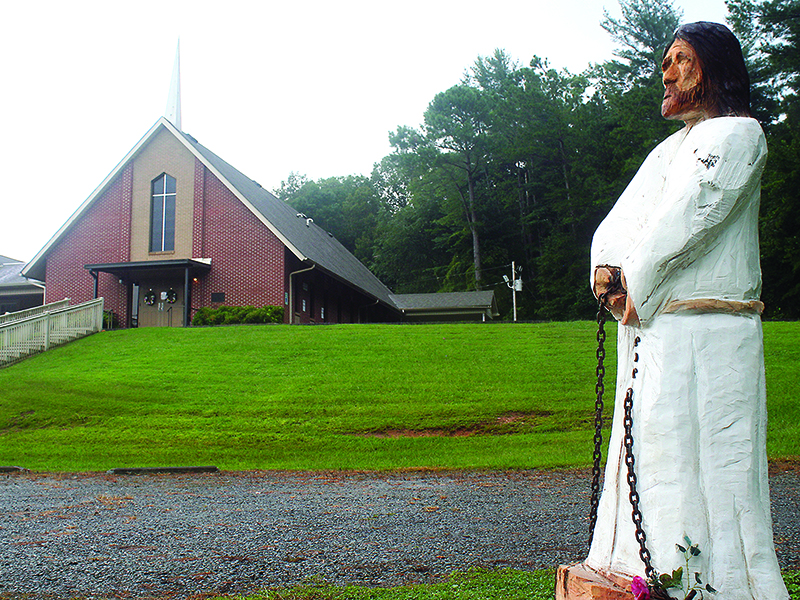
A dying tree led to the creation of a “living statue” of Jesus Christ that now watches over Cartecay United Methodist Church (CUMC), as well as those driving by the place of worship at Highway 52 and Roy Road.
A giant white pine tree in front of the church was dying and had to come down, said Bill Ford, CUMC member. The approximately 14-foot bottom section of the tree, which was still OK, offered an opportunity for the statue to be made.
“I have no idea what made me think about it, but I thought, what if we make a huge statue? I talked to the trustees and they said to run with it,” said Ford.
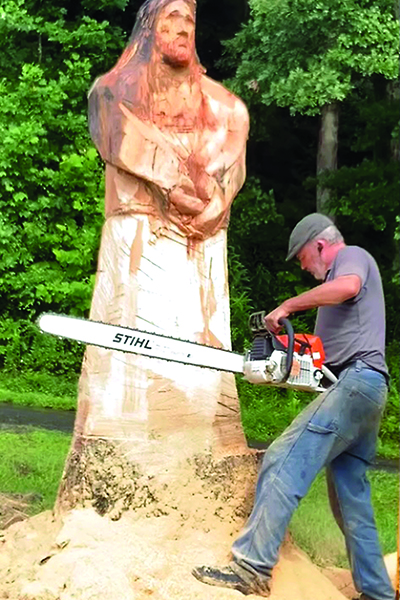
Chain saw carver Mike Duke, who created the statue, said he worked with a hired tree service to have the ailing pine cut just below the rotten portion, which left a good-size piece of wood to work.
“It has a lot to do with width versus height. It just turned out that the width and the height (of what was left) gave us this form and size,” Duke said. “I think it gives a good contrast against the church. It grabs your eye as you’re coming up the highway.”
‘Quiet time with a chain saw’
When the project first started, Duke was doing his woodcarving at a workshop also on Highway 52. He’s been using power saws to carve smaller wood sculptures like bears, eagles and aliens for about six years. Several of his statues could easily be seen by passersby, one of which was Ford.
“Bill just swung by one day and said, ‘What do you think about coming and carving a statue of Jesus?’” Duke recalled.
“I didn’t really know him yet, so it was kind of like a cold call,” Ford said. “Mike showed me what he could do, and I figured we’d give it a shot. He was really exited about it. He said he’d been looking for a project with which he could honor his faith, and this one just kind of fell into his lap.”
Starting out, Duke estimated the statue would take about 18 months to complete. After a year’s work, the 13-foot figure is now 90 percent done. It’s been carved, detail-chiseled and painted, but some additional detail work and painting remain, Duke said.
“By the time I started blocking it out, there was snow on the ground and it was cold outside,” he remembered. “I really didn’t count the time. For me, it was more of a meditation exercise. It was also a time to commune, which was a great blessing for me. It was quiet time with a chain saw, if you can imagine that.”
The labor-intensive project was also a learning process in carving human features, Duke noted.
“I’ve done the standard mountain carvings, but never any kind of humanoid form like this. When you read The Bible, you don’t think about things like what Jesus’ hair looks like from the back. Then, you’ve got the natural tree dynamic. This tree was at an angle, not straight up and down, so the figure had to lean back just a little,” he said.
“Halfway in, it looked like Peter, according to my wife and several other people. It looked like a person, but, like with any chain saw carving, it’s big and bulky when you’re blocking it out. My wife said, ‘you did great if they wanted Peter. You just need to give him a net!’”
Duke felt fortunate to be working with pine, which allowed the carver some leeway if errors occurred.
“The bigger the piece of wood, the bigger errors you can make. It happens all the time. Sometimes, it’s the type of wood that dictates (the piece). You start off trying to make it look a certain way, then you hit a knothole and your saw goes sideways. It just sort of develops,” he explained. “Cedar is like a hot knife through butter and is easy to carve, but oak is like carving a concrete block. Pine is in the middle, and it allows you to move the saw around the corners a little more smoothly.”
There’s a message in the set of broken steel chains that Jesus carries with his extended hands, Duke noted.
“There was a lot of praying about what message would come out of this and what it would become. The idea it evolved into is truth for all those folks who are struggling with addiction. This is the key to being set free from that. That’s the message I hope the piece sends over time,” he said.
Duke credits another local carver, Robin Wright, for teaching him how to use a chain saw to make art.
“He did it for years and years. We worked out a deal where he would teach me, and I carve using his style. You still see his work all over town in different places,” Duke added.
The statue nears completion as Duke starts another venture in opening his own gallery. Carver’s Creek Gallery, located off Highway 282 on Mountaintown Creek, will display his wooden carvings, as well as the work of others.
Duke said he’s looking to open next month, and a good chunk of proceeds from gallery sales will go to local charities.
“It used to be an old run down gas station, and we wanted to make it something nice for the community. We’re inviting artists from all over to bring their pieces in. We call it mountain art or art you can touch. It can be wood, stone, metal or glass,” he added.
A God thing
The unfinished carving is already drawing attention from both church members and visitors who’ve come to have a peaceful moment by the statue of their savior.
“We hope people are able to use it and get joy out of it in a sense of being closer to God. I’m glad we were a part of it, and I’m glad Mike was a part of it. I think it was one of those things that was just meant to be,” Ford said.
“I give all the credit to God because I’m sure he’s the one that popped it into my head. It was a God thing, for sure.”
Duke, who’s donating his work to the church, hopes the end result brings some comfort to those who need it.
“The greatest thank you I can get is that people admire it and maybe ask questions and come to know Jesus. There’s also a passing blessing in that you drive by and see people holding hands in front of it, getting a picture taken or hugging it. I’ve seen all of that, which is pretty neat,” he said.
Ford said church members plan to put a bench near the statue and have a dedication service when everything is finished.
He’s been calling the piece a “living statue,” both because it depicts the living spirit of Christ and was made from a living tree.
Duke described something that happened during his carving time that lends some added perspective to that description.
“When you’re standing next to it, you can put your hands right in his hands. I was out there working one day and, while looking down, I put my hand up. It felt just like I was holding someone’s hand, which is a pretty unique experience,” he said.