
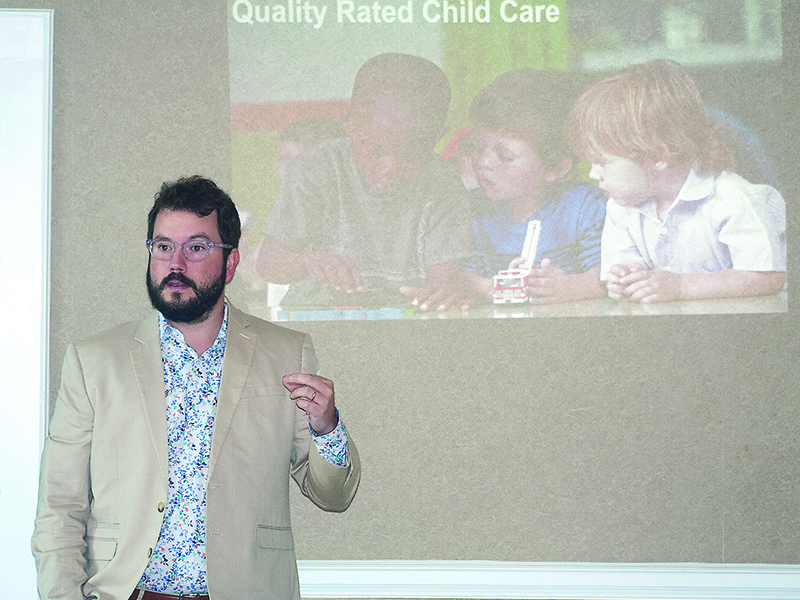
Representatives from several local organizations, businesses and agencies were briefed on the limited access to licensed child care facilities in the county, as well as state efforts to “quality rate” more child care providers, during a recent collaborative workshop presented by Gilmer Family Connection.
The workshop’s guest speaker, Clayton Adams, of the Georgia Department of Early Care and Learning (or DECAL), said the state agency focuses on early educational needs of children from birth to age 5.
“We actually have two titles. We’re known as DECAL and also Bright From the Start,” said Adams.
“Most people think of the K-12 system being your departments of education, but we are one of only two agencies in the country devoted to just birth through 5. (The other one is) in Oklahoma. We were created by Gov. Sonny Perdue in 2004 (and) what we’re most known for is the Georgia Lottery pre-K (program) that’s been in place since 1992. We also do licensing for child care centers in the state.”
‘A huge gap’
The most recent numbers show 1,588 children under age 5 in Gilmer County, but the capacity of the few licensed child care facilities here is much less — only 246 — Adams said.
“That means every licensed child care center and home in Gilmer County is filled to capacity. That’s a lot of children (left),” he added. “It’s supply and demand. We know the children are out there, but there isn’t enough seats in Gilmer County to fill (the demand).”
Adams said the quality rating system used by DECAL was developed after the agency “took a hard look on child care in Georgia and what it looked like was poor quality.”
“(They found) facilities that were poor quality. The staffs did not necessarily have the right training and background to serve the children or the owners and directors weren’t meeting the expectations we wanted for our youngest and most vulnerable learners,” he explained.
The DECAL quality-rated improvement program is a one-to-three star rating process for day cares and early education centers, as well as homes where up to six children are cared for.
Adams said the goal is for all of Georgia’s licensed child care providers to be enrolled in the quality rating program “to ensure they are going above and beyond basic licensing (requirements).” There are more than 5,000 licensed child care providers statewide, he added.
“That includes a little over 3,000 child care learning centers and a little under 500 child care homes. A little under 2,000 of those have been quality rated,” he added. “It is a volunteer program and a very rigorous program that can last anywhere from six months to a year. It makes parents knowledgeable so when they go to look for childcare, they will know to find a center or a home that is quality rated.”
There are three licensed child care providers in Gilmer, two of which are three-star rated, Adams said.
“Gilmer is no different than any other county, be it Gwinnett or Pickens. There’s a huge gap (in services). I’m sure there are more home child care (providers in Gilmer), but they are not licensed,” he added.
The highest concentration of quality-rated providers are in metro Atlanta counties, but several counties, especially in south Georgia, have zero options, Adams said.
“That’s not just quality-rated. There are counties that have no (licensed) child care whatsoever. Are these children staying with grandparents or a neighbor? Are mom or dad having to stay home?” he asked.
Quality-rated deadline approaches
Though participation in the quality-rated program is voluntary, by Dec. 31, 2020, all child care centers and homes in Georgia that receive CAPS (Child Care and Parent Services) subsidy assistance for low income families must be enrolled in the program or risk losing customers who receive the subsidy.
“That will be the biggest policy shift in my (time with DECAL),” Adams said.
“What we were seeing was our highest needs families many times going to facilities of the lowest quality. If those facilities with the lowest quality are receiving state subsidy dollars, by Dec. 31, 2020, they will have to become quality-rated. If they aren’t quality-rated by then, foster families and (other families who receive CAPS) will have to find another place to go.”
It’s hoped that more child care providers enrolling in the rating program, will increase the general quality of early childhood learning in the state.
“The earliest ages are the height of the brain’s ability to change in response to experiences. The amount of effort (needed) is the lowest. As you get older, it gets harder and harder to change the ability of the brain. This is just a brief example of the importance of (learning in) those earliest years of childhood,” Adams said.
“One of the biggest roles of the 0-5 child care/Head Start (program) is school readiness, so that when these children go to kindergarten, they will be prepared to take on that challenge,” he added.
Another advantage of children attending Early Head Start, Head Start and pre-K is the development of soft skills, Adams said.
“If you go around asking employers what is one of the biggest issues with the workforce right now, they’ll say, ‘lack of soft skills.’ I hear it all the time. People don’t show up on time or at all. They can’t interview or are not respectful. Those are soft skills learned at the earliest ages that can be taken for granted and are being missed now,” he added.
Being able to find a quality provider is not the only child care-related obstacle faced by modern parents. There’s also the heavy expense, Adams noted.
“We all know, whether we have children or not, that child care is very expensive. It’s more expensive, on average, to send your kid to childcare than it is to send them to the University of Georgia,” he said.
“That makes it very difficult for families. Having a lack of access to affordable child care (also) makes it difficult for parents to work or take a job offer. It’s a huge barrier.”