
A grant program administered through a partnership between the Georgia Soil and Water Conservation Commission, state Environmental Protection Division (EPD) and Gilmer County Environmental Health Department will provide funds for repairing failing septic systems and septic system pump-outs done at properties located in a designated area of the county.
To reduce coliform bacteria contamination
Representatives from Nutter and Associates, an Athens environmental consulting firm working in conjunction with Georgia EPD and other state agencies, including Georgia Soil and Water, held two public meetings last year to receive input from local residents and to inform the public about a future watershed management plan.
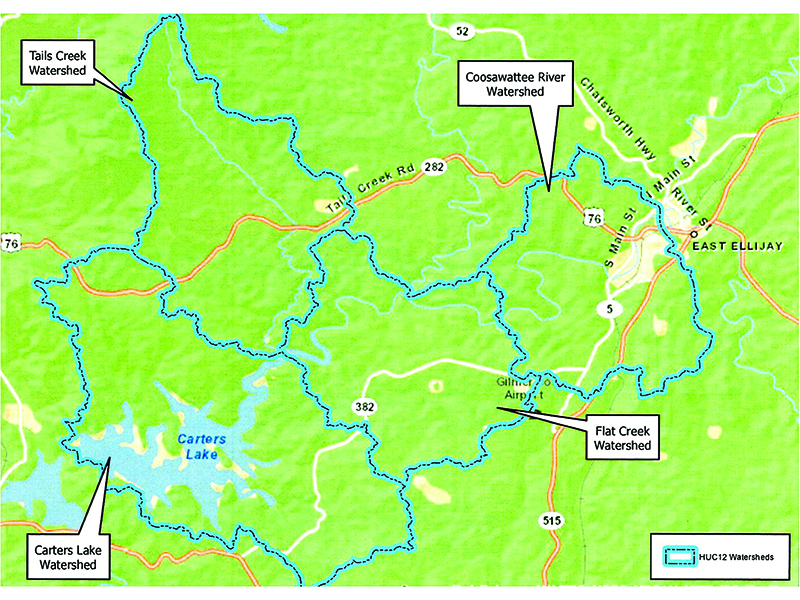
“The project area is comprised of four watersheds that drain into the Carters Lake reservoir — the Coosawattee River watershed, the Tails Creek watershed, the Flat Creek watershed and the Carters Lake watershed,” said ecologist and project coordinator Krisha Faw during one of those public meetings held last July.
Hot spot areas for elevated levels of fecal coliform bacteria, a product of human or animal waste, have been identified in the project area, Faw noted.
“(It’s) an indicator of potential pollution from such sources as failing septic systems, illicit septic discharges, agricultural operations such as poultry and cattle, urban storm water runoff from impervious surface areas and leaking sewer system pipes,” said project manager Erin Harris last year.
The Coosawattee River– Carters Lake Septic Project is a cost-share program financed in part through a grant from the U.S. Environmental Protection Agency under the provision of Section 319(h) of the Clean Water Act, said Ricky Ensley, Georgia Soil And Water Conservation Commission resource specialist.
The grants being dispersed by Georgia Soil and Water are part of the watershed management plan devised to help reduce the high levels of fecal coliform bacteria within the 2,230-acre Coosawattee-Carters Lake Watershed Management Area, he added.
“The septic (grant) is part of a bigger grant for the watershed (management project) that also includes agriculture. We’ll also be doing a green infrastructure project. Just for the septic, the grant will be about $12,000 total,” noted Ensley.
Applicants must live within the designated project area, which includes the Coosawattee River, Carters Lake, Tails Creek and Flat Creek watersheds, Ensley confirmed.
The approximate boundaries of that area are as follows: north boundary - Highway 282, south boundary - Highway 382, east boundary - west of East Ellijay and west boundary - Carters Lake.
“We’re going after the whole watershed and watersheds are not straight lines,” said Ensley.
If applicants are selected to receive grant funding, they will be reimbursed for part of their expense, Ensley noted. The work must take place after the project roll-out date of Aug. 1, 2020.
“It’s a 60/40 grant. We pay for 60 percent and they pay for 40 percent. They have to pay for the process or pump out, then submit their application,” Ensley confirmed. “We’ve already teleconferenced with some of the pumpers in the area. After the application is submitted, we will make sure everything is up to speed. There’s also an educational arm to this in which participants will attend an educational session about things we do to septic systems and those kinds of things.”
The grant funding is not recurring and will be only be available until the total amount has been dispersed, Ensley said.
“It’s something we won’t have annually. When this project is over, those dollars have been spent. We expect to have a big turnout for it,” he added.
How to apply
Applications are available locally at the Gilmer County Environmental Health Office, located downstairs in the courthouse at 1 Broad Street. Forms can be picked up just outside the door of the office, noted Gilmer County Environmental Health Manager Andrea Mathis.
Mathis said anyone interested in applying can also email her at andrea.mathis@dph.ga.gov to request an application.
Starting this week, the application form will also be available on the North Georgia Health District website, NGHD.org, where it can be downloaded and printed, she added.
For more details, the Calhoun office of the Georgia Soil and Water Conservation Commission can be contacted at (706)624 -1105 or ricky.ensley@gaswcc.ga.gov.
Ensley said applications are also available through Georgia Soil and Water and that he can also be reached by anyone wanting to find out if their address lies within the designated grant project area.
“They can call us and we will GPS (their address),” he added.