
Brood X expected to start buzzing in May
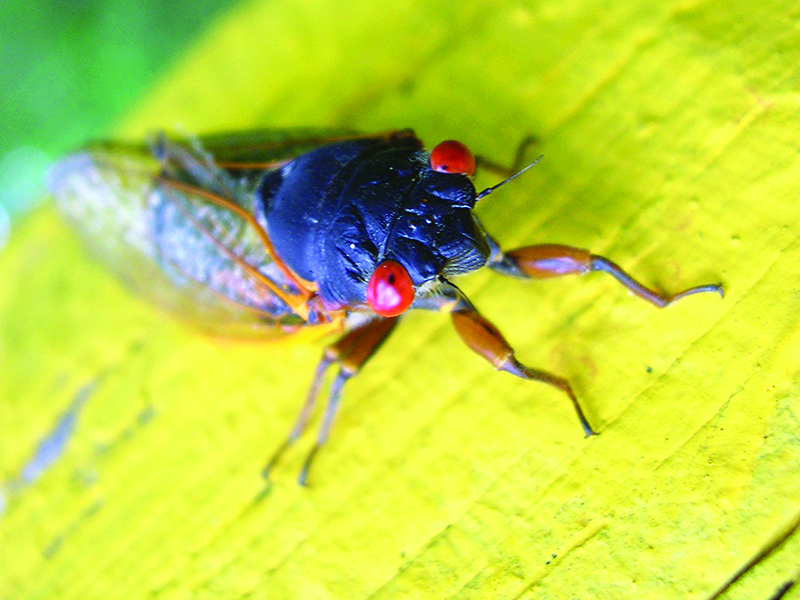
Like a solar eclipse or visible comet, the emergence of periodical cicadas is one of those natural happenings that only comes along every so often. For Brood X Cicadas, every-so-often is a 17-year cycle that will conclude and reset this year.
Gilmer is among three north Georgia counties where this particular brood of buzzing bugs is expected to emerge in May, according to a release from the U.S. Forest Service.
Fannin and Union counties, as well as several eastern Tennessee counties, are also listed on a Forest Service map showing areas in which the cicadas are expected to take flight next month.
“Georgia is barely within the distribution zone of this brood, so we may not see many periodical cicadas this spring. However, if they do have a presence in our state, it is likely to be in these three counties,” said Gilmer County Extension Agent Ashley Hoppers.
Long time underground, brief life above ground
Periodical cicadas emerge in strict 13 or 17-year intervals, while annual cicadas emerge each year from summer till fall. Brood X (or the Great Eastern Brood) is the largest 17-year brood, spread out over parts of 15 states.
Cicada broods are classified using Roman numerals and differentiated by the years and geographical areas in which they emerge from underground, noted University of Georgia entomology professor Dr. Nancy Hinkle.
“The mother cicada lays her eggs just under the bark at the very tips of tree limbs. When they hatch, the nymphs, which are about the size of a grain of rice, fall down and grow into the ground where they suck juice from the tree roots,” said Hinkle.
That process continues for the next 17 years until the fully formed insects emerge to break free of their protective exoskeletons and start buzzing.
“If you have enough of them, they can make some racket,” Hinkle said. “They’re feeding on sap in the tree roots for all that time, which is not the most nutritious material in the world. It probably takes them that long to get enough nutrients to get to the size where they can be an adult.”
They only appear where hardwood trees were present at least 17 years ago, Hinkle said.
“They’re not found on pines, only on hardwoods,” she added. “They don’t crawl great distances, so they’re pretty much going to stay under the tree on which the eggs were laid. If that tree is cut down, they no longer have sap to drink and will die. Every time we build a shopping center or a road or a housing development, it probably wipes out populations of cicadas.”
The primary reason the bugs emerge after so long in the ground is simply to reproduce and make more cicadas, Hinkle confirmed. After coming above ground, they only live, at most, a couple of weeks.
“The annual ones live about the same (length of time), but they come out every year,” Hinkle said.
Many become nourishment for various birds, fish, wildlife and other insects.
“It’s not uncommon for cicadas to fall into streams and lakes, so fish get to gorge on them. Hunters and fishermen should be thrilled that wildlife and fish will be so well-fed this spring,” said Hoppers.
There’s a simple reason for their brief longevity after emerging, Hinkle noted. The bugs don’t feed as adults.
“They don’t have biting mouth parts. All the energy they have, they had to acquire before they emerged,” Hinkle said.
Since they can’t bite or chew, cicadas pose no threat to crops, Hinkle noted. They are, however, frequently mistaken for locusts, which are agricultural nuisances.
“They are not the same thing as a locust, Hinkle confirmed. “I think the numbers make us think of a plague and the only plague of insects know of is the plague of locusts in The Bible, but a locust is a grasshopper, which is completely different. Grasshoppers will eat just about anything,”
With their bulging crimson eyes and orange wings, periodical cicadas may look sinister, but, without means to bite or sting, they are harmless, Hinkle said. They do leave behind souvenirs, their shed exoskeletons, which can often still be found stuck to trees or fence posts after the actual insects have died off.
“They pretty much stick to (where they emerge). They’re lousy fliers and kind of bumble from one tree to another. Their minds are on mating, so they’re not going to go any long distances,” Hinkle said.
‘A rare event’
Hinkle said the Brood X emergence is expected to take place around or after Mother’s Day. Between Mother’s Day and Memorial Day will offer the best opportunities to see, or hear, the cicadas.
“If I’m going to see this particular brood, I’m going to have to drive up to north Georgia,” Hinkle noted. “The whole emergence may last a month to six weeks. We’re expecting that, by the end of May, they’ll be dying off if they haven’t already been eaten.”
A veterinary entomologist who studies fleas and ticks, Hinkle said researching cicadas has become a hobby of hers over the years. She has actively researched the Great Southern Brood (or Brood XIX), a 13-year cicada.
“I went out and did some surveying and we tripled the number of Georgia counties that were known to have the Great Southern Brood,” she said.
Modern technology can now be used to help identify areas where different cicada broods emerge. An app, Cicada Safari, has been developed for this very purpose, Hinkle noted.
“They are very spotty in their distribution. You may see them in one hollow and go half a mile away and there’s not one. That’s why we’re asking citizens to help us determine where they are. This could be citizen science at its greatest,” she said. “When you see a periodical cicada, just take a photo and submit it to the Cicada Safari app. That will get them on the map and we’ll know exactly where they are in Georgia in a couple of months.”
After 2021, the next emergence of Brood X will be in 2038. The next appearance of periodical cicadas will be in 2024 when both Brood XIII and XIX emerge. Several Georgia counties are expected to host Brood XIX, but, so far, Gilmer isn’t among them.
“This is a rare event (that) you really will probably have only four or five times in your life to see. Grandparents can take their kids out to see them. When the grandkids grow up, they can take their kids out and reminiscence about when grandpa took them out in 2021 to show them the Brood X emergence,” Hinkle said.