
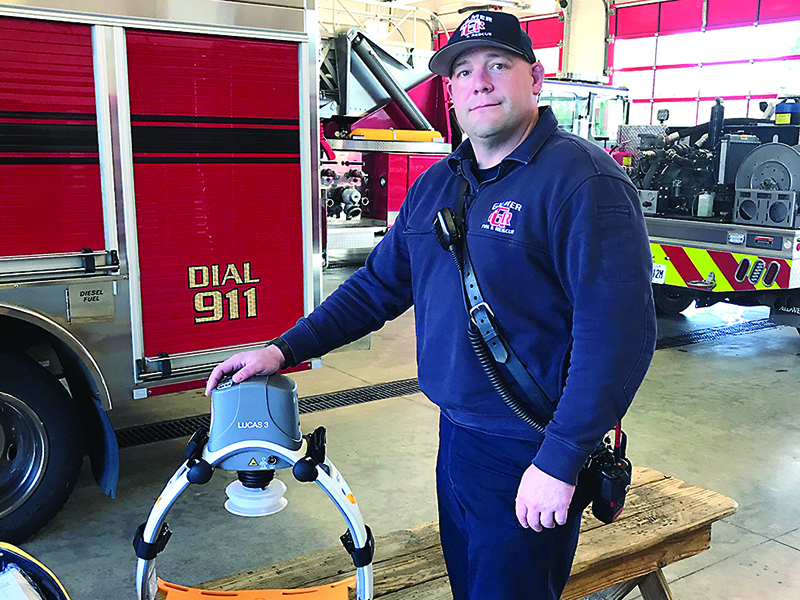
Two new automatic chest compression units were recently added to Gilmer Fire and Rescue’s equipment resources.
The LUCAS devices were acquired through CARES (Coronavirus Aid, Relief, and Economic Security) ACT funding received by the county, confirmed Gilmer EMA Director Keith Kucera.
The mechanical devices are used primarily in the event of cardiac arrest, confirmed Gilmer EMS Chief Russell Brown. The acronym “LUCAS” stands for Lund University Cardiac Arrest System, in reference to the Swedish university where the equipment was first developed.
“It basically takes the place of a person doing CPR. They can perform compressions with the exact depth and rate that they’re supposed to be performed,” said Brown. “As far out as some places in the county are, that can reduce the number of personnel we need on the scene to do compressions. Somebody always has to go and do nonstop compressions so this either takes that person out of the equation, or it lets them do something else. It adds a person to be able to work with a patient.”
Two more LUCAS devices were included in the department’s 2020 budget and, when those are received, there will be one for each ambulance in the county, Brown noted. The department previously had only one automatic chest compression unit, which is a different brand and an older model, he added.
“I think it’s a really valuable tool in the toolbox for Gilmer Fire and Rescue,” said Fire Chief Daniel Kauffman. “It compresses the heart and also pulls the chest walls up. It frees them up to be able to do (other things like) lifesaving intervention and IV therapy without having to worry about the compression side of it. It also takes human error out of it with a consistent rate and depth every time. Humans tend to tire and, if we’re going through a narrow hallway or loading a patient, sometimes you might have to temporarily stop CPR. With this, you never have to stop CPR.”
Kucera said the devices’ internal battery can be replaced without having to turn it off.
“There’s no operational downtime. You get an alarm that says your battery is running low at a certain percentage. You can hot swap another battery and the machine won’t stop,” he explained.
The LUCAS 3 units, which are the latest model of the equipment made by the Stryker Medical brand, cost $23,000 apiece with warranty, Brown noted.
“We’ve also trained with (medical helicopter) crews from AirLife in Jasper. They came up and trained with us so they can use the device when they’re flying patients out,” he added.
The devices have only been at the local fire and rescue agency for about two weeks, but they’ve already been broken in.
In just one day — which happened to be the last day of training for the equipment provided to all three shifts by the manufacturer — they were used by both a local ambulance crew and a medical helicopter team transporting a patient, Kucera noted.
“It was a successful flight for them. They took the LUCAS device from the hospital and flew them to a cardiac center. That same day, we responded to a call for a cardiac arrest at a residence. They applied the LUCAS device and got a pulse back,” he confirmed.