
Nonprofit food provider still an all-volunteer organization
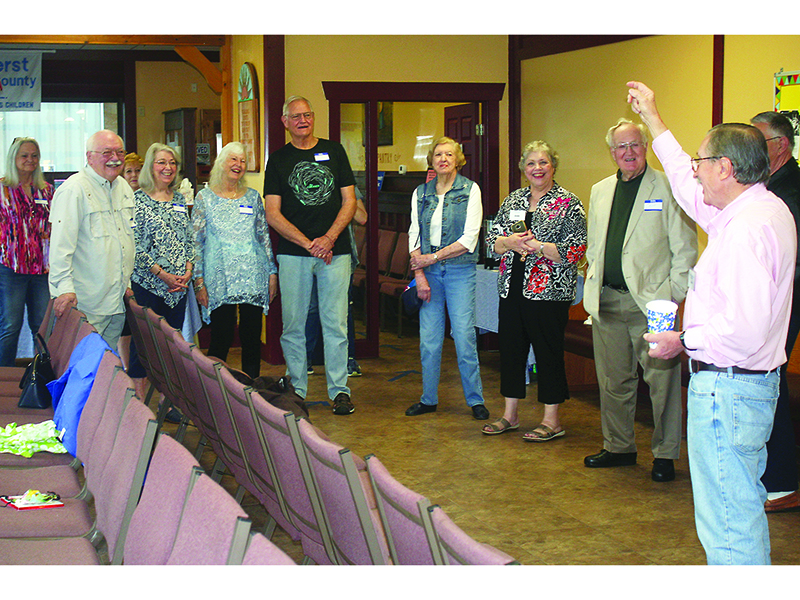
Throughout two decades that have included periods of economic strife, two facility relocations and, now, the COVID-19 pandemic, the Gilmer Community Food Pantry has continued to fulfill its mission of providing food to those in need.
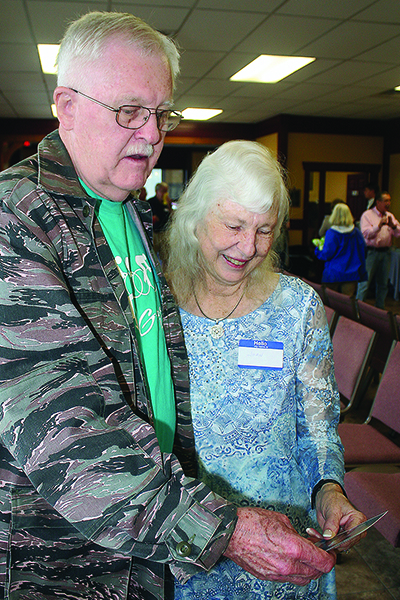
Past and present food pantry volunteers shared memories and stories as they toured the Highway 52 East facility last week in celebration of its 20th anniversary.
“I’m so proud of this food pantry and the work that continues to be done for the sake of people in this county. Every time I come here, I get a little teary-eyed,” said David Smedley, pastor of Hope Lutheran Church and a crucial figure in the pantry’s 2001 founding.
‘A learning process’
Smedley remembered how the initial idea to start a local food bank came to him after he’d visited a similar organization in Pickens County.
“I went to visit Sharon Watkins at the Methodist Church right after Thanksgiving of 2020. Our church kids group had raised a bunch of food that I took out to families at Thanksgiving. I was shocked by what I encountered in the community. I’d seen the food pantry they had in Jasper and just loved it. I thought we needed to get something like (it) started here in Ellijay,” Smedley said. “I wrote some articles for the newspaper. Then we called for a meeting so we could have a conversation with people in the community and 80 people showed up. That was probably in December of 2000.”
Watkins, then pastor at Ellijay First United Methodist Church, remembers meeting with Smedley and Dr. Fred Craddock, then pastor at Cherry Log Christian Church, to discuss starting a local food pantry. Shortly thereafter, her husband, Jerry, helped find the pantry’s first location, a metal garage-style building on Sailors Drive.
“(That building was owned by) Lee Pritchett, of Pritchett Engineering, who let us use it. It came together really quickly, which was just amazing. It was up and running in no time,” Smedley said. “Before we did anything, we went to all the places in town that were giving bags of food to people and said what we were going to do. We didn’t want to step on their toes. They said, ‘This is perfect. If you do that, we’ll throw our support your way.”’
“It was basically a pickup-truck operation in the very beginning and very hands-on volunteerwise. There wasn’t much administration. The majority of the first people who came were elderly people in the county. It was really a choice for them between having food and having medicine,” remembered Watkins.
An early version of the food pantry was up and running by January 2001. It incorporated as a nonprofit May 8 the same year. Several local and state organizations and individuals, many of whom were affiliated with local churches, helped make that quick turnaround possible, Smedley noted.
“The thrift store, which I don’t even think was Faith, Hope and Charity at that point, gave us $10,000. The Cecil B. Day Foundation gave us another $10,000. St Anne’s Catholic Church from Roswell came up with a truckload of food,” he recalled.
“Believe it or not, we had some opposition with people thinking we didn’t need to be giving things away and that it was just a flash in the pan. But it took off and it’s been a success,” Watkins said.
Jim Cole, who still volunteers to distribute food at the pantry, was among that original group of volunteers. It was a learning process just starting out, he noted.
“(It was slow) the first couple of weeks, but then word of mouth started getting out. We had about three or four Methodist churches, all the Baptist congregations and the Unitarian church (involved),” Cole said. “(The Sailors Drive space) was a small area, and we would take the food out in carts. There was a strip about this big that was cement, and the rest was gravel. (Have) you ever pushed a cart on gravel?”
Joan Blomquist, another longtime volunteer, said raising money to keep the pantry going the first few years was no easy task.
“People thought we would come and then go away because so many pantries had opened in the area, but they took their money and left. To convince them that this wasn’t how it was going to be here was very hard,” she remembered.
The food distribution process was done a little differently then, Blomquist and Watkins explained.
“I used to package (bags of) laundry detergent because it’s expensive. We would portion out sugar (in small bags), but we can’t split up the 5-pound bags anymore,” Blomquist said.
“One of the assistant managers at Walmart called me one day and said, ‘I’ve got a bunch of chicken I’ve got to do something with. I’ve either got to throw it away or give it away. I said, ‘don’t do that!’’ Watkins recalled. “I put the seats down in my SUV and we had about 150-200 pounds of chicken wings in there. We didn’t have a freezer or anything then, so we farmed it out to people to put in their freezers. We made a list and when we ran out of chicken wings to give out, we’d call those people. We called it the chicken wing run.”
A 2013 move from the pantry’s second location on Old Highway 5 to the current 5273 Highway 52 East address was a major step toward its longevity. The larger building, purchased by Faith, Hope and Charity Recycle Store Inc., for the sole purpose of housing the food pantry, provided ample room for food storage and distribution, as well as increased parking.
In a 2013 announcement of that move, then-pantry director Judy Farmer said, “Many times during our 13 years of service to Gilmer County, we would discuss what we thought our future should look like. Our biggest dream, by far, was to own our own building. That was something we never imagined would really come true, but you have to dream big. Thanks to the Faith, Hope and Charity, our dream has become a reality.”
To pick up food, groups of pantry volunteers used to go to the Chattanooga Food Bank on buses supplied by First Baptist Church, Cole recalled. Food is now delivered by truck to the pantry each week, and a walk-in cooler allows for safe storage of meat and frozen items.
Today, 90 percent of food distributed at the pantry comes from the Chattanooga Food Bank and 10 percent from the food bank in Atlanta, noted Allen Triebel, Gilmer Community Food Pantry Director.
Smedley said the pantry “has evolved in all the very best of ways” in the years since it first opened.
“They’re in good shape financially and everybody pitches in. This is probably the best ecumenical group in the county. There’s people from all different churches here. One of the things we were real intentional about when we got this started was that we didn’t want it to be tied to anything (in particular), but instead a freestanding community (place)” he added.
Still feeding people today
Although some things have changed or become more structured, the pantry still functions much like it did in the early years.
“It was just a kind of seat-of-the pants thing (in the beginning), but it’s evolved. It’s important because it’s still going and it’s still feeding people,” said Watkins.
Triebel said the work of the pantry’s volunteers is still what makes things happen, and no one there is a paid employee. Since 2007, volunteers have distributed more than 5.4 million pounds of food locally, he noted.
“I think it’s significant that the Gilmer Community Food Pantry still exists and is run solely by volunteers. Both the Pickens and Fannin County pantries have paid individuals,” said Triebel, who’s volunteered since 2010.
The COVID-19 pandemic has affected operations in several ways, Triebel told those who attended the anniversary reception.
“Last month, we had 200 (families) and, I think, last week we had 38. It’s up and down, but it’s at least half of what it was under normal circumstances. In my mind, it should be 50 percent greater than in normal circumstances like we had in 2019. We’ve got about 24-30 regular volunteers. A lot of people left when COVID hit for the safety of themselves and the people here,” he added.
Still, the nonprofit finds new ways to meet food needs in the community.
Its Sack Pack program provides bags of shelf-stable weekend food to around 350 elementary school students each week of the academic year.
“They get four meals, two for Saturday and two for Sunday,” Triebel said.
Receipt of grant funding recently led to a satellite food pantry in which volunteers deliver food to the Gilmer Senior Center for distribution. Triebel said the pantry has also started a pet food outreach program with pet food received at no cost from the Chattanooga Food Bank.
Food is distributed at the Highway 52 location each Wednesday from 9 a.m.-12:45 p.m. The pickup process was expedited during the pandemic, and new applicants are normally in and out in less than 10 minutes, Triebel said.
If someone needs the food pantry’s services, but can’t physically get there, there’s a way to meet that need, too, Triebel noted.
“We’re trying to find anybody who needs our service. If they qualify and can’t get to us, we have volunteers willing to bring out food,” he added.