
Program for local seniors, persons with medical conditions
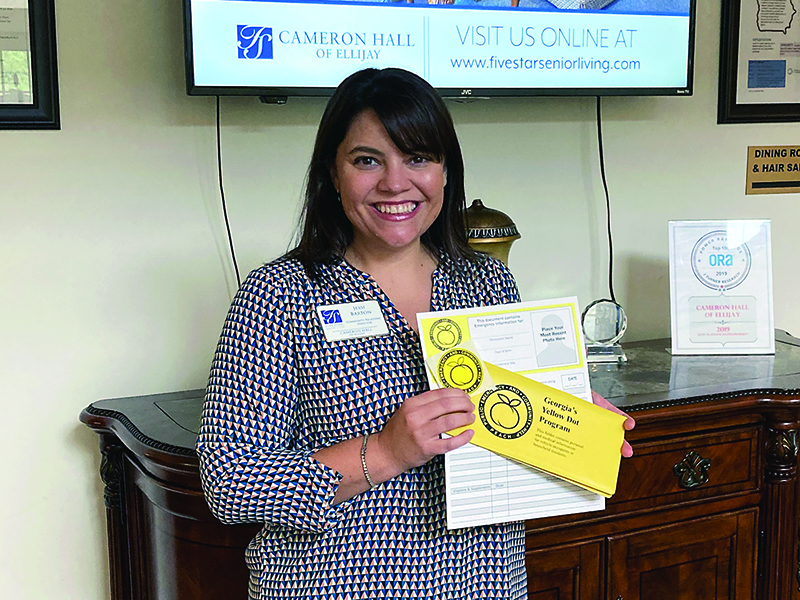
It’s hoped that a medical information program new to Gilmer County will expedite emergency response efforts of local police and fire departments if they respond to calls involving registered persons.
According to the Georgia Department of Public Health, the Yellow Dot Program was designed to help first responders provide life saving medical attention after an emergency. It began in Connecticut in 2002 and is implemented in Georgia through a partnership between the state public health and aging services departments.
“It was mentioned as a trial program they were starting over in the Winder area about three years ago. That was when I first learned about it. I started paying attention to it and following the progress,” said Jessi Barton, community relations director at Ellijay’s Cameron Hall Assisted Living and the county’s Yellow Dot coordinator.
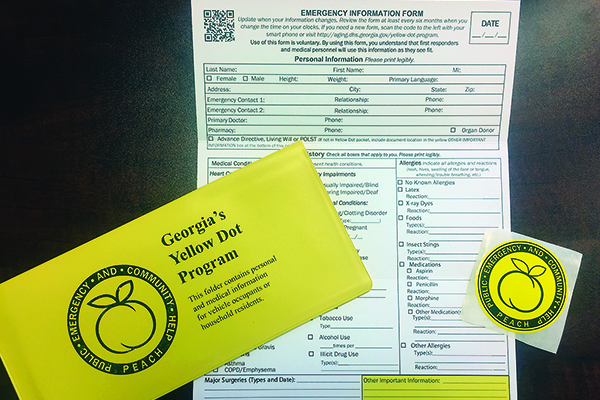
The program uses a round yellow sticker and a plastic envelope, also yellow. In the envelope, details about a person’s pre-existing medical conditions, prescribed medications, allergies, disabilities and other conditions can be kept, Barton explained.
“The sticker was initially designed to be put on the back windshield of a vehicle in case there was an automobile accident and people were found unconscious or unable to communicate. That was the original plan, but (they figured) it would be great for homebound seniors, too,” she added.
“The yellow packet is where you keep everything. It has a two-sided sheet for things like any kind of medical diagnosis, your current medications and allergies, but there’s also a place for a photo ID and emergency contact info. If you think about an auto accident and how vehicle contents can get scattered all over the place, by knowing this sticker is on the windshield (first responders) know to go directly to the glove box and that information is going to be there. We ask people (who want to display the yellow sticker at home) to put it on their front door and put the packet on their refrigerator.”
The packet also has room for extra documents, which could include a living will or other forms that specify medical treatment options, Barton noted.
The rollout of Yellow Dot in Gilmer is primarily for senior citizens, as well as persons with medical conditions or special needs, noted Gilmer County EMA Director Keith Kucera.
“The program is designed more for elderly seniors, but there are many different applications to it and we would like to implement it amongst a wide range of folks,” he added.
Police and fire agencies in Ellijay, East Ellijay and Gilmer County will receive training on how to recognize and locate the Yellow Dot material, Barton confirmed.
“I started the process of seeing what it would take to get this in our community in January. We were in the midst of introducing it to the law enforcement departments when COVID-19 hit, so that has delayed us,” she added. “I’ve met with law enforcement in the cities and county. They said they will support this 100 percent. Gilmer Public Safety is also 100 percent on board and excited to have this new program to help them and law enforcement as they respond to accidents and medical calls.”
Every emergency is ‘time-critical’
Kucera described how having a patient’s medical information at hand could be of benefit when EMS workers respond to either a car accident or a home emergency.
“It could help out tremendously if a patient is incoherent, unresponsive or in an altered mental state. (By looking at) any medications or ailments listed on there, we would be able to make sure that, with medication we give in the emergency medical setting, there would be no contraindications that cause any kind of reaction,” he said.
“It could be a critical situation, such as a motor vehicle accident, where the person is unresponsive. Having that Yellow Dot on the vehicle will be an indicator that there’s medical information in the glove box. In a trauma type of situation, that’s great for us to have to be able to move forward. It’s a wealth of information to be able to provide to a helicopter or ambulance crew.”
Every emergency situation is time-critical, offered Kucera.
“You want to able to get a patient to the next level of care as soon as possible. A lot of times, we need a medical history or list of medications a patient may be taking. It takes time to try and get that. If it’s already listed in this packet, that’s less time we have to take to (get that information),” he added. “By implementing it within our community paramedicine program, they can also help patients update their information when they do home visits.”
Kucera noted having those details at hand would be especially useful if a patient lives alone and doesn’t have anyone to provide medical details.
“If a person is alone, there’s not a way for us to find out. We’re basing the treatment from the signs and symptoms we can see. We would first have to get them to a hospital, then advanced care would communicate with their physician. Having this information available to us will enhance the care we’re able to give someone,” he added.
First rural county
Yellow Dot is used in some other states including Alabama, Tennessee, New York and Maine. In Georgia, it’s available in several larger areas including Dunwoody, Oglethorpe County, Athens and Savannah.
Gilmer will be the first rural county in Georgia to actively utilize the program, Barton said.
“We’re excited for the county to get it. Cherokee and Pickens County both use a different style of program called Project Lifesaver, but it’s more for wandering children or adults,” she noted. “It (Yellow Dot) is only as good as the training EMTs and law enforcement gets, so if someone has it on their car and they go to another county where they don’t have this program, those first responders may not know what it is.”
There will be 1,500 Yellow Dot packets available to Gilmer in the grant-funded first phase of the program. After those have been given out, more can be applied for, Barton noted.
“If a business wants to sponsor the funding, we can do that as well,” she added.
Cameron Hall of Ellijay, 114 Penland Street, is the county’s first enrollment and packet pickup site. Other pickup sites may be added at some point, Barton confirmed.
“We’re going to have an outdoor tent at Cameron Hall that people can pull up to Wednesday, Sept. 2, and Wednesday, Sept. 9, from 11a.m.-2 p.m.,” she said.
“They don’t have to bring any kind of paperwork. We will instruct them on the best way to fill out the paperwork and we’re encouraging people to keep it up to date, especially if there are any changes like medication changes. Also, the information is not stored in a database. It is solely the person’s responsibility to have their information up to date.”
Barton said if someone misses those two enrollment events and would still like to pick up a Yellow Dot packet, they can contact her at 706-502-0154 and arrange a time to pick up the material. Cameron Hall is not open to outside visitors due to the continuing coronavirus pandemic, but arrangements can be made for curbside pickup, she noted.
“We will also be putting it on Cameron Hall’s and Gilmer Public Safety’s Facebook pages. If there’s a community group, such as the Lions Club or a church senior group that wants us to come to them, we can set up a time and place to do that,” Barton said.