
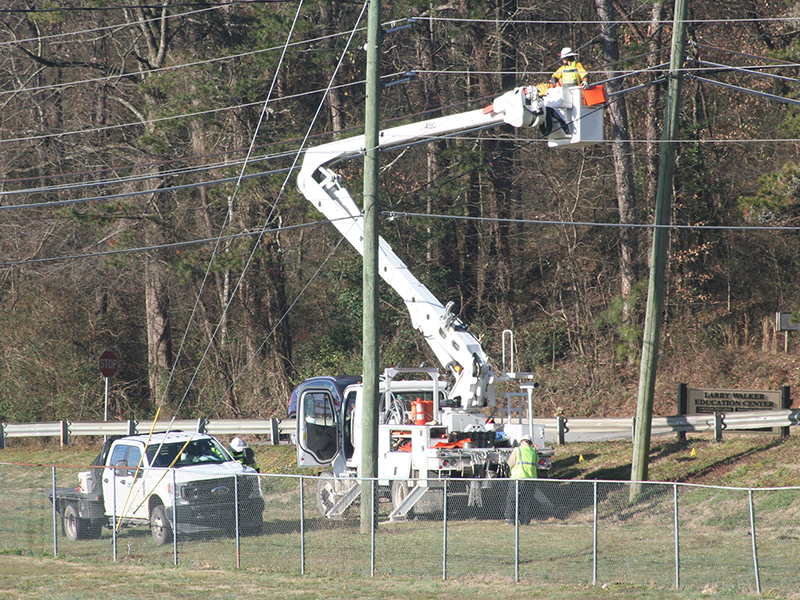
Work being done to improve Georgia Power’s electrical service infrastructure in Gilmer County is part of a statewide $1.3 billion project under the umbrella of the company’s Grid Investment Plan.
Georgia Power is currently leading two grid investment projects in Gilmer County, and additional projects are expected to get underway in the coming weeks, said Craig Bell, Georgia Power spokesperson.
“All of the current and planned projects are generally located within the central portion of the county,” Bell added.
One of the current project areas begins between Ellijay and East Ellijay, just south of Highway 52. It then branches down South Main Street and moves west via Legion Road into Coosawattee River Resort and neighboring areas. The second project area begins near the intersection of Industrial Boulevard and South Main Street, moves south on Old Highway 5, then branches out west via Highway 382 and east via Talona Road.
Georgia Power is working with multiple contractors in the project areas, and construction on both current Gilmer projects is expected to wrap some time in late 2021, noted Bell.
“Construction start and finish dates are projected and subject to change due to weather impacts and other factors,” he added.
The Grid Investment Plan involves upgrading power transmission and distribution infrastructure to improve reliability and efficiency, Bell noted.
According to a Georgia Power release, the statewide project is expected to take three years and will include several different types of work, including installing automated line devices that isolate power outages to smaller portions of an affected line, adding connections to power lines to provide alternate sources of power during outages and relocating lines in areas that are hard to access.
The projects also involve rerouting targeted portions of overhead power lines underground and strengthening other lines that will remain overhead with material and technological upgrades.
The goal of the whole project is to decrease the number and length of power outages experienced by customers, Bell noted.
“The (underground) installation is primarily done through directional boring with cable generally installed along the right of way,” he added.
Routing the overhead lines to run underground also reduces exposure to trees and severe weather, which are the two factors that cause the most power outages, Bell said.
“While we expect a reduction in the number and length of power outages experienced by customers, we do not expect outages to be eliminated entirely,” he added. “Uprooted trees, vehicle and digging accidents and flooding can still cause issues with underground lines and related above ground equipment.”
Strengthening overhead lines could involve replacing wooden or steel hardware with fiberglass equipment and installing wildlife protective equipment to help prevent power outages caused by falling limbs or wildlife contact, Bell noted.
According to the Pickens Progress newspaper, grid investment projects are also being done in Pickens County for the same purpose. Work areas there include north Jasper and parts of Burnt Mountain Road and Talking Rock. Grid investment projects are also ongoing in a large portion of Murray County that includes Chatsworth and Ramhurst.
Bell noted that modern construction techniques will be used to reduce traffic disruptions here, but did not specify any traffic changes or delays expected for the project areas.
“We’ll work with residents to gain access along the construction area throughout the project. Additionally, traffic crews direct traffic around construction areas to maintain everyone’s safety. Drivers are reminded of Georgia’s ‘Move Over’ law that applies to electric workers, as well as first responders. (It)requires drivers to change lanes or slow down when approaching work crews,” he added.