
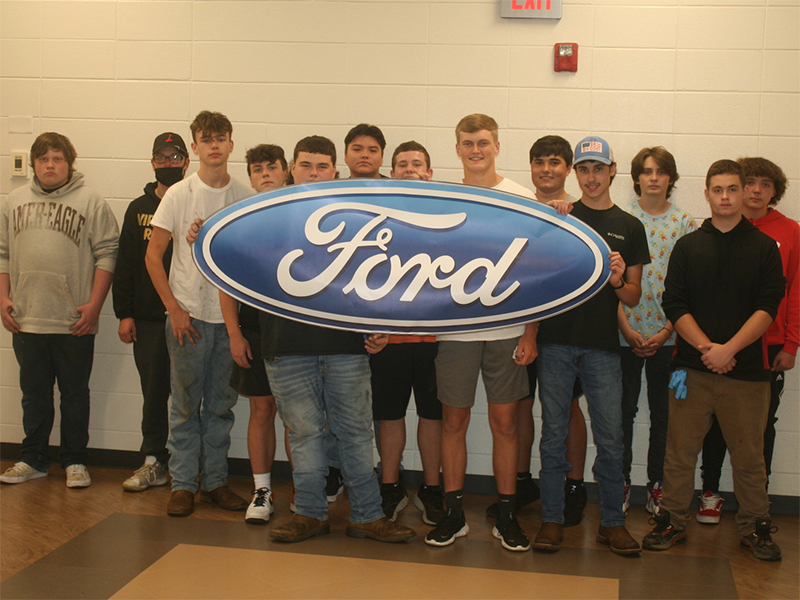
As the COVID-19 pandemic brought a shift from onsite to online learning for many during the 2020-21 school year, students in Gilmer High School’s auto tech program were able to complete 1,129 online skill certification courses offered by Ford Motor Company.
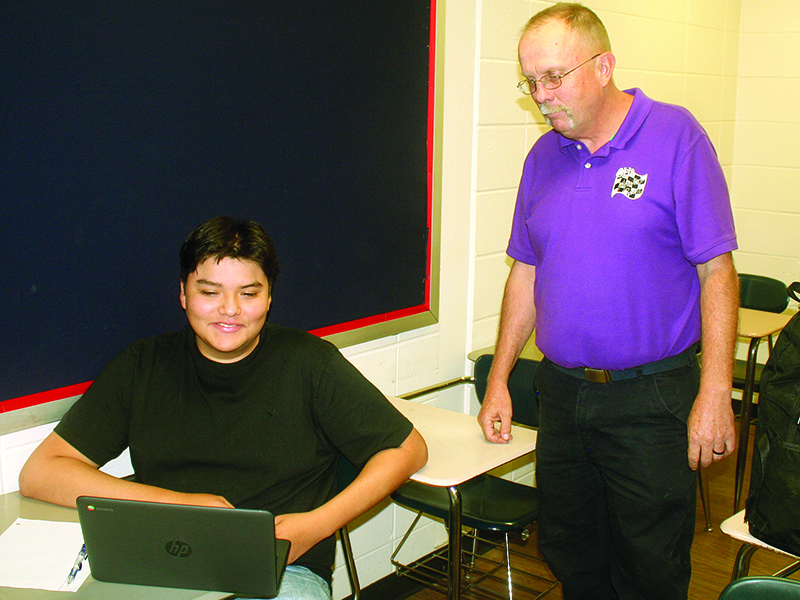
Ken Martin, who teaches the auto tech classes at GHS, was recently informed that his students placed first in their region for the number of Ford ACE (Automotive Career Exploration) courses completed last school year.
“The numbers were high enough that they (Ford) went ahead and gave us courses that weren’t just for high school, but also college-level students,” Martin said.
This is actually the second school year in which GHS Auto Tech has placed at the top for most completed courses in its region, which also includes parts of Georgia, South Carolina, Tennessee and Alabama.
“There were 6,372 total course completions (in the southeast region for 2020-21), and my students did over 1,000 of those,” he added. “(Ford) started out doing this to see if high school students would explore a career in the automotive industry, and we were actually (one of the) first to do it nationwide. I think we were number four in getting it kicked off.”
The Ford ACE program offers students opportunities to gain basic auto service knowledge, while attaining certifications that can carry over to a place of employment. They’re tested on what they learn and, when they pass the test, certification is achieved in that specific course, Martin noted.
“They start out learning what a Ford product looks like and how Ford runs their service centers, and go all the way up to advanced electrical training,” he added. “If you went to work at a Ford place, they would have you do some of these courses while you’re employed by them. We’re setting them up to have some of these done before they even go to work.”
Anthony Davis, technical placement specialist for Ford’s Atlanta region, said the certifications are transferable if an ACE student is employed by a Ford/Lincoln dealership, at which a similar training program is used.
“These (courses) are transferable to any Ford or Lincoln dealership in the country,” he confirmed. “For any Ford employee, from the general manager down to an entry-level tech, we use a training system called STARS (Standard Training and Resource System). Every Ford employee, dealership or corporate, has a STARS ID.”
The courses can be done on most any device with internet access, Martin said.
“I’ve had students do them on their phones,” he confirmed.
Ronnie Thompson Ford, in East Ellijay, is the local sponsor dealership for the ACE program. Sponsorship by a Ford dealer is a prerequisite for the courses to be offered to students.
“Mr. Martin does a great job with the students, and it’s a great relationship between the dealership and the school,” Davis said.
Several GHS Auto Tech students have either gone on to work at the local Ford dealership after graduating or while still in high school, confirmed Conrad MacArthur, Ronnie Thompson Ford parts and service director.
“We look at students who are graduating and want to be in the field, as well as students who are currently enrolled,” MacArthur said.
“We’ve had quite a few come through here who’ve been a part of Mr. Martin’s program. Some have gone on to become certified Ford technicians or advisors. They can go into anything from an entry-level technician to a Ford certified technician specializing maybe in transmissions or diesel repair. We also have the customer-facing adviser and parts manager positions. It’s possible they could even go into the sales department, if they have that mentality.”
MacArthur said the ACE courses give students an entryway into auto repair and diagnosis, while also allowing them to find out if that’s a career path they want to pursue.
“It gets a lot of the entry-level stuff out of the way,” he added. “It gives them basic knowledge of how systems work. When they come here, they can take that next step of us walking them through the diagnosing processes of electrical concerns, engine concerns, etc.”
‘You’re driving a computer’
Martin said vehicle manufacturers like Ford are increasingly looking for skilled workers who’ve completed some sort of training or educational program, which could be courses done while still in high school, he noted.
“There’s a nationwide automotive and light truck technician shortage right now. If you look at the demographics, you’ve also got (a lot of) people who are approaching retirement age,” Martin said.
By participating in educational courses like Ford ACE and working part-time automotive jobs, students like those in Martin’s class are getting an early primer in how today’s technology-driven vehicles function.
“Automotive technology is getting so advanced,” Martin said. “Look at what Tesla said about his vehicles. He said, you’re not driving a car anymore. You’re driving a computer.”
Auto dealerships are also experiencing that shortage of skilled technicians, MacArthur noted.
“There’s a huge shortage, and Ford is really pushing toward the schools to try and get more (young) people involved with the technician program. It’s just not something everyone is signing up for these days,” he said.
Davis noted that mounting technician shortage led to Ford starting the ACE program in 2017 as a “grass-roots” pilot initiative in the Dearborn, Mich., area. It’s now used in high schools and colleges in all 50 states, he added.
“They saw that we needed over 17,000 technicians just in our Ford and Lincoln dealers. Every manufacturer nationwide needs about 145,000 technicians. That’s every manufacturer that has a dealership in the U.S.,” Davis said.
Martin said, last year, Ford’s training center donated two engines for his classes to use in their studies thanks to the high number of ACE courses completed by GHS students. He expects to have more than 100 students enrolled in his auto tech classes this school year.
“Freshmen to seniors can do these (courses), and they can start as soon as they’re enrolled in the class. I’ve even had a couple who’ve shown interest while still in middle school. As long as they’ve got a school email address and have enough interest, they can get in there and start as an eighth grader,” Martin said. “It’s something that can turn into a future.”