
Financial stipend also available for college prep
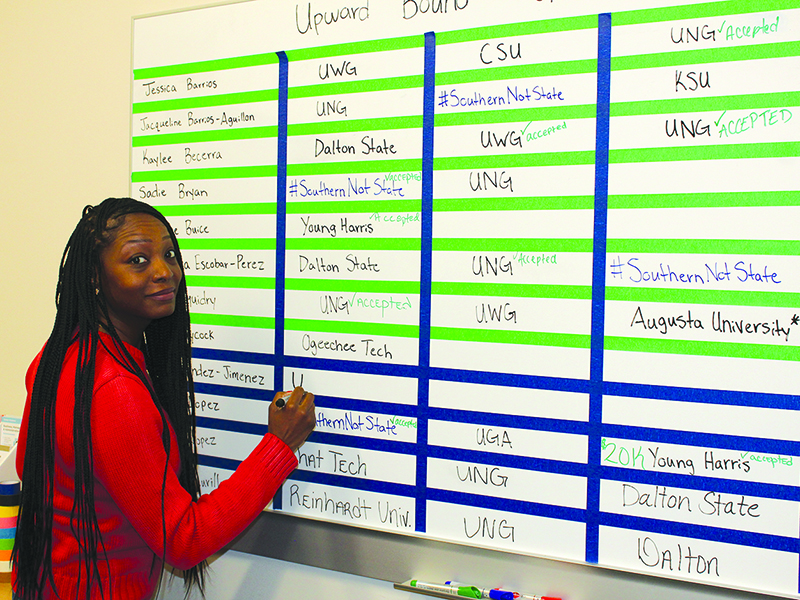
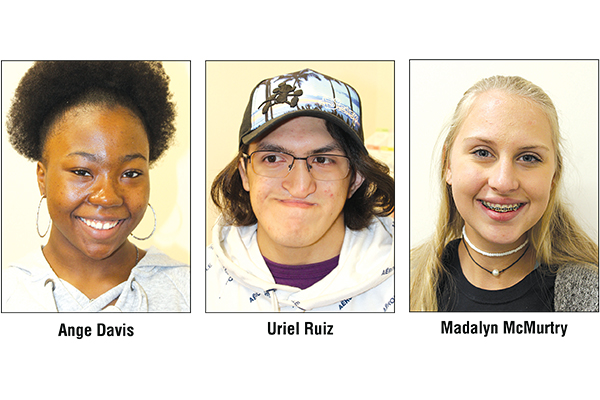 Ange Davis was shocked by what happened to her newborn nephew in a hospital. So much so, it has motivated her pursuit of a career.
“When my nephew Josiah was born five years ago, me and my niece went to visit the maternity ward,” said Davis, 17, a Gilmer High School junior and participant in the Upward Bound program. “A nurse gave him an injection and was really aggressive with him, and she slit his heel when he kicked at her.”
The neonatal nurse may have been “tired or just in a bad mood,” but it didn’t matter.
“We both just burst out in tears,” she recalled. “It was really an emotional experience for me … and I decided I wanted to change that, I want to keep that from happening.”
When asked how she would do that, Davis — who has been involved with Upward Bound since her freshman year — became excited talking about the innovative program that utilizes federal funds and is operated regionally by the University of North Georgia. She’s learned much about the medical field through UB, she related, and much of that has been at the UNG campus in Dahlonega.
“Most of the colleges we visit cover the medical field — West Georgia, Alabama State, and I want to visit Valdosta State,” she continued. “I’ve gotten a lot of experiences out of Upward Bound I wouldn’t have gotten anywhere else. We travel a lot, and my family is really happy for me. I want to go into the medical field as a neonatal nurse.”
Uriel Ruiz is a GHS senior and has a career goal of becoming a cinematographer. He believes Upward Bound can help him achieve a major in film or film production and a minor in photography
“Some schools have film production majors now,” noted Ruiz, 17. “Upward Bound has so many resources that help a student gravitate toward what they want to do with their life.”
His favorite parts of the program are college campus visits that include staying in a dorm and taking part in classes, even though he won’t graduate high school until this spring. At UNG, his favorite experience has been interacting with other students in Upward Bound at GHS and Johnson High School (in Hall County), where UNG administers their other UB program.
Ruiz appears to be making a wise choice. A quick website search reveals the Georgia film and TV industry boasts more than 92,000 people employed, with $4.6 billion paid in wages, according to the Motion Picture Association of America.
Ruiz has planned ahead by applying to several colleges, which he admits he didn’t think of doing until his involvement with Upward Bound.
Latrice Richardson, the project director for the two programs at GHS and Johnson, explained Upward Bound is for prospective first-generation college students who are income eligible.
“So either their mother or father have not earned a bachelor’s degree,” she said. “High schools are chosen for the U.S. Department of Education grant funds according to statistics such as academic need, student-to-counselor ratio, the number of students who pursue a degree after completion of high school, test scores and other things.”
Presently, there are funds for 60 students to be involved in the program at Gilmer High, same as Johnson High.
“Students can become active in the program as rising ninth-graders, which is preferable because there’s a greater impact,” Richardson said.
Since more than 60 students wanted to get into the program, but could not, according to grant funds, she called the process — which includes a nine-page application — “very competitive.” Students and their parents fill out the application together, then there must be approval from a “core area” teacher and the student’s in-school counselor.
“The student also has to write an essay talking about what their aspirations are for after high school,” Richardson said. “There’s a career-and-interest survey that asks them what do you want to do, have you thought about these things? Then there’s a student interview and a parent interview. It’s really intense.”
A ‘good fit’
Richardson said there are many more students who are eligible due to the parent’s educational achievement and income guidelines, but the program is also about a “good fit” for the program and is aligned with objectives.
“Let’s say I take in Johnny, and at first he seems motivated and enthused at the onset of the application,” she said of the 60-day trial period. “These students get a (financial) stipend, they know they’re getting money to participate, and their parents are really excited about it. But when it comes time to meet the requirements — like after-school tutoring, academic advisement and consistency in meeting with your advisor — then Johnny just kind of falls off. So I notice in Day 35, we just need to break up, so to speak, because it may hurt the program in the end. And he realizes the program may just not be for him.”
The grant was initially funded at $262,000 in 2016, and each year since has seen an incremental increase. Students can earn up to $120 per semester (two nine-week periods), based on participation, grades, school attendance and some other criteria.
Richardson was asked how Upward Bound is different from other college prep classes in high school.
“The added layer (of motivation) is that we are hands on,” she said. “Look at it this way. A high school can have a college prep track. Upward Bound is here to support that goal, and they’re aligned with that. Gilmer High School has a college prep track, and they may have 600 students in that with three counselors. We have 60 students to focus on with that same goal with myself, a counselor and an advisor — so it’s much more intense and intentional, one-on-one.
“We’re going over students’ schedules and making sure that, hey, this is not the course you should be taking for what colleges are looking for to pursue a degree in, say, computer science or liberal arts. So it’s that aspect. But we get students outside the school, taking the students to visit at least four colleges a semester … we’ve already planned our spring (in that regard).”
Richardson said UB also pays for juniors and seniors to take the SAT and ACT college admission exams.
“Just in general, we’re that added support,” she said, adding there is also a six-week summer program.
‘Outside’ experiences
Madalyn McMurtry, a freshman student, has just joined the program.
“It’s really a big deal to me because I want to get into a good university,” she said. “I just appreciate this support system that will help me get there. My goal since fifth grade has been to be a pediatric surgeon. Medicine and biology have always fascinated me, and I’ve always really enjoyed helping people.”
McMurtry, 15, was asked what other college courses she might take.
“I’m planning on taking a lot of psychology courses, because I believe this will be a tough career mentally, so I want to learn some things that will help me with my patients,” she said, adding participation in band can help her incorporate music therapy to help future patients.
Richardson pointed out most postsecondary-directed students “don’t get the experience of college until they go to college.”
“You have a complete culture shock when you go to college as a freshman,” she said. “With Upward Bound, in the summer they first get two weeks of SAT and ACT prep. It’s very expensive to pay for those tutors, but they don’t have to do that. They can live on campus at Dahlonega … it’s all to get them acquainted with the college experience and living on campus in a dorm.”
Students have also traveled to Chicago, Ill. — and visited the iconic home of the Cubs, Wrigley Field — as well as other cultural sites there and in St. Louis, Mo., as well as other cities.
“It’s really a holistic experience for them, both academically and culturally, but still with the goal in mind that they’re going to college,” Richardson said. “We want to give them experiences that are outside Ellijay, Gainesville and Georgia.”