
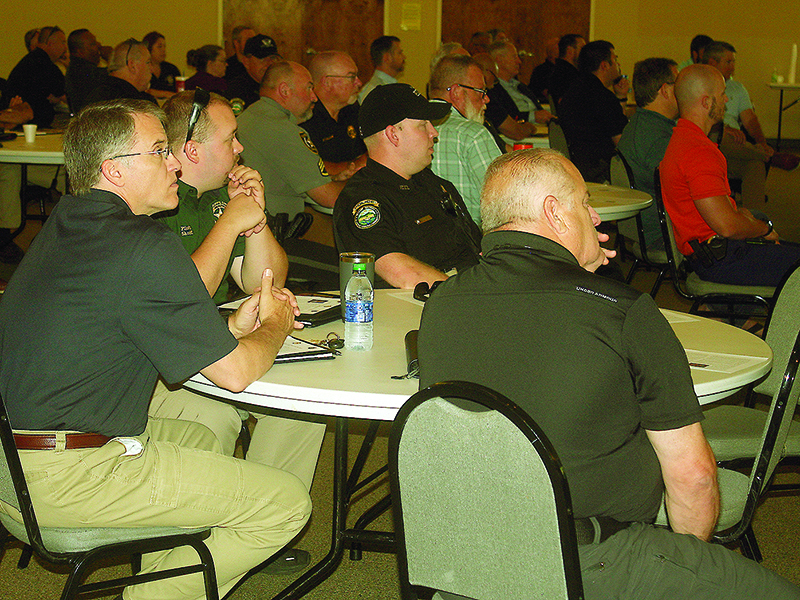
Law enforcement and public safety personnel from across Georgia gathered in Ellijay last week for a daylong training session led by FBI and GBI agents.
The purpose of the session at the First Baptist Church Fellowship Hall was to make attendees aware of the multi-agency response resources available in the event of a child abduction, said Ellijay Police Chief Edward Lacey, who arranged for the training to be held here.
“All of you have some loved ones, children or grandchildren, that, if they were missing, you would pull out all stops. There would be no stops in your way,” said Lacey as the seminar opened.
‘OK to pull out all the stops’
Lacey told the room that there’s been a “culture change” between the early 1990s, his first years in law enforcement, and more recent years when it comes to “pulling out all the stops” in a child abduction case by calling on other agencies.
“Some of our greatest fears aren’t necessarily getting shot or beat up. It’s looking silly in front of somebody. None of us wants to look stupid. We don’t want to be the guy who cries wolf and gets all the resources to show up, then we find the kid under the bed or the child ran away,” he said. “I’m here to tell you, we went through a culture change. If a child is involved, we pull out all the stops and it’s OK to pull out all the stops.”
Both the GBI and FBI have response teams that can be called in by other agencies to assist in responding to child abduction cases. The GBI uses its Child Abduction Response Team (CART), while the FBI has the Child Abduction Rapid Deployment (CARD) Team.
“Anybody who can request the GBI investigate a case can request CART,” Rocky Bigham, GBI special agent and CART point of contact, told attendees. “We (GBI) are a small portion of what CART truly is. What you’re getting is basically the whole state of Georgia’s resources whenever you have a call-out.”
Bigham said if an agency has a missing child case that’s believed to be an abduction, the first step is to determine whether to activate an emergency alert and get information out to the public.
“Once that’s done, you can start deciding, do we need CART? Do we need CARD from the FBI? What kind of resources are we going to need for this?” he added.
Bingham said Florida law enforcement led with the CART concept, then other states started taking it on. Georgia’s team was started in 2008 through an executive order from then Gov. Sonny Perdue, he noted.
“This is not, ‘Hey we just want to set up a team. If you need us, call us.’ That’s not how it works,” he explained. “They are very methodical in laying out the training and how you’re going to get certified.”
There are four emergency alert systems used by the Georgia Information Sharing Analysis Center (GISAC), the GBI division to which Bigham is assigned.
“When I came to GISAC two years ago, at this point I’d been with GBI almost 13 years, I only knew of two (alerts) — Levi’s and Mattie’s. Thats the only thing, as an agent, I had to do and the only things I ever knew about,” he said.
Levi’s Call, named for Levi Frady — an 11-year-old boy from Cumming who was found murdered after going missing in 1997 — uses radio and TV to alert the public of a confirmed child abduction. Its purpose is to help locate the abductor and missing child quickly before the child is harmed.
After going missing, Frady’s body was found in the Dawson Forest Wildlife Management Area. He’d been shot multiple times. Today, the cold case remains unsolved.
“We’re very (restrictive) about specific reasons we activate it. The child must be under 17, and there must be a known, confirmed abduction,” said Bigham about qualifications that can lead to a Levi’s Call being issued. The national version of the missing child notification is the Amber Alert, he added.
Other alerts used in Georgia include Mattie’s Call (for missing disabled or elderly persons), Kimberly’s Call (for violent criminals at large who may be of threat to the public) and Blue Alert (for violent criminals who kill or seriously injure police officers or to help locate missing officers).
“Maggie’s Call used to be for 60-65 and up with some type of cognitive issue, but we now use it for 16, 17, 20 year olds with some type of cognitive issue,” Bigham said.
Ninety percent of children who go missing in Georgia are typically found or returned home, Bigham told attendees. Nine percent are noncustodial abductions, and less than 1 percent are considered “stranger abductions,” he added.
However, sobering case statistics show what could happen, and how quickly, after a child is abducted.
When an abducted child is killed, 49 percent are murdered in less than one hour, 74 percent within three hours, 91 percent within 24 hours and 99 percent within seven days, Bigham said.
“This is why those first few hours are so critical,” he stressed.
A main takeaway of the training was for agencies to make sure they have a detailed plan or policy for missing and abducted child cases that can be activated quickly, Bigham noted. Those policies should specify when another agency or special team like CARD or CART should be contacted to assist, he added.
“You’re dropping the ball if you don’t have some plan of what (you’re) going to do, a step-by-step process. Think about those procedures, and have a plan prior to the event actually happening. With no plan in place, accessing resources could take up valuable time,” Bigham advised.
Local training could continue
Lacey said cases involving children are near to his heart.
“We have the Apple Festival, and have a lot of people who aren’t from here coming here. One of the things that keeps me awake at night is the fear of getting a phone call that we’ve got a missing kid,” he said.
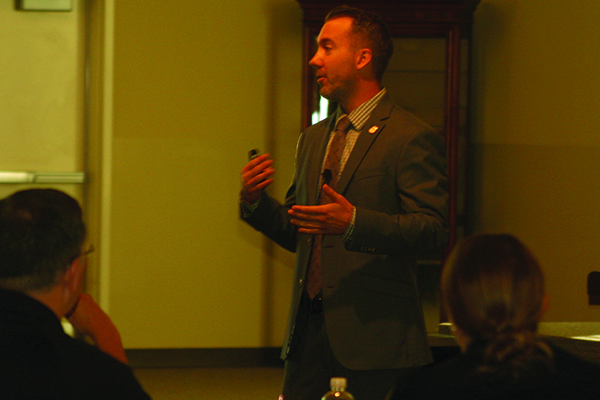
The Ellijay Police Chief said he worked with FBI agents Sean Burke, a supervisory agent for several Georgia counties including Gilmer, and Brian Ozden, a crisis negotiator and CARD Team member, to have the training held here. Burke and Ozden were also here as training presenters.
“Each of them went through what their agencies bring to the table to assist local agencies in these cases that need a high amount of resources. Both of them got into specific responses, and managing of those cases,” Lacey said. “The second part was more case study driven. We had several case studies of abductions where some turned out favorably and some not favorably.”
This year brings the 10th anniversary of a child abduction case that hit home for many Georgia parents and grandparents.
Seven-year-old Jorelys Rivera disappeared Friday, Dec. 2, 2011. Her body was found in a dumpster the following Monday. Ryan Brunn, a 20-year-old maintenance man at the apartment complex where both he and Rivera lived, eventually pled guilty to her murder.
“I really wanted to get out some useful information, and I had a personal goal of getting this training done before that 10-year mark,” said Lacey, who was employed by the Cherokee County Sheriff’s Office then.
He remembered the multi-agency response effort that unfolded to find the missing girl and capture her abductor.
“All of a sudden, you had nine state agencies coming. They didn’t have to ask what do we do. They just went to work,” Lacey said.
The training that was done here was also open to fire and rescue and 911 dispatch staff. Public safety personnel from local city and county fire and police agencies attended, as did representatives from many other jurisdictions and counties, Lacey noted.
“We had 70, which was a very good representation from everybody. We had police officers, sheriffs, dispatchers, sergeants, corporals, detectives, chiefs, assistant chiefs, captains and fire and EMA personnel. It was a real broad spectrum,” he added. “Everybody in that room now knows of the resources that are available and how to get in touch with them.”
Lacey hopes there can be a second local session where more hands-on, situation-based training is offered.
“Our thoughts are that this is the first level. For the next level, we’d like to expand it a little more. Maybe have the CART and CARD teams come up and have everything set up as if they were actually doing a response. We could have representatives from other agencies come and see first-hand that this is what’s going to show up, and this is what we can do,” he said.