
For Gilmer Genealogical Society
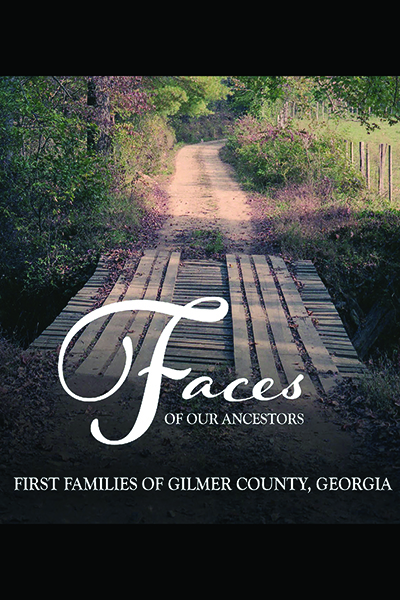
A new book that traces several of Gilmer County’s pioneering families from the 1800s to the modern era represents several firsts for the Gilmer County Genealogical Society (GCGS), an all-volunteer organization dedicated to promoting and preserving family history.
At 800-plus pages, the hardbound Faces of Our Ancestors: First Families of Gilmer County Georgia is easily the heftiest and most thoroughly-researched publication the group has produced to date.
“To me, this is a really big deal,” said Karen Titus, chairwoman of the Faces of Our Ancestors book committee. “I wasn’t born here or raised here. I just lived here. (I come from) Virginia where the history is older and that history may have been traced individually for certain people, but not for an entire county. That’s why I hung in there with this book, because we’d done so much work on it and it contains so much important information.”
A five-year project
 The genealogical society’s First Families program recognizes persons who settled here prior to 1840. When registering as a First Family representative, modern-day descendants of those early pioneers must prove their ancestry by tracing family lines back to someone listed on the 1834 or 1840 Gilmer County Census.
“Betty Riddle, Eurilla Davis Hyatt and Shirley Sluder started the First Families (program) in 2012. We are grateful to them for that,” said Brenda Cochran, one of the book’s coeditors.
Since forming in 1996, the genealogical society has issued the books Poetry From the Mountains, a collection of poems by local residents and their ancestors; Days Gone By, a compilation of writings by late local historian Ernest Parker and Reflections on Mountain Heritage, a collection of mountain tales and memories.
A group of members began compiling material for Faces of Our Ancestors around five years ago as a way to preserve historical documents and other information that had been submitted by First Families applicants.
“People heard about (First Families) and started saying, ‘I should do that. I should leave that legacy.’ Then, we realized there’s a bigger legacy here because we were sitting on a pile of information that’s really significant to Gilmer County. We had all those files and information, so, one day, (GCGS member) John Davis said, ‘we should do a book,’” explained Titus.
“We had a starting point, but then we had to figure out what we would actually put in the book. Then we had to reach out to people for more information so we could expand. We let them know we would like to have things like family stories and photos.”
Titus said there was a lot of “one step forward, two steps back” during the first couple of years spent plotting the book. The committee comprised of her, Davis, Cochran, coeditor Gladys Spivey and editor Hollyanna Hardy White persevered and eventually gained traction in putting the assorted pieces together.
“At first, we were just trying to wrap our heads around it. Are we crazy? Is this actually doable? The first two years, we were mostly working (to get information) and formulating and trying to format (what we had), which was not easy. We sent out a lot of letters telling people what we wanted to do. We got wonderful family stories, things that people had passed down and things they’d found in family Bibles. Maybe a little too much information in a case or two, but interesting information nonetheless,” Titus said.
The next phase was heavy with research, phone calls, editing and formatting revisions. Filling the blanks left in material the group had already received required reaching out across the country to contact descendants.
“(There are First Families descendants) from all over Georgia, as well as Florida, Alabama, Texas, Colorado, California, New York and West Virginia. Not only did we have to go backward, we had to come forward a bit with (providing modern-day) family tree information. If we would have kept going, there would be a second volume. I was hoping we could do better than 600 pages and no more than 700, but look at where we are.”
Censuses were starting points
Family trees included in the book branch from those 1800s census reports.
“We actually have (documents) from 1834, which was a state census that was done in order to figure out if Gilmer had enough people to make it viable to be a county. That census is included. You had Cherokee people still living in the county, who were ancestors, before the removal. Everybody who was a proven First Families ancestor has a chapter. Every ancestor has a document that says, ‘Here I am in the census.’ They are listed in the front by name. It’s not everybody on the 1840 census, but it is 68 of them,” ” Titus said.
“You would have one family tree with five generations and it would sit there on a page. Then, you have this family that comes in and marries into five other families. All of a sudden, you have a flood and there’s 39 pages with just one family. Then it’s back to the drawing board to look at another way to format it so you can get the (necessary) information in there, but it doesn’t take up so much of the book,” she added.
White, the book’s editor, described some of the family stories that unfolded as the project came together.
“(They) reminisce about climbing the mountains, rabbit hunting with grandpa and sitting at great grandma’s table listening to tales about when she was just a girl. Combining the stories gives our descendants a sense of what life was like and how our community evolved,” she noted.
“One ancestor had to submit a family Bible to the Department of the Interior in 1840 to receive a widow’s pension. The Bible was discovered 37 years later and returned to the family. There was a ‘seven sisters married seven brothers’ scenario. A perpetual motion machine was invented. There were children who were orphaned, but taken in by family members, as well as neighbors.”
Cochran described why she and other members of the genealogical society are excited about completing the volume, which might eventually lead to a second First Families book.
“Someone asked me, ‘Why would you spend years of your life writing about others?’ First of all, we had a purpose to document the history of our ancestors. We tell their stories because they are important. I was born here. When I got big enough, I came back home so I also wanted to do it as something that (documents) the history of the county,” she said.
“Another example of ‘why’ is, during our work on the book, it was discovered that some of the Confederate soldiers who were deemed deserters on the last known Muster Roll were, in fact, killed in battle or died as POWs and are buried up north. At the end of the Civil War, times were very confusing. Revealing this history is very important to us. Through this book, these families will discover what really happened to their soldiers.”
A lasting legacy
Faces of our Ancestors is the first genealogical society publication to bear both an ISBN (International Standard Book Number) and a Library of Congress number. The two assigned numbers are unique markers for the sales and cataloging of published books.
“I wanted to make this a legitimate book with an ISBN and a Library of Congress number like you would if you published a book and wanted it on shelves. It’s a book that deserves to be put on shelves of libraries where people might be interested in it,” Titus said. “It’s also been copyrighted for the genealogical society. They will never lose that copyright unless they give it up. We only got 300 books printed this first time around because they were so expensive, but we feel like there could be a reprint order (at a later time).”
A copy of the book has already been submitted to the U.S. Library of Congress, where it will be cataloged for safekeeping alongside more than 30 million other publications.
“The (Library of Congress’) response is very nice and organized. You have to go through an approval process first and tell them what the book is about. They give you a temporary number at first and they say ‘we may or may not want to put your book on our shelves.’ It worked out because I guess they thought it had some validity,” Titus explained.
“When I got the number back, it said they would like the first book from the printer sent to them. It was a valid book, then, although we’d already thought it was after being knee-deep in the weeds for almost five years.”
A copy will also be available for reference in the Georgia Room, an area of the Gilmer County Library that houses genealogical and historical publications.
“That’s the best thing about this book. It’s a legacy that will never be lost. One of the books will always be somewhere people can access it,” Titus said.
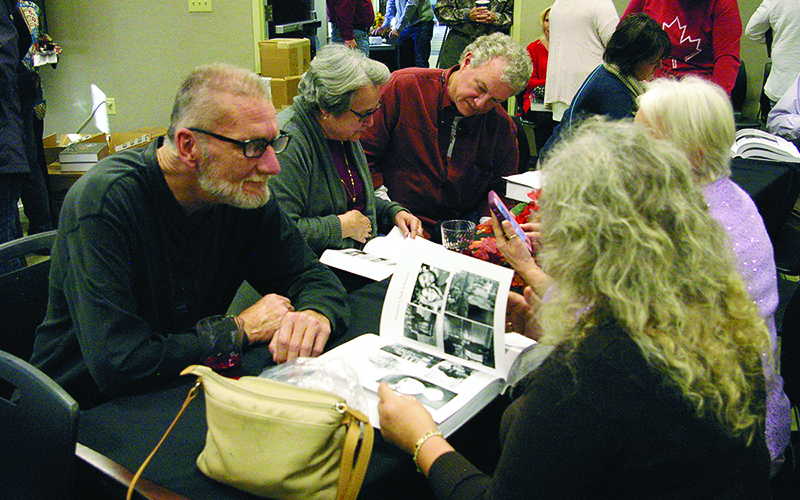
Genealogical society members enthusiastically celebrated the official book release at the library last December.
“To the almost 100 people who came to help us celebrate at our book reveal party, it was awesome to see all of you and see your smiling faces,” said Cochran.
“Milestone” is a fitting one-word summation of the extensively researched and meticulously assembled volume, suggested Titus.
“When people got on board, they could then see our vision. I think that was a problem at the beginning. People would say, ‘Well I know this or that (about my family’s history).’ They might have known their family was in Gilmer County for a really long time, but there was still a lot they did not know until we set up the First Families program and people started looking at their backgrounds,” she added.
“We have a lot of people in the book who came from independent family lines, as well as people who are in more than one or two families. There are people who are going to be surprised when they look in the index and find they are in three other family trees they did not know about.”