
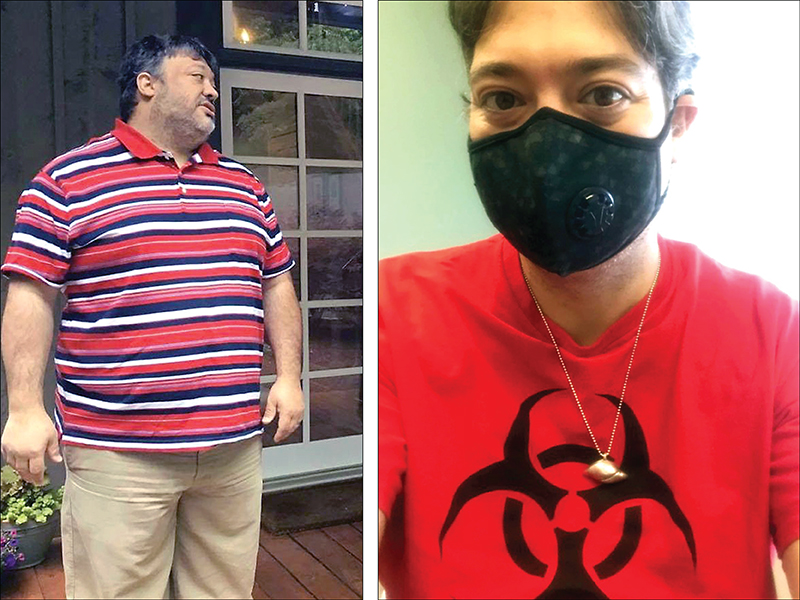
For an Ellijay man who recently received a liver transplant, the difference between last year and now is a 360-degree turn in the right direction.
“Last Father’s Day, I was with my kids and wife, my parents and brother and my grandparents. A picture was snuck of me because people were noticing my deteriorating health. Despite me not wanting pictures, my mom took one in case,” remembered Colton Parker.
It wasn’t long until, Parker, 38, learned he would need a new liver.
“I had been looking yellow for about a year, and I started gaining water weight like crazy. At one point, I was gaining 5-10 pounds per week and I had swelling everywhere. The whites of my eyes were even starting to look yellow,” he explained. “Father’s Day of last year was when I knew it was an issue. The yellowing had started to get worse.”
Serious situation
Although Parker had been diagnosed with fatty liver five years earlier, he didn’t think the condition would one day lead to him needing a transplant.
He described what led to both diagnoses.
“I had a car accident when I was 23 and it shattered a good portion of my bones. I had tons of surgeries. I spent a long time in a wheelchair and learning how to walk again, but it was just more painful. Over time, I became less active and got fatter. They prescribed me all kinds of pain medication and I quickly saw how that could become addictive,” he said.
“I’ve always had insomnia, so I turned to one or two glasses of wine a night to help me sleep (thinking) red wine is supposed to be good for you and a couple of glasses a night isn’t going to hurt. Over time, that plus getting fatter is not good for your liver. Before I gained the water weight, I’d already topped 300-something pounds. That is a major factor with fatty liver.”
Parker said he stopped drinking, but the damage was already done.
“If you get to that state where you’re already yellow and for a long time, you’ve already got a failing liver,” he advised.
After being diagnosed with liver failure, he was referred to Piedmont Atlanta Hospital. The process that followed was a crash course in what first must be achieved before one can even be considered for a liver transplant.
“They told me all the things I was going to have to do, (including) a month’s worth of classes before I could start doing all the other stuff. Then, it would be four to five months to pass all those things. It was over six months before I got to be on the list,” he said. “In order to be put on the list, you have to prove you are serious about this and prove you have financial means or insurance to pay for the (operation).”
Fortunately, Parker was serious about the dire situation, as well as the lifestyle and diet changes needed to turn it around. One of those changes was losing at least 25 pounds in order to be put on the list.
“By the next time I went back (to the doctor), I’d lost 50 pounds and eventually I lost over 100. When I had my transplant, I was about 200 pounds,” he said.
“I increased my activities and was extremely careful with my diet, which was hard because I still had to feed my liver a bunch of protein, but also remain down on calories. I basically lived on a couple of servings of fish, egg whites, protein shakes, a cup of fruit and about two to three cups of vegetables a day. I did that for months and I worked out to the best of my ability. I’m disabled, so the only thing I can do is walk.”
Originally, it looked like Parker’s wife, Heather, would be his transplant donor. However, things worked out differently.
“She had gone through every bit of testing and had been increasing her iron (intake) for a long time so she could give me half her liver,” he said. “It’s the only organ that can grow back. They can take about 60 percent and it not be a problem.”
Parker had been put on a standby list in case a transplant opportunity that fit his body and blood type came along. Suddenly, this past June, the call came.
The liver of a deceased organ donor was scheduled to go to someone else, but it didn’t fit their requirements, Parker said. The next person in line wasn’t able to get there in time, so Parker and his wife rushed to Atlanta hoping for the best.
“You have to have your phone on you all the time and answer every single number. If they call you and just have a question, but you don’t answer, then they have to rethink and say, ‘is this person taking this seriously?’ The organ won’t wait,” he said.
Entering a hospital for surgery during the COVID-19 pandemic was a concern, but the reward outweighed the risks, he confirmed.
“They were putting needles in both my arms and, at the same time, they stuck the COVID test up my nose. I was trying my best not to flinch,” Parker recalled.
The transplant surgery finished June 5, two weeks prior to another memorable Father’s Day for the dad of three. Parker is still undergoing monthly blood tests and adjusting to the antirejection drugs he’ll have to take permanently, but he expects to eventually make only one yearly visit to the hospital for evaluation.
“This year, on Father’s Day, I was freshly transplanted and still recovering. It was my wife and children seeing me and several phone calls, too. We celebrated the fact that I will hopefully see many more Father’s Days and live to see my children grow into the amazing adults I know they will be,” he said.
‘Maybe there’s a reason this happened’
Parker’s family moved from Virginia to Ellijay when he was in the ninth grade, and he graduated from Gilmer High School in 2001. With friend, Cal Crenshaw, he started the Facebook page Ellijay Today as a way to spread stories and positive happenings in the local community.
He’s grateful that several Gilmer residents reached out willing to donate a portion of their liver to him.
“So many people tried to be my donor. I was truly overwhelmed with emotion to see all those people trying to help me,” he said.
“Donations are so important. Usually, only one-third of us that need an organ get one before we pass away.”
The typical wait time for a liver transplant can be up to three years, Parker noted, emphasizing how lucky and appreciative he is to have received one within a year. He reviewed some of the things that helped make that possible.
“You move up in severity (on the transplant list). My numbers were actually pretty good, but I worked hard to impress so many doctors,” he said.
“They also knew I was extremely serious about COVID and had taken tons of precautions. I started taking it very seriously on Valentine’s Day. If people saw me during that time, they would see me wearing a mask.”
Parker noted the importance of Georgia’s organ donor program, which residents can opt into
when renewing their driver’s license, as well as the Georgia Transplant Foundation, a nonprofit that offers various forms of support.
“They can help with lots of things including people who choose to donate,” he said.
“Not only can you get your medical tests done for free, but they will also cover several months of lost income (for people who donate an organ).”
After going through the life-changing experience, Parker now wants to help others going through the same things he was not too long ago. He recently completed a training program offered by the transplant foundation and, soon, will be a certified mentor for others in need of an organ transplant.
“I thought maybe there’s a reason this all happened and now I get to be an advocate. I’ve done the online classes and, as soon as I hit six months (post-transplant), I’ll be able to mentor people. If they’re getting a transplant and have questions or just need to talk things through, they can contact me. I had a mentor, as well,” he said.
Parker also intends to show his appreciation to the family of the late woman who was his organ donor.
“I will be writing a letter to her family soon. You don’t have to do that, but I’m going to,” he said.