
Longtime local physician retired in December
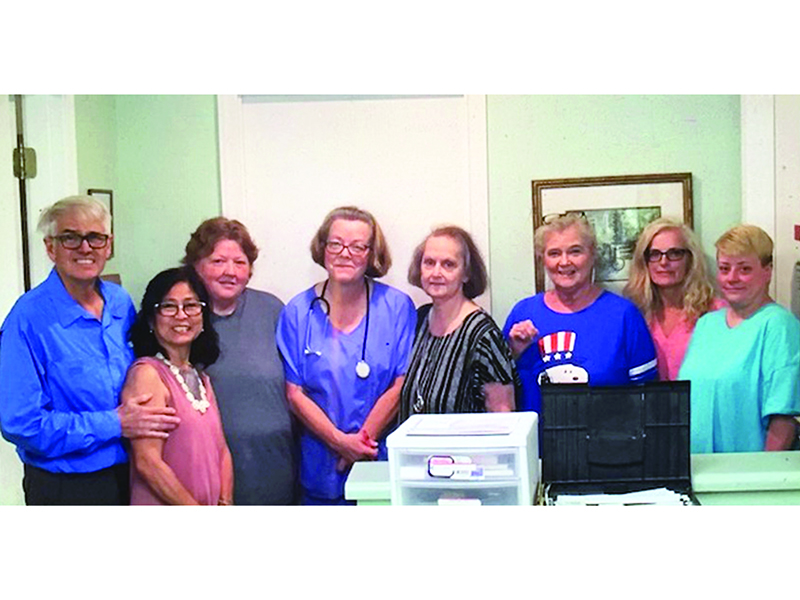
Retiring Ellijay physician Dr. Robert Bond is quick to emphasize the people have been the best part of practicing medicine here the past 39 years.
“I really love the people of Gilmer County. There are wonderful people here. They were kind enough to let me stay and try to help them and that’s a good thing,” said Bond, who closed his practice, Blue Ridge Mountain Internal Medicine, at the end of 2020.
The beautiful mountain scenery didn’t hurt, either.
“I grew up in Cobb County and noticed they were tearing all the trees up there. I was looking for a place where the government owned enough trees that they couldn’t cut them all down,” he said. “(Gilmer County) was on the map and described by the government as an underserved area. I liked the area and was impressed that they had a hospital. I knew that, if the road was going to be improved at some point, this area was going to take off and need more (doctors).”
‘Always knew I was going to be a country doctor’
Bond had already worked in the internal medicine department of Warner Robbins Air Force Base Hospital before settling in Ellijay in 1982. A June 1982 introductory article in the Times-Courier told how that transition happened.
“I’ve always loved the mountains and the statistics revealed that north Georgia needed doctors. When we came through Ellijay, I liked the way it looked and stopped at the real estate agency on the corner and bought a 20-acre plot,” Bond told the newspaper then.
Today, he’s confident that decision was the right one.
“The people I met here on that first trip were so kind and so friendly. They still are. Looking back on it, I was probably being called. I’m not much for cities, and I always knew I was going to be a country doctor,” he said.
Dr. Bond’s office was a fixture on the downtown square for years. He later moved to an office near downtown on Barclay Street where he continued to treat patients as an internist and primary care physician.
“We saw adults and kids, (because) there weren’t any pediatricians, so it was a little bit of everything. (At one time), there were three doctors here for 10,000-11,000 people. There was a surgeon, Dr. E.J. Fernandez, and Dr. Wilbur Schneider, who was a wonderful doctor and wonderful human being. We had other doctors come as (the county grew) and they built the four-lane,” he said.
For years, Bond was an attending physician at Watkins Memorial Hospital, later North Georgia Medical Center, and also its chief of staff for some time.
“I did a lot of emergency room shifts when I first got here. I remember that I didn’t take a day off the first two years and I would not recommend that. There was a need, though, and it was a necessity,” he recalled.
“I was mostly in the intensive care unit working with heart attack victims, respiratory failures and a lot of getting people stabilized and getting them to larger facilities. Dr. Fernandez handled surgery, and Dr. Haymore came for a while and handled deliveries. We had wonderful nurses there, and the nurses in surgery did a wonderful job. We tried to make it a full-service facility.”
After almost closing at different points in the ‘80s, the local hospital remained open and had several good years after that, Bond noted, before finally shutting down in 2016.
“We had orthopedists, urologists and all kinds of specialists. An MRI (would) come up. The people there did a great job and there was a lot of good stuff that would’ve been state of the art for a small town hospital,” he said.
Bond was at the hospital one snowy March evening when the Blizzard of 1993 began. The extreme winter weather may have actually been the most exciting part of that shift, he confided.
“It was actually one of the quietest nights I ever spent in the emergency room. People weren’t getting out much at all then,” he said. “We knew if we didn’t get in, somebody was going to be stuck there sleeping and doing a double shift. Once my relief came, I got somewhere warm.”
Bond noted he was the first physician in the area that spans from Chattanooga and Dalton to Gainesville and Canton to give a clot buster for a heart attack. That procedure involves giving medication through an IV to break up blood clots.
“Those things had to be done quickly. You give something to dissolve the clot acutely,” he said.
“One of the reasons I’ve loved working all this time is that I love medicine. I don’t do a lot of procedures. I like to figure out what’s wrong with people and treat it with medicine, (so they can) avoid surgery or hospitals.”
With 40 years in the field, Bond has seen numerous medical advancements come along. Keeping up with them has been fascinating, he noted.
“All the good cholesterol medicines came along in that time. We had maybe a handful of things for high blood pressure back then. Now there’s dozens,” he said.
“I’ve been doing this long enough that (I can remember) the original CAT Scan was called the EMI Scan because The Beatles’ record company (EMI) invented it. The difference in CAT Scans and ultrasonography (ultrasound) has made diagnoses of really obscure things 100 times easier. There’s so much that can be done for people now, but getting it done for people on the margins was frustrating because there’s a lot of people who can’t get access to some of this stuff.”
‘It hit so suddenly’
Prior to his retirement from practicing medicine, Bond first caught COVID-19, then the flu, he noted. It was becoming difficult to keep the practice running and be available to attend to patients’ needs.
“I was very short of breath, weak and tired. I also had open heart surgery a couple of years ago,” Bond said. “It was certainly not much fun for anybody that it hit so suddenly. I felt decent before then and hadn’t planned on retiring for at least another couple of years. But I really, physically, didn’t have any (other) choice. I didn’t know how quickly I would be able to get back to work and there was just no way to keep it going.”
Bond said he was fortunate to have had so many loyal patients, as well as a top notch nursing and office staff through the years.
“People have told me over the years that they really thought we had the best staff. One of the reasons I wanted to keep working was that I had such a great staff. I would not have been able to do it without them,” he said.