
At Family Connection meeting
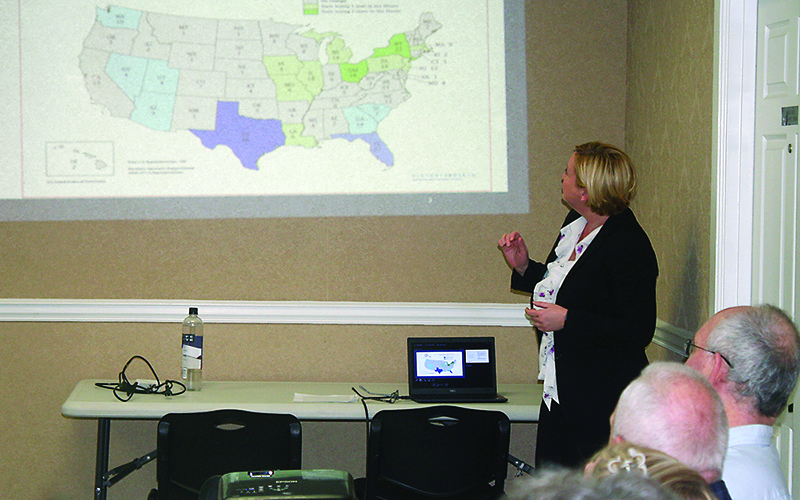
A U.S. Census worker could very well knock on your door sometime this spring or summer, but there are others ways to be counted in the national population survey that will curtail a home visit.
By April 1, most homes will receive an invitation to participate in the 2020 Census in one of three ways — by mail, by phone or online, confirmed Kristen Nespoli, a partnership specialist with the U.S. Census Bureau office in Atlanta who was guest speaker at a recent collaborative meeting presented by Gilmer Family Connection.
“April 1 is Census Day,” Nespoli said about the campaign’s official kickoff date. “Invitations will start going out March 12 (and) 95 percent of households will receive an invitation in the mail asking them to respond (online, by phone or by mail). You can go online and respond through July 31.”
Nespoli gave a rundown of the types of information that census enumerators, also known as census takers, can and cannot request, Nespoli said.
The Census Bureau webpage notes that enumerators should be wearing a valid ID badge with a photo, a U.S. Department of Commerce watermark and an expiration date. They may also carry Census Bureau bags and other equipment displaying the bureau’s logo.
Nespoli said census takers never ask for the following information: Social Security numbers, money or donations and PINs or similar information pertaining to bank accounts, credit cards or other financial accounts.
“They won’t ever ask (you things like), ‘When do you leave for work in the morning or when will you be home in the evening,’” she noted.
The Census Bureau also never sends requests on behalf of a political party, nor does it make initial contact by phone, Nespoli said. Although the survey form does ask for a phone number, census takers won’t usually call before someone has filled out a form.
“The only interaction will be either a paper mailing or an enumerator knocking on your door. After the census, there is a chance we will call for clarification of (submitted) information,” Nespoli confirmed.
Census takers are not allowed to assist participants in answering questions and all Census Bureau employees are sworn for life, by United States Code Title 13, to protect the data they collect, she added.
“It’s a felony if they disclose the information. It’s punishable by a $250 fine or five years imprisonment. They take keeping the information secure very seriously,” Nespoli said.
Impact of census data
The number of U.S. citizens counted in each 10-year census, the next of which will be the 24th since 1790, affects how billions of dollars in federal funds are distributed to individual cities and counties. Census results are also used to draw congressional and state legislative districts and to determine the number of seats each state garners in the U.S. House of Representatives.
“It determines areas that are eligible for housing assistance and other public assistance, education, healthcare and transportation programs. Schools are specifically affected. Medicaid, special education, Title 1 Schools, Meals on Wheels, and Head Start all receive federal funding,” Nespoli said.
Children were the most undercounted of any age group in the 2010 Census, she noted.
“Children under the age of 5 were undercounted by a million in 2010. We don’t want schools having trailers outside their buildings because they just didn’t know these kids were coming. It’s really important that we get a good count,” Nespoli said.
When it comes to determining the size of one’s household for survey purposes, the Census Bureau recommends to include anyone in your household who lives at that address the majority of the time.
“We think (undercounting of children) is happening because people are unaware they need to count foster children or a child who is not biologically theirs, but is living with them. Or they are a grandparent (caring for a child) who spends time between more than one home,” Nespoli said. “For nonparental caregivers, any child residing in their home needs to be included even if they have arrangements (to live in) more than one household. If you have someone in your household on April 1, but they don’t have a normal place where they live and sleep most of the time, count them, too.”
Gilmer has low response area
Nespoli reviewed a low response area from the 2010 Census in Gilmer County where more replies to the upcoming decennial effort are needed.
“The higher the low response score is, the more likely it is we think they won’t respond and we won’t get a strong response from that area,” she said.
That local low response area, Census Tract 803, is “smack dab in the middle of the county,” Nespoli noted.
“It encapsulates Ellijay and East Ellijay. (These areas are) defined a lot by natural boundaries like rivers,” she explained. “To the north is Kell’s Creek and the Ellijay River. To the east is Ray Mountain, then it leads to Turniptown Road. Down toward the bottom is the Cartecay River and John Call Road. It goes up to Talona Mountain Road and follows Old Highway 5, then jumps off to the left along Legion Road and Pleasant Grove, then connects again to Kell’s Creek. Another big problem is 34 percent don’t have internet access (in this area).”
Census takers will begin knocking on doors across the country in May to count persons who haven’t already responded online, by mail or by phone. The door-to-door visits are expected to last through July.
The Census Bureau is still signing up enumerators to conduct those visits in Gilmer County. Census takers are paid hourly and work in their county of residence, said Nespoli.
More details can be found online at 2020Census.gov.