
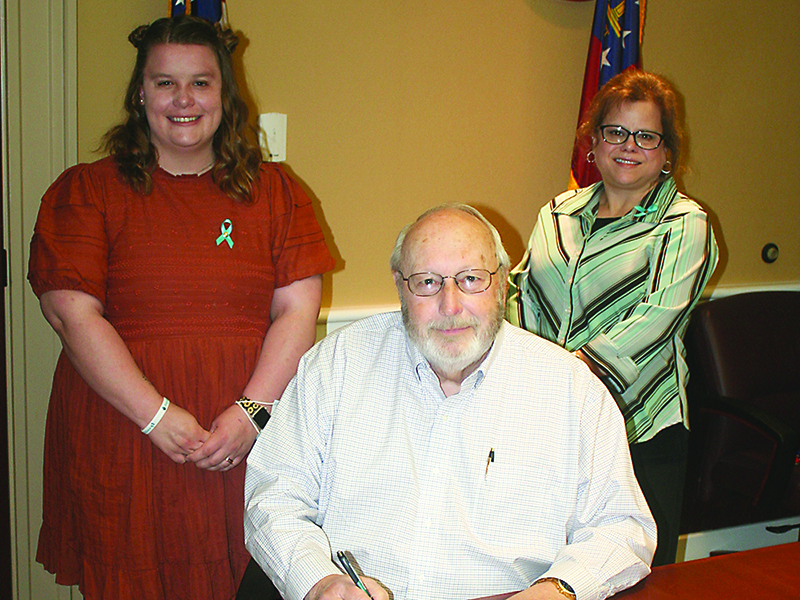
During a time when increased sexual and domestic violence cases continue to be seen, the North Georgia Mountain Crisis Network (NGMCN) wants residents of Gilmer, Pickens and Fannin counties to be aware of the services it offers to victims of these crimes.
April is recognized as Sexual Assault Awareness Month nationwide. Gilmer County Commission Chairman Charlie Paris signed a proclamation last week that designates the special awareness month countywide. The proclamation urges all citizens to observe Sexual Assault Awareness Month by becoming aware of the reality and tragedy of sexual assault, as well as supporting NGMCN in its efforts to end sexual violence and exploitation.
Kimberly O’Neal, the nonprofit crisis network’s executive director, said similar proclamations have also been signed in Pickens and Fannin, the other two Appalachian Judicial Circuit counties served by NGMCN.
“Sexual assault can be defined as conduct of a sexual nature which is nonconsensual and is accomplished through threat, coercion, exploitation, deceit, force, physical or mental incapacitation and/or power of authority,” O’Neal said, referencing a recent Department of Criminal Justice Services report.
“Research indicates that an American is sexually assaulted every 73 seconds. According to the National Intimate Partner and Sexual Violence Survey, about one-third of women and approximately one-fourth of men will have unwanted sexual contact at some point in their lives,” she added.
The Blue Ridge-based crisis network provides a variety of outreach services to those affected by sexual or domestic abuse.
“Sometimes people are not ready to get out of a domestic violence situation, so we offer (services like) counseling or financial assistance, whatever the need is. Maybe (they need) transportation assistance if the abuser is withholding their ability to go anywhere,” O’Neal said.
A crisis help line -— 1-800-33-HAVEN (42836) — is available 24 hours a day, and an emergency shelter for victims of sexual and domestic abuse is operated in Fannin.
“We have an advocate at our emergency shelter 24/7. Part of their responsibility is to answer that hotline. Both the state hotline and the national domestic violence lines come into our hotline. The hotlines pick up where the person is located. If they are located in Georgia, they are routed to the nearest center that’s able to serve them,” O’Neal said.
Since the COVID-19 pandemic began, the crisis network has seen an increase in the number of sexual and domestic violence cases with which it has assisted.
“We probably have, on average, 300 calls per month. We were averaging around 225 per month (before the pandemic), so it has increased,” O’Neal said. “We have a detective on our board, and he has told me to expect to keep seeing an increase.”
O’Neal said there are multiple ways that the crisis network can become involved with an assault case. It’s often through police, she noted.
“If we have a victim at our hospitals (or) law enforcement is called out, they will call us and let us know. They also give the information (about us) to victims. We do temporary protective orders, so when people go to the Clerk of Court’s office to get the paperwork, they will point them to our agency so we can assist them with that if they qualify under our criteria,” she explained.
Usually, crisis network staff would conduct a broader range of programs during April including a 5K color run fundraiser and visiting area high schools in observance of Sexual Assault Awareness Month and Denim Day.
Denim Day is a public awareness campaign that began after a ruling by the Italian Supreme Court where a rape conviction was overturned because justices felt the victim wearing tight jeans contributed to her consent. The next day, women in the Italian Parliament came to work wearing jeans in support of that victim.
“We take a pair of jeans (to schools) and the kids sign them during their lunch break. We keep it very age-appropriate and talk to them about consent,” O’Neal said.
That in-person program and the 5K fundraiser are both on hold this year due to the pandemic, but an online auction will be conducted. Proceeds will go to help NGMCN re-establish its forensic medical exam program.
Through that program, sexual assault victims will be able to receive an onsite forensic medical exam from a specially trained sexual assault nurse examiner (or SANE). The service was previously available in Gilmer, but was discontinued after the nonprofit’s office moved to Fannin.
“We are working to re-establish that program, (in which) we have a secure facility where people can have a forensic medical exam for sexual assault. It (would be) set up like a hospital room and is private and secure,” O’Neal said. “We are having the online auction April 26-30. We will have an event up on our Facebook page, as well as our website, and they will be able to click on the auction link and bid,” she added.
Even if a sexual assault victim is beyond the time period for a forensic medical exam or chooses not to report the abuse to law enforcement, the crisis network can still help, O’Neal noted. Its services are confidential, free of charge and available to all victims of sexual violence.