
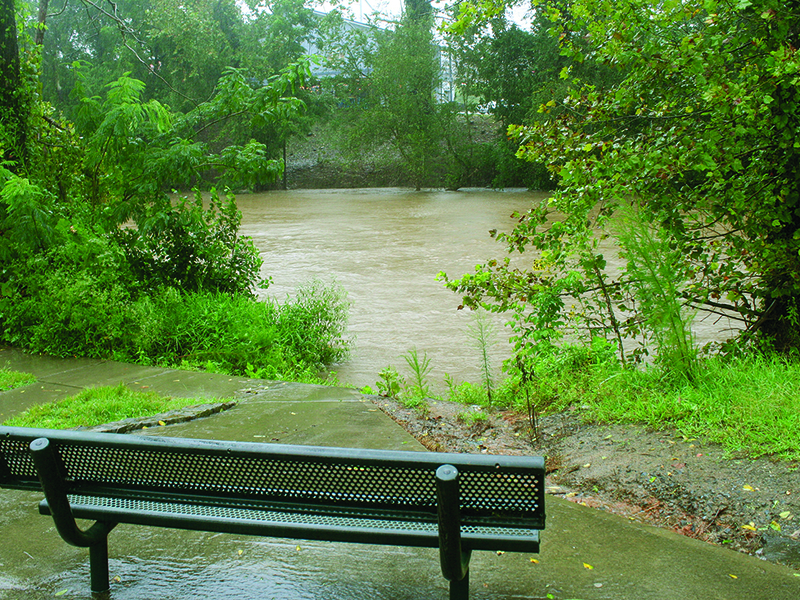
Gilmer County experienced little damage to roads and only a small amount of flooding as storms from Hurricane Ida brought days of heavy rain last week.
Hurricanes and tropical storms have long been cause for local emergency response and road department crews to prepare for the type of widespread flooding and damage the county has received from other storms, particularly Hurricane Ivan in 2004.
Fortunately, the storm impact was minor this time around, unlike when Hurricane Zeta came through last fall or when severe storms caused widespread damage in March, noted Public Works Director Jim Smith.
“All in all, it was just trees down and a few pipes. We dodged a bullet,” Smith said. “Comparatively speaking, with some of the other disasters, it was minor compared to those. (We had) stuff like a few pipes washed out (on) Big Creek Road and Corsair Circle. Big Creek is a big pipe, and that road (was) actually closed at the connector portion to Fannin County.”
Smith noted that, just last week, the county received a FEMA reimbursement check for damage from those late March storms, which caused repairs in excess of $200,000 mainly to roads and culverts across the county.
“We get reimbursed 85 percent, (which was) about $120,000,” Smith said.
Aside from downed trees and power lines, Gilmer Fire and Rescue didn’t receive many calls during last week’s storms, confirmed EMA Director Keith Kucera.
A tree down along Old Highway 5 did cause a section of that road to be shut down for some time, noted EMS Chief Russell Brown.
“Other than a few trees down here and there, we didn’t have much at all. We fared pretty well,” Kucera said.
On the heels of a summer in which weather conditions alternated between extended dry spells and bouts of heavy rain, 5.11 inches of rainfall was recorded in Ellijay for Aug. 30-31, according to the UGA Environmental Monitoring Network. Last year, 6.1 inches of rainfall was measured for the entire month of August.
Last week’s plentiful rain did cause local rivers to rise quickly, but serious flooding did not occur, noted Al Cash, of Gilmer Fire and Rescue.
Cash said USGS (U.S. Geological Survey) numbers show the Coosawattee rose from 2.32 feet at 8 a.m. on Tuesday to 8.97 feet at 1 a.m. on Wednesday, a six-and-a half-foot rise in just 17 hours.
“Even as a result of that, we had little or no damage reported to our department. Some low-lying areas were flooded, but the waters receded quickly not even leaving behind any significant debris,” he added.