
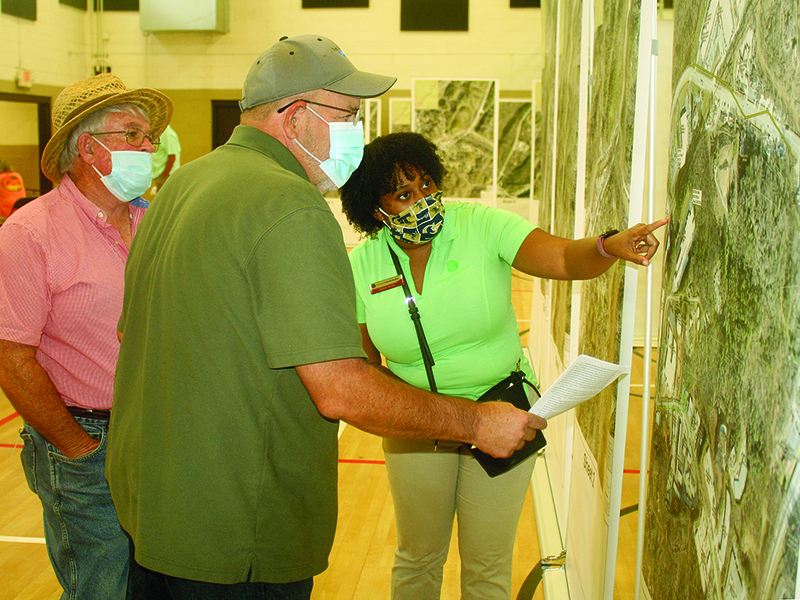
A total of 75 people attended two public open house meetings held last week to address a subtransmission power line now routed to run along Highway 515.
At the meetings held by Georgia Transmission Corporation (GTC), attendees were able to pose questions to GTC representatives while viewing large-scale panel maps of the proposed Whitepath Electric Reliability Project route and the property it will affect.
“These meetings provide (the public’s) input, questions and concerns. If we can make adjustments we will,” said Terry Cole, GTC public affairs director. “Somebody may say, ‘I prefer not to have that pole right in front of my kitchen window, can you move it 10 feet over?’ If we can do that, we certainly will.”
Although most of the almost 11-mile proposed route runs along the four-lane highway, it starts with an existing line and substation on Industrial Boulevard, then follows that road until running behind the Food Lion store to reach Highway 515. The route ends at a new substation planned to be built near the intersection of Lucius Road and Cherry Log Street
While looking at the project route maps, Dewell Sanford and Terry Hensley, owners of Twin City Motors, said it looks like the line will pass by their business on Industrial Boulevard.
“What we were here for was to see if they had proposed a pole on our two lots,” said Sanford.
Jeff Young, an engineering consultant for GTC, said most of the feedback he heard at Tuesday’s first open house involved people preferring the line sand poles go on someone else’s property, not their own.
“That’s a common occurrence,” he said. “I’m here representing engineering and the technical aspects of the line. Honestly, most people don’t care about that other than how big the poles are going to be.”
Roughly 10 poles per mile are typically used for this type of project, but that could vary, Young added.
Redden Randell, who owns property along the proposed route, hopes natural scenery along the four-lane is not changed too much by the power line going up.
“The 515 corridor is traveled by thousands of tourists and guests,” he said. “I know they wanted to keep that corridor clear and with scenic views. These large power lines are just going to add to the blight.”
James Thomas, who owns several parcels along the route, expressed similar concerns.
“What we’re worried about, I think more than anything, is maintaining the natural beauty of the highway. It’s one of the most beautiful places you can drive through. I’d say one of the biggest concerns is making 100 foot right of ways and not having the trees anymore,” he said. “One of the things the community needs to come together on is maybe camouflaging the poles. They have ways to do that.”
Cole said Highway 515 was the route originally proposed for this power line, but issues with the Georgia Department of Transportation (GDOT) caused the project to move to Boardtown Road.
The route reverted back to the four lane after abundant feedback and concerns were given by Boardtown residents who opposed the power line going there.
“We held public meetings (for the Boardtown route) and got lots of input. We went back to GDOT at the community’s request and were able to get some accommodations (made). Now this is the route that we’re at,” Cole said.
Many have asked why another proposed alternate route, the more isolated old L&N/CSX railroad corridor, wasn’t chosen. Cole said there are a few reasons why that won’t work.
“I know a lot of people would like to see it go there,” she added. “One of the challenges with the railroad is we would have to construct a whole bunch of new access roads because we have to maintain the line once it’s there.”
Chris Smith, GTC environmental manager, said the railroad is a historic resource, and there are issues with the location’s rough terrain that would limit construction.
“It limits the opportunity we have to get in there and construct our line, whereas a road or highway would aid or help with construction access. You can’t drive cranes or heavy equipment down the railroad,” he added.
When asked if enough public opposition to the current plans could cause the route to change again, Cole said GTC always listens to the feedback it gets, but the line has to go somewhere.
“There’s a tremendous need in Gilmer County. It’s a growing community, and this project is to address current and future needs. We feel like 515, since it’s an existing corridor, makes sense to be our route,” she added.
Craig Heighton, GTC external affairs director, said Gilmer County is at the end of the company’s service territory.
“Everything north of here, folks get their transmission from the TVA. We’re at the end of the line, if you will, and for years there have been electricity reliability issues in this area,” he added.
Heighton said an integrated transmission system will allow the subtransmission line and substations to be used by both Amicalola Electric and Georgia Power.
The 45-kv subtransmission line will not connect to a larger voltage 230-kv transmission line that runs along Highway 282 toward Carters Lake, he added.
“They are two completely separate projects and two completely separate voltages. This is considered subtransmission and is a much smaller line,” Heighton said.