

As spring fades into summer, the Beekeepers of Gilmer County are busy -—- although perhaps not quite as active as the well-populated hives they tend.
“This is when it kicks into gear. The last couple of months have actually been pretty busy,” confirmed Lloyd Vautrot, president of the local beekeeping club.
Helping to save the honeybee
The primary objective of the Gilmer Beekeepers is to educate the public about honeybees and their crucial roles as carriers of pollen that fertilizes plants and crops.
“Without pollinators, we’d be in bad shape,” said Vautrot. “There are a whole bunch of species of bees that are important for pollination, not just the honeybee. I’ve found that people are pretty knowledgeable about the fact that bees are in danger and how we need them for pollinating and our food supply.”
While many members also keep their own hives, the beekeeper club’s apiary just off Howard Simmons Road is a group endeavor that requires year-round attention and input from several individuals.
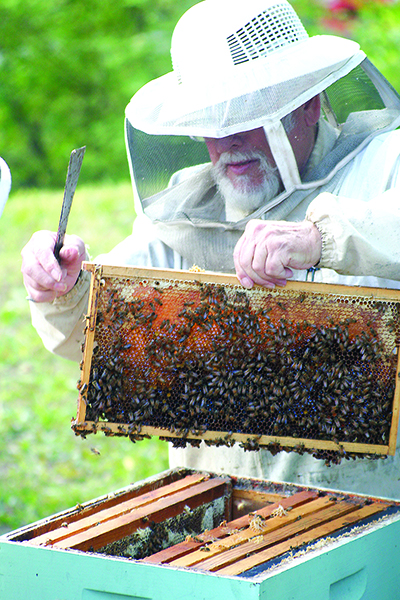
Visiting the apiary site in spring or summer will prove there’s truth to the old expression “busy as a bee.” While throngs of honeybees buzz in and out, club members check the hives and observe the thousands of tiny residents hard at work.
“A large number of the bees are still out and foraging right now, so now’s a good time to do it. A little bit later, you’ll have so many bees in there,” said Vautrot on an early Monday evening when hives were being inspected at the apiary.
Longtime Gilmer Beekeeper Steve Towe said a good, mature honeybee colony should have roughly 50,000-60,000 in it by this time of year.
Six multibox hives are kept at the apiary on the Simmons Farm property, and each one is a separate colony, Towe noted. A fair estimate of the total number of honeybees kept this time of year ranges in the hundreds of thousands.
“Some (bees) are stronger than others because they’re not all at the same stage. You just have to estimate the total number, but, if you have 10 frames in each box and 1,000 bees on each frame, that’s 10,000 bees in that box. That’s (not counting) the ones that are coming and going,” Towe said.
As flowers and trees start blooming in spring, the bees constantly forage for nectar to make honey, a process that continues through summer.
“They only make honey from plants that bloom. They’re collecting a lot of nectar right now, and honey is just nectar that’s been dried down to a point that it will store effectively. In June, you can usually start pulling honey off to harvest,” Towe said.
“We monitor how much (honey) they’re putting in there. When they get the combs full and cap them with wax they make, it can be removed and harvested. We like to educate people on harvesting honey and how to handle it when you get it out of the hive.”
Poplars are in bloom right now, and a lot of nectar for honey will be harvested from those trees, Towe noted.
“Your spring honey is usually a mix of wildflower honeys and maybe blackberry nectar if there’s enough in the area. In this part of the country, sourwood honey is what most people like to have. It blooms in late June and July,” he added.
Honeybees are loyal to their nectar sources, and that loyalty is reflected in the honey they produce, Towe said.
“Whatever plants they’ve visited contributes to the taste, aroma and color of the honey,” he explained. “They’re unique in that they exhibit what’s called floral fidelity. A lot of bees will go from flower to flower, but not honeybees. If they’re visiting one type of bloom, thats all they visit. If they’re working blackberry, they’ll just keep working blackberry.”
Harvesting and selling honey is both a good activity for the club and good publicity for the bees that produce it, Vautrot noted. It’s usually sold at various places around the county if enough is made for that purpose.
“We’ve sold a bunch of it at Hillcrest (Orchards), and we’d been selling it at the farmers market when it was functioning pretty good. The idea isn’t to make money on it, but to spread the word about bees,” Vautrot said.
The beekeepers normally convene at the apiary prior to their monthly meetings. There, a routine task like scraping and removing burr comb (hardened nectar or pollen deposited by bees to plug up open space in a hive) can give novice beekeepers or anyone interested in taking up the pastime a first-hand look at what goes into it.
“It’s an educational resource that introduces people to beekeeping. Hopefully, they’ll become more interested,” Towe said.
It’s all part of the club’s mission — helping to save the honeybee.
“Most people have never seen the inside of a bee hive, so this is an opportunity to show them. If they do get involved, we’ll show them more. We have extra veils and protective gear there, and we highly encourage people to wear the protective gear because we don’t want anybody getting hurt,” Towe said.
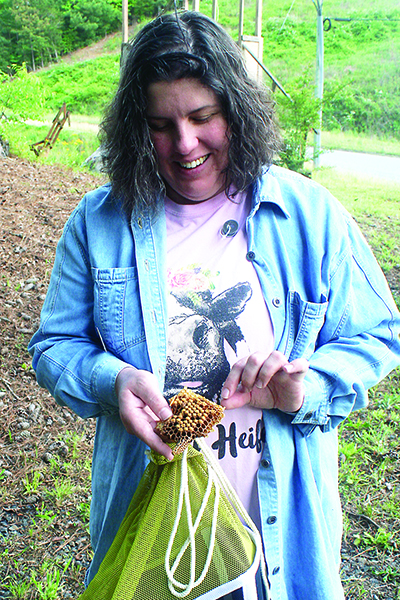
While conducting a recent hive inspection, Towe and club member Robert Gifford gave rookie beekeeper Katy Wood tips on removing, inspecting and maintaining a hive’s individual frames.
“What we’re looking for is the overall health of the colony to see if there’s anything we need to be aware of. If we have some new people, it introduces them to what to look for as far as how the colony is developing,” Towe said.
Wood just started dabbling in beekeeping, and she came to the apiary session to learn more. For her participation, she left with a queen cell — a section of the hive where larva develop and mature into new queen bees.
Despite the persistent swarming going on around them, the beekeepers remain cool and calm while inspecting and observing. That’s a must when dealing with honeybees, Towe noted.
“You have to be calm with them. They’re moody and you’ve just got to be aware of that,” he said. ‘They’re not aggressive, but they are defensive of their hives and the area around them.”
Although honeybees are generally calm unless agitated, getting stung is just part of the process, Towe shared.
“You’re going to get stung. That’s a given,” he said. “We have to be cautious about that because some people can have severe systemic reactions (from stings).”
The beekeepers can minimize their chances of getting stung by using a handheld smoker in which wood chips or other material is lit to produce a cool smoke. That smoke masks pheromones that tell agitated bees to sting, Towe noted.
“If it’s cloudy or stormy, they’re more defensive and agitated, so that’s not a good day to be working with them. If the sun’s shining and there’s plenty of nectar and bees are coming and going, they’re real easy to work with,” he added.
Back to meeting in person
Towe said the county extension service’s Gilmer Master Gardeners were instrumental in forming the local beekeeping club in 2014. The club’s membership has revolved through the years, but several Master Gardeners still remain members.
Towe first got involved with beekeeping after a career in phone and data system installation took him across the country for work. An Ellijay native, he decided to follow through on a hobby aspiration he’d long had by purchasing beekeeping equipment from Dale’s Variety Store, the Boardtown Road business run for years by beekeeper J.T. Dale. The interest stuck and it just grew from there, Towe said.
There’s always something to learn about bees and how they work, he noted.
“I always tell people that, to be a good beekeeper, you have to be a little bit of an entomologist, a little bit of a botanist and a little bit of a chemist. All that is involved in understanding what they’re doing and why they’re doing it,” Towe added.
Although apiary maintenance has continued through the COVID-19 pandemic, the Gilmer Beekeepers only recently started back meeting in person following months of Zoom meetings.
The in-person meetings include a mix of club business, speaker presentations and activities for beekeepers. In June, the club will return to meeting at the Gilmer Civic Center the second Monday of each month. Meetings start at 7 p.m., and an educational session at the apiary precedes each meeting at 5 p.m.
“Hopefully, with every meeting, we’ll pick up a few (new members). We have close to 30 right now,” Vautrot said.
Information gleaned from the club can be useful not just for new beekeepers, but for anyone wanting to know more about the fascinating insects.
“Education is the way to do it. People learn things like not to spray all kinds of stuff around. Most yards right now have these buttercups all over the place. Bees will forage on that, but not when people cut them down or herbicide them,” Vautrot said.
Some club members have also been known to do bee removal, Vautrot noted.
“If somebody gets a swarm in their house and wants it out without killing the bees, we have a group (for that). We can send somebody over to get it out,” he said.