
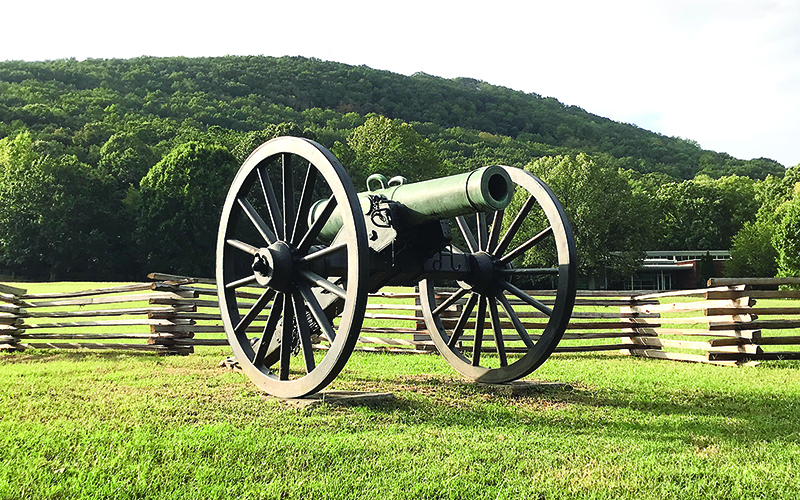
Ever wanted to know more about what’s inside a cannon artillery shell?
If so, there will be a good opportunity to learn just that when the Gilmer County Historical Society resumes its educational lecture series this weekend.
The first installment of this year’s recurring series of presentations will be held at the Gilmer County Library Saturday, Jan. 18, at 2 p.m.
Wayne Hooper, the historical society’s vice president, will discuss how shells fired by cannons or “field guns” were used during the Civil War, as well as what made them such a destructive means of defense for both Union and Confederate troops.
“In the Civil War, they cast a round ball and put the shrapnel inside a matrix of sawdust or sulfur that held it. They drove a hole down inside where they put a little bursting charge of black powder. They screwed a fuse in top of that, which was a timed fuse that could be set to when you wanted the shell to burst in the air,” Hooper explained.
The talk will focus on field artillery weapons and ammunition used at the June 1864 Battle of Kennesaw Mountain. In the prelude to the following month’s Battle of Atlanta, the Confederate Army of Tennessee led by Gen. Joseph E. Johnston attempted to overtake advancing Union troops led by Gen. William T. Sherman.
“There are literally hundreds of types and variations of artillery shells that were made during the Civil War. There have been whole books written on it. The ones that Sherman and Johnson were shooting were typically 10-20 pounds in weight. The choice of shell was dictated by the type of target,” Hooper noted.
Jim Scarr, a Marietta collector of Civil War-era projectiles, will attend the lecture to present a display of inert artillery “half-shells” that have been cut open to reveal their inner contents.
“Jim is a collector and dealer of artillery shells with an engineering background. He has the ability to deactivate and cut these shells in half,” said Hooper.
“We have had them on display for about two months at the (Tabor House) Historical Society Museum, which is closed till March. We will be bringing the display to the library for (everyone who attends this event) to see. These are shells that have been collected from all over the country. There are laws that say you can’t do anything at Kennesaw Mountain, as far as (artifact) collecting.”
Shell dissection is a specialized and potentially dangerous process that should not be attempted by novices, Hooper noted. Despite being an outdated form of defense, the shells can still detonate if mishandled.
“Just because it hasn’t exploded doesn’t mean it’s not still dangerous. Part and parcel to this whole talk is that amateurs should not try to open up one of these shells,” he emphasized.
“People who are in to Civil War relic collecting have shows where they buy, sell and trade these kinds of things. The half-shells tend to sell for more than the undivided shells because it’s technically very difficult to do that. You have to have the right machinery to do it. If you or I tried to do that, we’d probably kill ourselves.”
The historical society’s library lectures will take a break in February, then resume in March. They are all free to attend and open to the public.
“(This one) will have a slide show segment, then a question and answer portion on the inert display of shells. If you have an interest in Civil War history, you will find this educational,” Hooper said.