
After serving in the U.S. Army in the 1970s, Dozier Watkins “lived on the wrong side of the law for many years” by abusing methamphetamine, cocaine and marijuana.
“I got in trouble in the 1980s, but stayed under the radar (of law enforcement) until 2015,” he said of an arrest and probation. “I figured out the time frame where I could use drugs and still pass the next (drug) test … but I failed the test.”
Watkins had been sitting in jail when the late Ron Gravett, case manager for Veterans Court of the Appalachian Judicial Circuit covering Gilmer, Fannin and Pickens counties, paid him a visit.
“He talked to me and offered me the Veterans Court program, and I accepted it,” he said. “I knew it was God’s will that I do it, and that it was time for me to turn this around.”
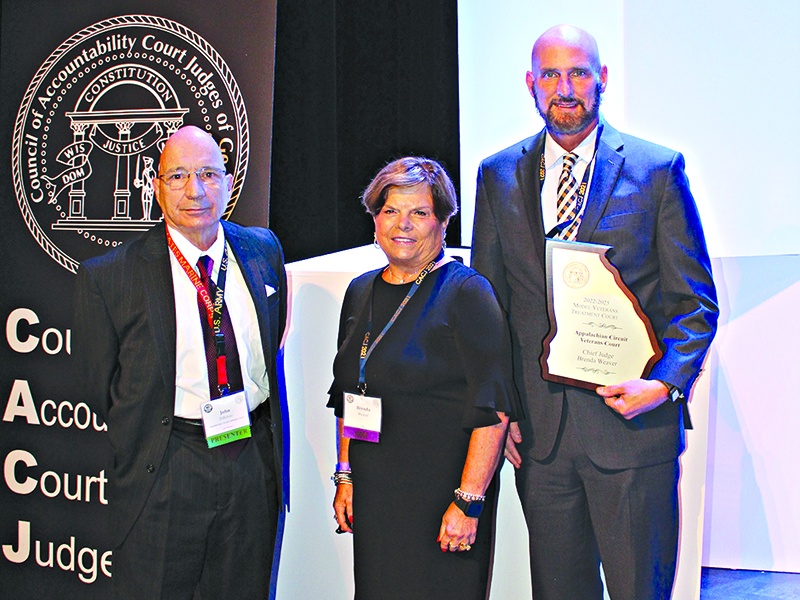
Veterans Court, one of the “accountability courts” under the Appalachian circuit’s auspices that gives offenders a chance to break their cycle of drug dependency and avoid further incarceration, is evidently a flagship program around the state. Two weeks ago, the area Veterans Court was presented “Model Court” status by the Council of Accountability Court Judges (CACJ), which oversees the drug courts in Georgia for veterans as well as some others charged with felonies.
Chris Holt, coordinator of accountability courts in the judicial circuit, noted the three-county Veterans Court is “one of only three in the whole state that was awarded (as) a model court.”
“What that means is we meet or exceed the standards set forth by the CACJ, and serve as a resource for other Veterans Courts,” he said. “Model court designation is for three years, until 2024. We just found out about it recently. Judge (Brenda) Weaver wanted to make sure that the Drug Court program and the Mental Health Court program have also been awarded those designations, and it was two years ago for Drug Court and last year for Mental Health Court. This year is the very first year they’ve ever awarded any model courts for the Veterans Court program.”
Senior Judge Weaver said two years ago, the CACJ decided certain accountability courts needed to be recognized as being quality courts, and that other judges who wanted to start courts — such as felony Drug Court, Mental Health Court or felony Drug Court — would be able to get assistance for starting programs from the model courts.
“We’ve been very lucky in our circuit,” she said. “We were one of the first felony Drug Courts to be recognized as a model court, and then our Mental Health Court was recognized as a model court, and this year our Veterans Court is a model court … we need more Veteran Courts in Georgia.”
Weaver was asked if the Appalachian circuit has been serving as a “flagship” program.
“I think we have, but it’s certainly not because of me,” she said. “We have just wonderful staffs who work in all of our accountability courts. They believe in what they’re doing, they work very hard, and they’re basically on duty 24 hours a day, seven days a week. Because we don’t know when someone is going to have a crisis and we need to intervene. We’re very lucky to have what I consider to be the best staff in Georgia.”
Jody Merrill, a graduate of Veterans Court, has become a mentor in the program. An Air Force vet for 20 years, Merrill was in “stressful situations” as a fuel system technician with the legendary Thunderbirds flying unit. Later, he worked in a “black job” that required top-secret clearance. He turned to alcohol to relieve the mental tension.
Without Veterans Court, Merrill said, “I don’t know what would have happened. I’m adamant about what I’m doing now.”
Watkins actually called his arrest in Pickens County “a godsend.”
“I finally realized it was God’s will for me to accept this Veterans Court,” he said. “It’s a great program if you’re desiring to accomplish it. They provide you with different tools — AA, NA, the Twelve Steps and such as that — but my recovery is more faith-based. Veterans Court got me sober, and Jesus keeps me sober.”
Watkins called Holt “one honest person.”
“If he tells you he’s going to do something, he’ll do it,” he said. “So I trusted him, and told Judge Weaver I would do it to the best of my ability, and I have. I’ve accomplished everything they’ve set before me, and done it with a smile and tried to help other people not be discouraged, whether it be a setback or the toughness of the schedule … I have no desire to go back to that lifestyle.”
To John Di Renzo, an Army veteran and the current case manager who was persuaded by his friend Gravett to follow him in the position, the award is “an honor.”
“We do peer reviews across the state,” he said of one aspect of the work undertaken by Holt and himself. “We’ve been instrumental in helping some folks get their programs off the ground, (tell them) how to improve them and what we do to be successful. We’re always available and want to help other folks with their veterans.”
Di Renzo said Veterans Court work is “very rewarding.”
“In a program like this, you’re not going to have a 100 percent success rate,” he pointed out. “No one ever does — in anything. But we’ve done things like help them get VA benefits, help write a resume, get a job, do budgets (using) Excel, things like that.”
However, it’s the pulling together of participating vets in the program during COVID-19 that has impressed him greatly.
“The veterans have appeared to come a lot closer together — they jumped in there and started helping each other,” he said. “We made a conscious effort to pull them back into their military roots, so to speak, and we talked to them about that culture and our core values … we work them pretty hard on that, and they’ve turned into a pretty loyal and tight group with each other. So that’s worked out real well.”
Judge John Worcester is over Mental Health Court, and Judge Weaver manages felony Drug Court and felony Veterans Court. The two-year court programs use accountability and serve as a potential diversion resource to keep participants from going to prison for committing felony drug violations.