
The tens of thousands who attend and spend at the Georgia Apple Festival aren’t the only important numbers related to the banner annual event.
Keeping the festival going each day means more than 250 vendor booths spread out over 100,000-plus square feet of ground that’s maintained by up to 50 volunteers from event sponsors the Ellijay Lions Club and Gilmer Chamber.
“We have a board of directors for the Apple Festival that’s set up with half Lions Club and half Gilmer Chamber (personnel). We meet almost all year-round to prepare and members of both (organizations) volunteer to work the festival,” said Martin Titus, Ellijay Lions Club president.
Resembles a small village
Physical setup of the sprawling fall fest, which began in 1972 as a small arts and crafts fair on Ellijay’s downtown square, is no small feat.
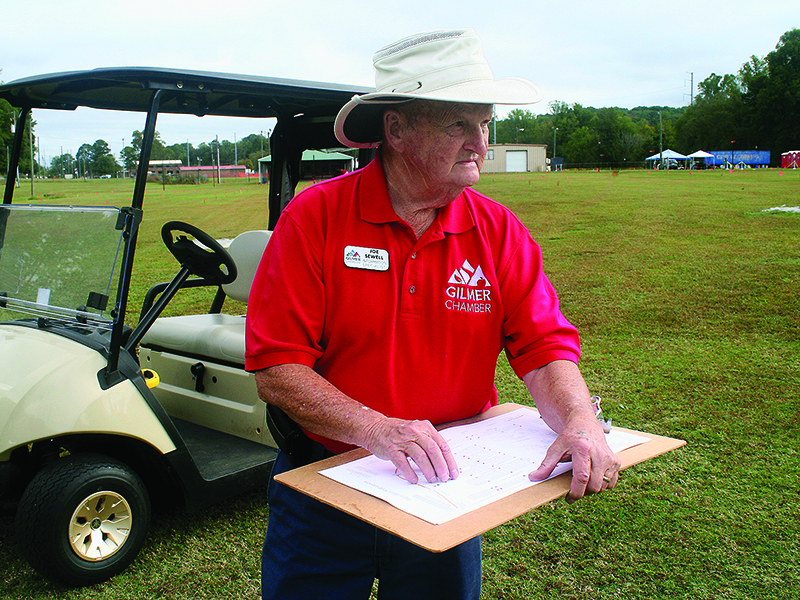
Joe Sewell, information specialist at the Gilmer Chamber, begins physically staking out vendor spaces 7-10 days prior to the opening festival weekend.
First, he must locate steel pins that are wedged beneath the dirt. Then booth spaces can be flagged and staked for vendors soon to arrive.
“I find the first pin and go from there. I have to dig down to find some of them and we mark them with (red paint). It takes a while to do it all. The guys from Isaiah House come in to help and it takes us most of the day to get the orange flags, the number stakes and the street signs up. Then we start putting the big signs up around the fence,” noted Sewell.
“There’s 105 booths in this one section alone,” he said while pointing to a row of vendor spaces on a map that shows the planned festival layout.
Street signs that reflect such apple-specific names as Winesap Way, Red Delicious Drive and Rome Beauty Boulevard also go in the ground prior to the festival kicking off.
“They’re about 10 feet tall. We use a ladder and hammer them into (a frame in the ground),” Sewell said.
The highly visible signs aren’t just for decoration, though they do provide sufficient opportunity for photo ops. Their main purpose is to help festivalgoers, vendors and volunteers find their way around the bustling event.
“Having the street signs going up makes a lot of difference every year in finding out where you’re going and (in the event that) somebody gets lost. We’ve had lost children, for example. Last year, we had a lost adult. We were able to communicate with each other with our radios to find the lost people,” Sewell said.
“Having those radios makes a lot of difference, too,” he continued. “The EMTs have them, so do the people who are at the gates and doing security. Last year, I was on a golf cart and came up on a medical emergency. I used my radio to get in touch with the EMTs and they were right there on top of it in less than five minutes.”
Before the fairgrounds begin to resemble the outlay of a small village, Lions Club members conduct maintenance around the grounds and fill volunteer slots for the big event.
“We do a lot of setup getting ready for the festival physically. Last night, we had a Lions Club meeting where we were setting up tents, weed-eating, filling in holes from the fair and generally getting the grounds ready, which is our responsibility,” Titus said last week.
Obstacles posed by weather and the generally busy festival atmosphere vary from year to year. No matter the climate or paid attendance, there are always a lot of logistics involved, Titus confirmed.
“(We have to consider things like) who’s picking up trash, who’s clearing off tables and how many times the port-a-potties need to be emptied,” he said.
“There’s four gates. Between us and the chamber, we take money and do admission at each gate. We have someone stamping hands for people going out. There are several places to eat and we help keep the tables clean. We love talking to people while we’re there, seeing where they’re from and trying to give them some warm hospitality.”
For the Ellijay Lions, preparing and selling plates of home cooking has long been a cornerstone of each year’s festival.
“The Lions have a kitchen where we sell food like hot dogs and hamburgers. Outside of there, we have our country kitchen with different food like fried chicken. Right across from that, we have a tent where cold drinks are sold. All those are fundraisers for the club,” Titus said.
‘Always trying to do better’
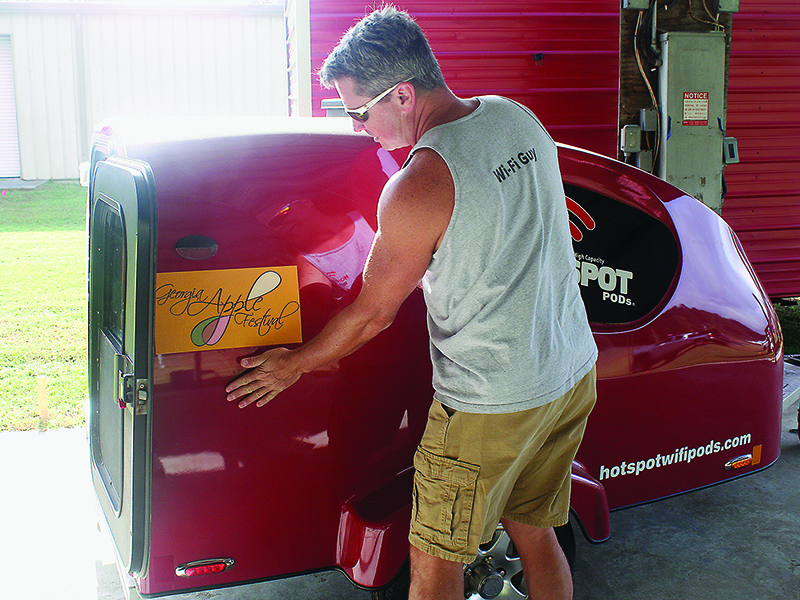
As festival staples like refreshment stands and trash dumpsters began arriving last week, so did a first-time event feature — a mobile Wi-Fi hub for vendors that will aid in the processing of credit cards and other forms of payment.
Brian Baker, of Hot Spot Wi-Fi Pods, said the company provides the mobile hotspots to events across the country. He’d just wrapped up at this year’s Suwanee Fest about two hours away before towing one of the bright red pod trailers to Ellijay. “This year, for all the vendors who spend money to be there, we have Wi-Fi for them so they can do Apple Pay and stuff like that, which is huge,” said Titus.
“We invested in that to help them with their businesses, because that helps us grow our vendor base. If we have enough bandwidth, we may (consider) a Wi-Fi hub for festival attendees in the future. Right now, it will be password protected because it is just for the vendors.”
Titus said another recent festival improvement is a color-coating system for shuttle buses that take festivalgoers to and from the fairgrounds.
“They’ve done a lot of improvements with parking. The buses are color coated, for example, so you know what color bus to take to get back to your car. It’s like when you go to Disneyland and have to (remember what lot) you were in,” he added.
“The festival becomes pretty crowded and we’re trying to make the experience as good as we can make it.
Sewell, 79, has been involved with setting up the Apple Festival framework the last 15 years. He noted how the number of vendors, and attendees has grown, as well as some of the organizational changes that have taken place over that time.
“Since Paige Green has been (president of the chamber) we’ve had several good changes made. The vendors coming in now are under a jury selection where they have so many of this kind and so many of that kind. They’re scattered out instead of (vendors of the same type) all being bunched together,” he added. The Apple Festival has been a collaborative effort between the local Chamber of Commerce and Lions Club since 1979 and proceeds from each year’s festival are split 50-50, Titus said.
“Neither one of us could do it by ourselves, just because of the amount of volunteers that you need. That’s why we join forces,” he added.
“The first thing the board does after an Apple Festival is over is get together and discuss what went well and what didn’t go so well that year. We’re always trying to do better.”