
Gilmer County School System examines stiffer penalties for students
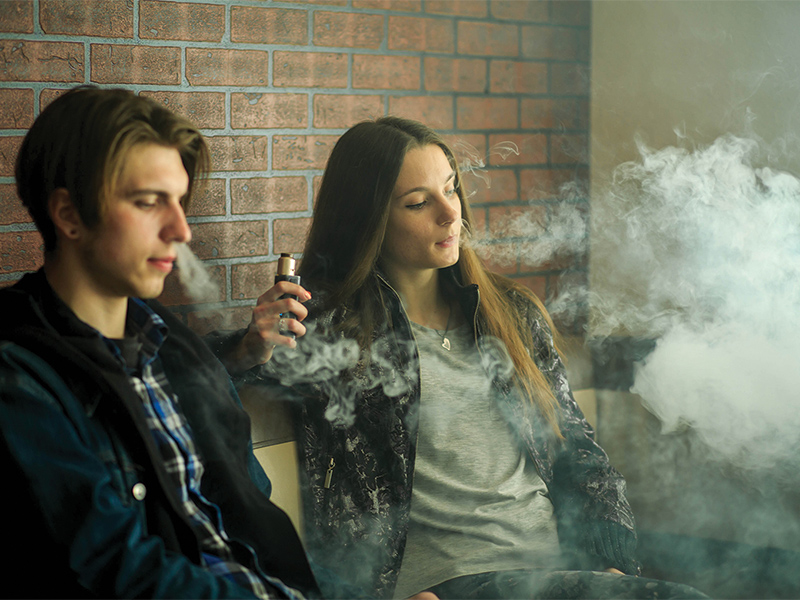
Vaping among the county’s students was referred to as “prolific,” an “epidemic” and “major concern” by school district leaders.
The topic was once again discussed during last week’s Gilmer County Board of Education meetings as the district revamps its code of conduct for students. Director of student services Jessica Chastain discussed the district’s vaping disciplinary process from the 2022-23 academic year during last Thursday’s regular session.
“This year (vaping) has definitely been one of our major concerns and offenses that led to the most hearings and tribunals within our system,” she said. “This year currently it would normally start with ISS (in-school suspension) progressive discipline and go to an OSS (out-of-school suspension) progressive discipline, and then on the third offense, it would be a hearing and tribunal unless it was (a) THC (marijuana vape).
“In response to the alarming increase we are seeing of both (nicotine) vapes and THC vapes, we are trying to intensify the severity of our consequences to hopefully reduce the number of offenses that we see for those charges.”
The Gilmer code of conduct has five levels of prohibited behaviors, and each triggers certain discipline. The severity of offenses increases with each level, and more serious offenses in level two, as well as those in levels three, four and five deal mostly with criminal activity that violate state and local law.
Tobacco products and the “unintentional possession of an electronic smoking device” are level one offenses. The “use or knowledgeable possession of an electronic smoking device” falls under level two.
Superintendent Dr. Brian Ridley noted last Thursday, “The changes to the code of conduct we discussed on Monday were to apply the state law and also to align our disciplinary consequences with the state discipline matrix. So we do have some leeway in how we handle it.
“Our consequences are going to become more severe next year to the point where we’ll probably be starting with days of OSS (for the first nicotine vape offense). We have an epidemic. THC vapes (remain) an immediate expulsion.”
School administrators determine the type of vaping device based on factors such as packaging, markings and color of the substance. Chastain said the district is looking into purchasing test kits. She spoke to surrounding counties and said, “It is by far one of the top offenses for all school districts.”
In 2022, the Federal Drug Administration and Centers for Disease Control and Prevention’s data from their youth tobacco survey found 14.1 percent (2.14 million) of high school students and 3.3 percent (380K) of middle school students reported current vape use.
Bathrooms at GHS, Clear Creek Middle and the college and career academy have sensors that detect nicotine and THC. Alerts are sent to administrators immediately, and they review video footage from outside of the bathroom. They conduct interviews with students in an effort to find the offending party, which often consumes large periods of time.
“The sensors are in all of those spots,” Ridley said. “The problem is, they work really well to the point where we’re doing a lot of business with them. We’re catching a lot of kids.”
The district did not have the statistics for the number of vaping offenses and confiscations by press deadline. However, assistant superintendent Dana Berry shed some light on its prevalence.
“We almost need somebody to police the vapes in each of those schools nonstop,” he said. “That’s how prolific of a problem it is in the schools. They’re getting them from anywhere and everywhere. I believe the GBI did a crack down on local businesses who were selling to minors. It’s more of a problem than smoking ever was.
“Vapes come in different flavors, and it’s really targeted to minors. (With THC vapes), it has become an easy medium for illicit narcotics. This is a nationwide, huge problem.”
A concern in the district is the effect on student achievement because of missed in-person instruction associated with suspensions. The district wants to educate vape offenders and also reach a younger audience.
“There is going to need to be awareness, support and cooperation from parents,” Berry said. “We need some proactive treatment. A lot of these kids are addicted to nicotine and THC. This has to be a multipronged approach to have any real effect. You can’t just punish. We’re so early on in vaping history that we don’t know the long-term health implications.
“We’ll be working at the elementary school level doing anti-vaping education because it really starts back in middle school for a lot of them.”
The vaping policy will continue to take shape as the new school year approaches.
“We want our kids in school, but we cannot tolerate this any further,” Ridley said. “It’s detrimental to the health of our students, and it’s a disruption of our schools. Our consequences are going to be intensified because it has got to stop.”