
Gilmer Schools combat what has become a ‘nonstop event’
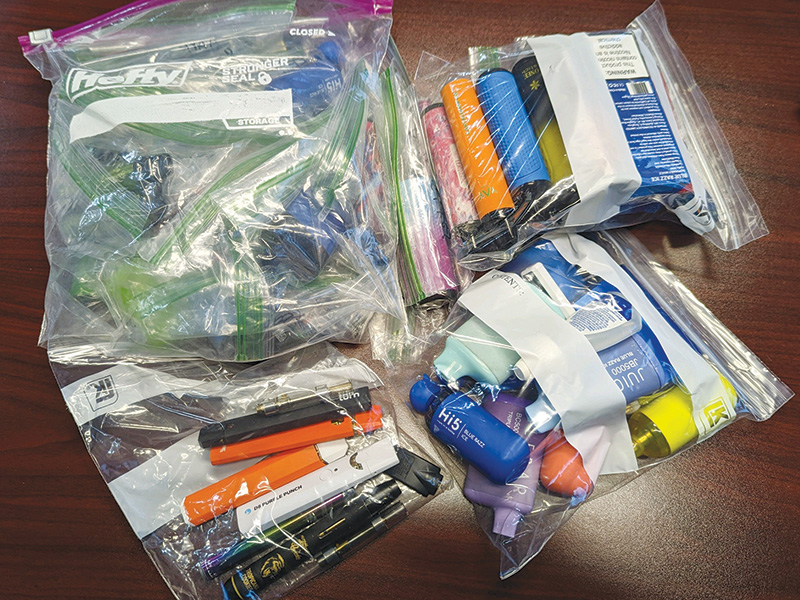
Nearly 70 vaping devices have been confiscated at Gilmer County Schools since classes began in August.
The large yield can be credited to a detection system that was installed ahead of the new school year. The need for the system produced by Verkada came after there were 102 vaping incidents in the district during the ’21-’22 academic year.
“This is a nonstop event at the schools,” said assistant superintendent Dana Berry Tuesday morning. “This is a daily event for us.”
The detection systems were installed in rest rooms at Gilmer High, Clear Creek Middle, the Mountain Innovation Program and the Gilmer College and Career Academy. Sensors measure noise, temperature, air quality and have the ability to detect nicotine from vaping and cigarette smoke, as well as THC, the main psychoactive component in marijuana.
Vaping and smoking are addressed in real time. Once sensors are triggered, camera footage from outside the rest room is reviewed to narrow the search and assist administrators.
Fifty-two vaping devices have been confiscated from students at GHS and the Mountain Innovation Program since classes resumed in August, while 15 more were confiscated at CCMS.
“The system looks backward to see who came in before and who left after that alarm is sent. It snaps a picture and sends it to administrators to be handled immediately,” Berry said.
“We don’t want to just punish kids. If we were to do that, then we’d be suspending kids left and right. While that does happen for repeat violations, we want to work with them and educate them.”
One cause for concern is the health of students. Berry spent 12 years in law enforcement and likens the effects of concentrated marijuana vapes to that of powerful illicit street drugs.
“The THC put in these vapes is off the charts comparable to joints of the past,” he said. “When vapes came around and kids started doing this, they thought, ‘Oh, it’s just THC. It’s just weed.’ But it’s hitting them so hard that I’ve seen three kids transported, in my career, to hospitals as a result of their well-being.”
erry oversees the system’s human resources, transportation, maintenance/facilities and safety and security. He gave a quick tutorial of the system’s effectiveness Tuesday morning from the central office. His curved, wide-screen monitor can act as a command center when needed. Data from every detection system is displayed and can be selected to view data and live footage from outside the rest room.
One particular sensor at GHS reported a vape index of 93 percent. Berry contacted an assistant principal at the school who was already on the case, and the offending party was identified and disciplined.
Another issue facing the school district is maintenance costs associated with vaping. The district spent over $8K from July ’21 through June ’22 to unclog sewer lines due to vape cartridges. The detection system cost the district $85,640, which was paid for with CARES Act funds.
“Since we’ve had this implemented, we haven’t had any plumbing issues. That was one thing because we were having to tear plumbing systems out because they were throwing the vapes down the drain,” Berry said.
“We have the better part of 100 vapes recovered that would otherwise be in the drain or continued to be passed around.”
Berry added, “Our goal is to curb the behavior. More importantly, students don’t have a clue as to what they’re ingesting. It’s not like this is regulated by any medical facility. A lot of these vape cartridges are bought at mom-and-pop shops. As a district, we’re concerned about the health effects with this that are coming down the road.”