
The easiest way to avoid becoming the victim of a phone scam may require the least amount of effort.
Not answering unfamiliar numbers is the most effective option. But, if you do answer an unfamiliar number and someone asks for your personal information or money, just hang up.
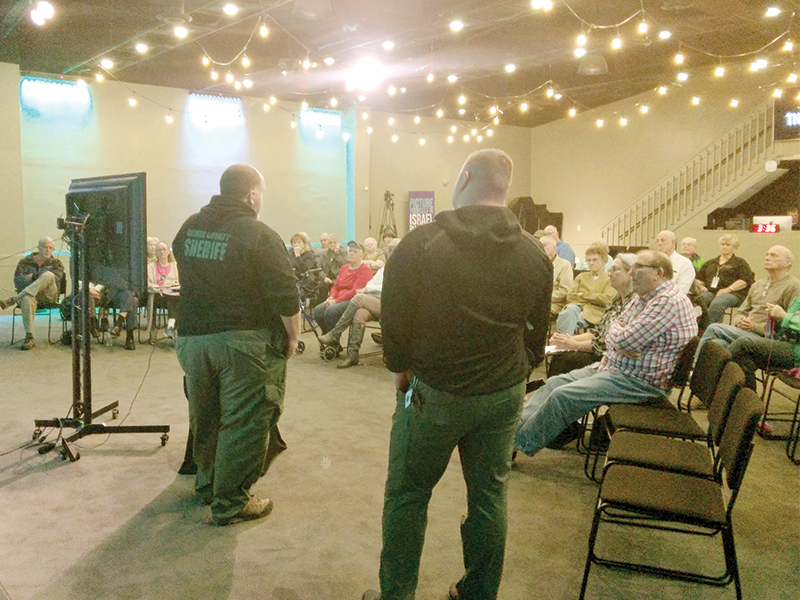
That’s one takeaway from a recent workshop on scams, cons and how to avoid falling for them presented last week by the Gilmer County Sheriff’s Office (GCSO). Detectives Dan Farnham and Trevor Stanfield gave the free workshop, which included a Powerpoint presentation and Q&A, at the Orchard Church Monday, Feb. 27.
“Unfortunately, there’s no law enforcement agency in the U.S. that has the resources to deal with every scam from a criminal aspect. If we got a complaint on every single scam that someone has suffered at the hands of, it would be overwhelming. You’re talking about 20 percent of the population, if not more, annually, all over the U.S.,” said Farnham.
“So the best reaction to all this is not reactivity at all. It’s proactivity,” he added. “That’s why I don’t mind telling people if you don’t want to get scammed, just hang up the phone. If someone calls and says your bank account’s been hacked, hang up, then call (your bank). Be the one to initiate it, not them.”
The hacked bank account angle was among numerous phone, online and in-person scams the detectives discussed.
“When I asked the people in the audience who has a Bank of America account, only about three raised their hands,” Farnham said. “But, if you send that text message out to 100,000 phone numbers, you might get people who do (have that type of account) and will call you back.”
Farnham said phone scams are the most prevalent type of scam due to their wide reach and the technology available to generate calls, texts and emails.
“It’s to the point now they’ve gotten good enough at spoofing numbers, they can make it appear it’s a local number calling you,” he said.
“The ones I really focused on (in the workshop) were ones that target elderly people where they try to go after their sympathies and their lack of knowledge when it comes to mobile devices, electronics and how things work online. It’s going to be a lot easier to convince someone who’s 70 that their Paypal account has been hacked than it would be (someone in their 30s or 40s).”
One phone scam that’s made the rounds in Gilmer County may be less common than the hacked bank account or other angles often used by scammers, but it’s reeled in many unsuspecting victims, nonetheless. It’s when a caller claims to be with a police agency and requests money to get a person’s loved one out of jail or out of a bind.
“I can promise you right now, if an officer calls you up and says somebody’s in jail, give me money and I’ll let them out, if they’re actually a law enforcement officer, they’re going to wind up in jail,” Farnham said. “That’s a violation of an oath office and extortion to the highest degree.”
Farnham said the GCSO has also received complaints about another take on this type of scam where local residents have been called by someone impersonating a police officer about a warrant. That kind of phone call is also not from a legitimate source, he noted.
“People have called dispatch and asked if deputy so and so works for us or what their badge number is because they allegedly called and said they had a warrant or needed to get in touch with them,” he said.
“If it’s actually something from the sheriff’s office, you’re not going to get a phone call from us. You can feel free to report anything like that to dispatch.”
Phone calls soliciting charitable donations are also common ways that scammers try to collect money or personal information, Farnham advised.
“If someone receives a phone call from anyone asking for a donation, I highly recommend not making that donation. If you feel tugged at your heartstrings to donate to any organization, don’t do it over the phone,” he added. “If you really feel led to donate, hop online and go to (an organization’s) official website. Any 501(c)(3) is going to tell you how to donate online.”
When reviewing online scams, Farnham gave examples of how common and easy it is for them to happen on trading/resale sites like Facebook Marketplace. If going through with a transaction that originates from a site like Marketplace or Craig’s List, request it be done in a public place such as the sheriff’s office, he advised.
“If it’s a scam, they’re not going to want to meet up in person. They’re going to want you to send them money over some sort of money exchange app. If they’re willing to meet in person, then it’s likely not a scam, although there could be some other nefarious reason behind it,” he added. “If you call the sheriff’s office nonemergency dispatch number, they can have a deputy stand by while you make the transaction.”
Stanfield told the crowd that, although it’s embarrassing, anybody can fall for a scam.
“We’re human. We make mistakes, especially when the (approach) sounds good. It can happen to you guys, and, if it hasn’t happened, it’s going to try to happen,” he added.
Stanfield, who has a small farm, used his own Marketplace deal gone bad as an example. Although a law enforcement officer, he was scammed last year when trying to purchase a miniature donkey on Facebook.
“They were going to deliver it, which was convenient for us. (They) needed $250 bucks because they were coming from south Georgia, and diesel was through the roof,” he said. “For a roundtrip from south Georgia, that seems normal for me. I sent them $250, but still haven’t got the donkey.”
When discussing travel scams, Farnham gave an overview of some of the street scammers who’ve become prevalent in such travel destinations as like New York City and New Orleans.
Farnham said one street scam that was highlighted — “the violin scam” (in which a busker pretends to be playing an actual violin, but is really miming along to a CD playing in the background) — he witnessed firsthand not in a major metropolitan city, but outside a local restaurant.
“A lot of times, tourist destinations can become target centers, especially for older folks, but anyone really. You’ve got certain in-person scams, like the violin scam, as well as credit card scams,” he said. “That’s when you’re sitting at dinner not even thinking about it. The the server brings the check, you put your card on there and they bring the bill back. Then, two weeks later, you’ve got money missing out of your account. How did that happen? They take a picture of your card and sell it online. Or if they’re really brazen, they’ll just use it. “
Although it doesn’t necessarily mean the number of people being scammed or the number of scams circulating have decreased, Farnham said he feels the GCSO is actually receiving fewer complaints about scams.
“That’s in large part because people have become aware,” he said.
“I was genuinely surprised when I had people at the end (of the workshop) say, pretty much in unison, that they all hang up. That made my heart feel good because I know at least they’re not going to get scammed.”