
National Vietnam Veterans Day, March 29
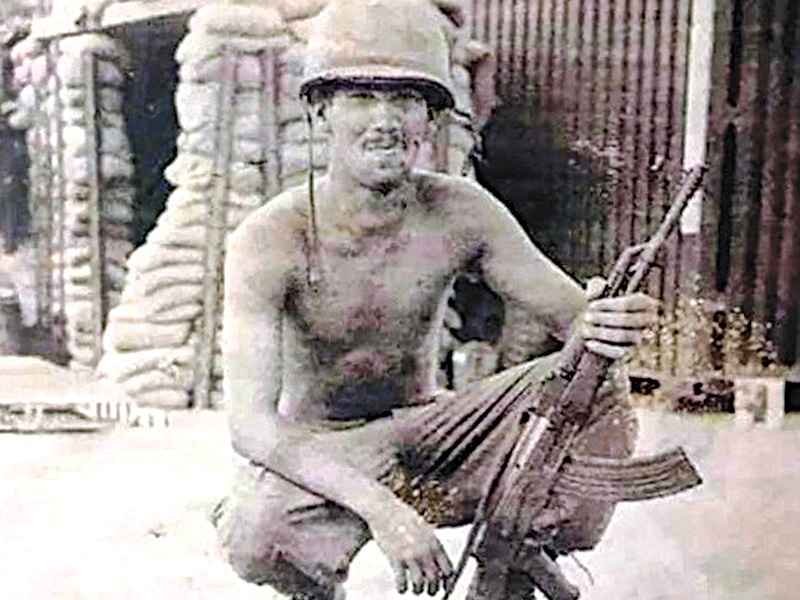
When an Army convoy rumbled through Ellijay in 1965, Bryant Strickland was intrigued — but not just to watch the trucks full of soldiers roll by.
“They came by the depot and I happened to see them,” he said. “They pulled off alongside the road, and I went down and talked to several of them, and decided right then that’s what I wanted to do.”
A native of Jefferson who had moved to Ellijay in 1960, Strickland soon dropped out of Gilmer High School, and with his mother’s signature, joined the Army at age 17. He would have graduated in the class of 1966.
Strickland volunteered for Vietnam not once, but twice. On his first tour, which began six months after his 18th birthday in August of 1965, he served with the 160th Recovery and Evacuation unit.
“We would pick up tracked vehicles that had broken down, then they formed a pipeline patrol that tried to keep (the enemy) from blowing up the fuel line from the coast to Pleiku (city),” he said. “This was a pipeline task force in the II Corps area.
His second tour with the 196th Light Infantry Brigade of the Americal Division, was in combat operations. While in Alaska for almost a year before going to Vietnam, Strickland had gotten an infantry MOS (military occupational specialty) designation.
“The 196th was a stand-alone brigade, we didn’t belong to a division and the Americal took the 196th, the 198th and the 11th Brigades under their umbrella,” he explained. “We worked in I Corps area close to Da Nang, the DMZ (de-militarized zone) and that area. The first tour wasn’t too bad, we’d get a little activity going out in convoys picking up (recoveries), and on pipeline patrol we’d go out and set ambushes. The Korean ROK (Republic of Korea) soldiers pretty well took care of the pump stations for us. We’d patrol the (fuel) line that went from the coast to Kuan Yin to An Khe on to Pleiku.”
When asked if he’d lost friends during combat, Strickland, who rose to the rank of Specialist 4, replied, “Yeah, yep. Yeah, I did.”
Why did he sign up for a second tour, and what was it like?
“When you’re young and kinda wild like that, you see different things and go different places,” he said with a smile. “The mosquitoes and bugs and all were bad over there where we were at, but they were a whole lot worse in the Delta area. I was never down there. I went in down there (initially), landed at Bien Hoa (Air Base) and stayed there until they sent me over to my unit. I didn’t see a lot of snakes over there. They were there, but you really weren’t looking for snakes. The last time I was over there, we’d run patrols, set ambushes, go on search-and-destroy (missions).
“I was never wounded. I got a little shrapnel from a mortar but no Purple Heart, just bandaged up (and) I kept truckin’. I was pretty well fortunate, I guess, lucky, blessed.”
Even the C-rations were good if you were hungry, Strickland remembers — except for one item on the menu.
“They said if you had a can of ham and lima beans and you threw them at the gooks (enemy), they’d throw them back at you!” he said. “My favorite was beanie weenies, beans and frankfurters. The first time I was over there we got a lot of hot meals, unless we were out in the field and we’d take C-rations with us. Back at Fort Lewis after Vietnam, they told us we could get anything we wanted to eat, and I chose pizza. It was mighty good!”
‘You think about it’
What about his return home?
“I was discharged at Fort Lewis, Wash., and there were protesters around, but they never did bother me,” he said. “I flew into Atlanta and didn’t have any problem there.”
After meeting Doris Smith in 1967, the two struck up a relationship.
“We wrote each other when I went back over and when I got out we married,” Strickland said. “She passed away March 25 last year. We just liked a few days being married 52 years.”
Strickland, 73, was surprised recently when an old friend, Eddie Weaver, passed away last month.
“He also served in the 196th, and I didn’t even know it, we never even talked about it,” he said. “I knew he was in Vietnam, but I never knew what unit he was in.”
Does he keep in touch with fellow soldiers?
“I keep up with one in Texas,” he said. “He doesn’t have a computer, so we call each other occasionally. The lieutenant up in the Carolinas, I talk to him some. I was sitting here one evening, and the captain I had when I was with the 160th called me. I guess he had seen me on the computer, on Facebook or something, and I talked to him for a good while. He had cancer and he’s passed away.”
Strickland is rated at 50 percent PTSD (post-traumatic stress disorder).
“When I first got back, I’d get pretty upset and my wife would take me to the emergency room (where) they’d give me a shot,” he recalled. “To be honest, you think about it, about something, almost every day. I have nightmares occasionally. When my wife was here, she’d wake me up …”
Strickland considers himself both “lucky and watched over” during his two tours.
“This Russian deal (war with Ukraine), it brings back memories,” he divulged. “You see the women and children getting messed up and leaving their country and all. It’s hard to watch.”
Strickland said he and another friend who is a Vietnam vet, Willis Padgett, have talked about going back to Vietnam, but “we’re too old now.”
Once back stateside, Strickland drove a truck “for a long time and all over the United States.”
“I never could work for anybody,” he said. “When I first got out, I went to work at a carpet mill. I had to do something when I got married. An old guy said to me, ‘What’s a young guy like you doing here?’ He’d been in that carpet mill forever, I guess, his whole working career. He said, ‘You need to get out and get you a job somewhere where they got benefits and all.’ And I thought about it a couple of weeks, and I left out and never did work for anybody else. I got into the pulp wood and log yard business on Progress Road, got into house building, got my broker’s real estate license and put a little business up, and built storage buildings and my wife took care of those — whatever I could do to make a dollar.”
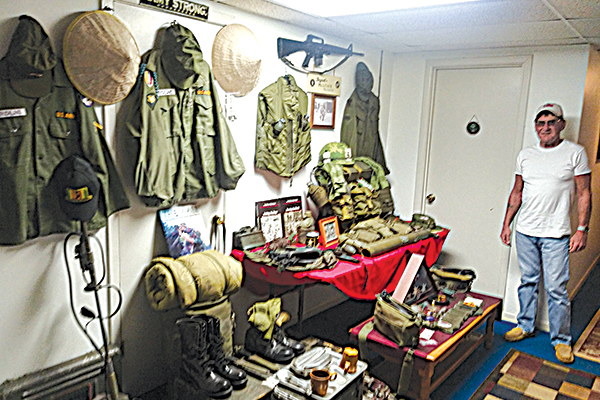
Strickland has a small Vietnam War museum in the basement of his Ellijay home, with uniforms, equipment and other momentoes on display. He goes there when the memories sometimes become overwhelming. He’s thankful he made it back.
“I can’t believe what a wonderful life I’ve had over the years,” he said in a social media post. “ I’ve been so blessed throughout my entire life with good family and friends. What more could one ask for!”