
A new storm water infiltration system at River Park will reduce erosion by redirecting storm water runoff in a section of the park near South Main Street.
“We’re trying to control and slow down the water that comes off the road so it doesn’t cause so much erosion in the ditch lines through there,” said Kevan White, Gilmer County Parks and Recreation director.
The majority of the project cost is being funded by a grant from the U.S. Environmental Protection Agency (EPA), which is administered through a partnership between the Georgia Soil and Water Conservation Commission (GSWCC) and Georgia EPA.
The grants are given through the Section 319 Nonpoint Source Management Program, an extension of the Clean Water Act that provides federal assistance for state and local projects that reduce pollution from environmental sources.
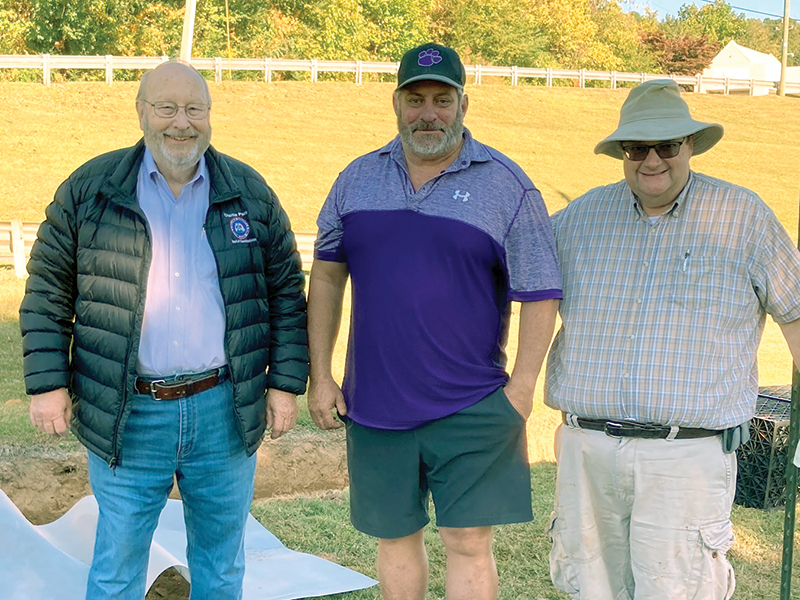
According to Ricky Ensley, GSWCC resource specialist, part of Gilmer’s 319 Grant was already used for a 2020 project in which owners of failed septic systems were reimbursed a portion of their repair expenses. Both grant-funded projects are intended to improve the Coosawattee-Carters Lake Watershed, noted Ensley.
“This one is for infrastructure, and our part on this (project) will probably be about $20,000,” he added. “Our first meeting out there was in June of 2020. (It took a while) to get everything together and get all entities working together.”
Physical work to develop the drainage system began last week near the Gilmer Civic Center and the park’s pickleball courts.
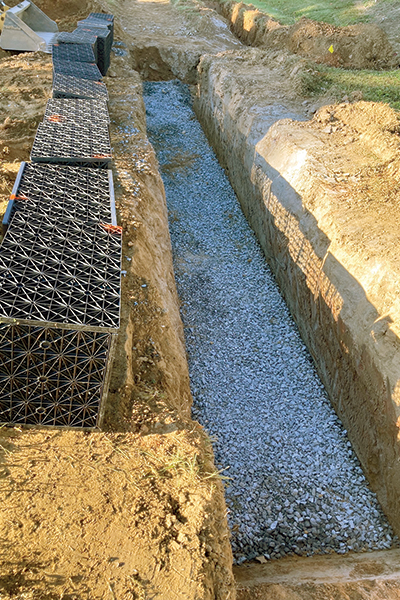
An existing ditch was used to cut an over 200-foot trench in which 60 collection boxes have been secured. Storm water will seep through surface gravel, then through the vented collection boxes which resemble large milk crates, then into the soil underneath.
Sock filters made of shredded coconut material have been placed on storm pipes to filter sediment out of the storm water, thus decreasing the amount of sediment that reaches the river, Ensley noted.
“We call it a retrofit ditch,” he added. “A lot of water goes through there at one time, so we’re trying to decrease that volume before it goes into the Coosawattee River and also decrease the sedimentation going into the Coosawattee.”
Due to heavy erosion, the ditch that runs parallel to South Main Street grew much deeper in a relatively short amount of time, White noted.
“It had already washed out to where it was about three and a half feet deep. A couple of years ago, it was only about eight inches deep,” he said.
Diane Minick, a Canton stormwater landscaper, developed the drainage system going in at River Park. Her company, Environmental Impact Assessment, was hired to design and manage the project.
Minick said the collection boxes made of durable polypropylene plastic are often used in disappearing water designs like manmade waterfalls. Here, they will be used to pull water from the surface so gravity can direct it where it needs to go.
“Sometimes there’s so much water that comes off the road or off buildings so suddenly, you have to have a way of conveying it rapidly in the ground,” Minick said. “These boxes are in trenches underneath river rock, and they’re shielded by fabric so the rock doesn’t get in. When the water comes across them, it instantly sinks out of sight. When any box fills up, the water comes above ground, meanders on down and goes to the other boxes. The gravity flow will carry the water to the river. As it goes that way, trees will be able to pull water up and use it as they need.”
Minick said she’s previously designed storm water management systems for Heritage Park in Canton, the Fernbank Museum of Natural History in Atlanta, the Anheuser-Busch Brewery in Cartersville and the Ringgold riverwalk. When finished, this one will look like a dry stream bed with only river rock visible at the surface, she explained.
“Technically, the ditch really hasn’t changed at all, but it is more functional now,” Minick said. “The boxes are structurally sound and, if they’re somewhere that people are mowing the lawn on top of them, they’re (still) structurally sound.”
Gilmer Parks and Rec. will fund a share of the project cost, which includes providing labor and river rock. Students in a Gilmer High School agriculture class also assisted with some of the work, which included helping assemble the collection boxes, Minick noted.
The project is nearing completion, but it’s a slow process, Ensley noted. He hopes it will be finished sometime this month.
Educational signage will be put out to notify passersby of the new drainage system, which will still have raised ditch banks on both sides. The ditch banks weren’t smoothed out due to the amount of other infrastructure already buried underground, Minick noted.
“We’re kind of considering this as a demonstration project so people can see how you can create a working ditch that will allow water to slow down, spread out, be cleaned and soak into the ground where it will do the most good,” she said.