
Blizzard of ‘93 memories still fresh upon record storm’s 30th anniversary
About this time three decades ago, students were finally returning to class from a week-long school break during which they were probably without electricity for days and might’ve even had to melt snow or ice for water.
This wasn’t one of the seasonal weeklong school breaks that are now commonplace. The implementation of those was still years away.
It was the Blizzard of ‘93 that kept schools closed and many Gilmer residents hunkered down in their homes for the week.
‘We’re not going anywhere’
The snowstorm, which started late Friday, March 12, and continued into the weekend, left anywhere from two to five-plus feet of standing snow throughout the county. It was labeled the Storm of the 20th Century then, and we may very well not see another one like it this century, either.
Now, 30 years later, memories are fresh in the minds of those who endured the record-setting blizzard.
“It’s something you never forget. I can see it now, how much snow there was. We’d never seen anything like that here,” said Gary Watkins, then Gilmer County’s assistant fire/EMA chief.
Watkins and Fire/EMA Chief Gene Jones knew a severe storm was expected to hit the area that night, so they started calling in fire and rescue personnel in hopes of doubling their normal on-duty ranks in case the storm turned out to be a bad one.
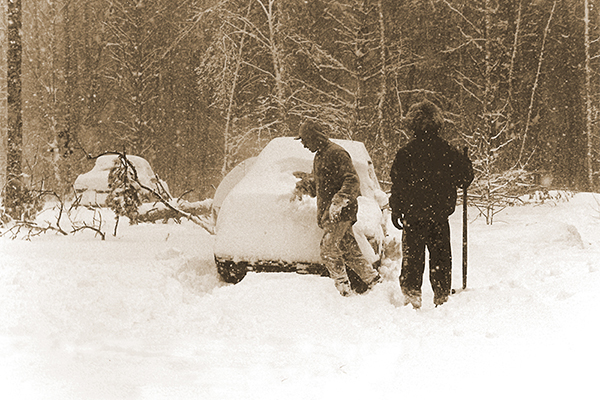
The snow came down so fast and heavy that some of the firefighters got caught in it as they headed to the county EMA headquarters, which was then at the Gilmer Civic Center, Watkins recalled.
“We called several people in, and some of them who came that night could hardly get there. It took hours because of the road conditions,” he said. “They had to saw their way in from up on Boardtown, Whitepath and up in there.”
It was one of the few times that local residents have experienced the rare weather event known as “thundersnow,” in which snow instead of rain falls intensely amid lightning and thunder.
The week after the blizzard hit, the Times-Courier’s then-co-owner, Annetta Bunch, wrote in her column: “About 2:30 (a.m.) we were awakened by a loud clap of thunder accompanied by lightning. We assumed it would be raining and wash away the snow, but (instead we saw) blinding snow coming down like rain. A few minutes later, the lights went off.”
The possibility of a snowstorm unlike any that Georgia had ever seen had been a topic of conversation that week, mainly because of WSB-TV meteorologist Glenn Burns, who’s now remembered as the first Georgia weatherman to accurately predict the blizzard’s severity.
“He was making the prediction early in the week that this would be just catastrophic. They were concerned about him going out on a limb and saying that, but he was spot on,” said Lex Rainey, then principal at Gilmer High School (GHS).
Although the weather had been fairly pleasant the day before and into Friday, local schools were released around 10 o’clock the morning of the 12th, Rainey remembered.
However, a busload of GHS students had left for a literary event in Clayton County the day before. They were still there when Gilmer schools began to let out early.
“I was sweating bullets about getting that bus back. I didn’t want them to get stranded down there,” Rainey said. “We didn’t have cell phones then, so it took me forever to get up with the (teachers). I said, ‘I don’t care what you’re doing right now, put every child on that bus and come straight home.’ Schools were turning out left and right that day, and they had to go through Atlanta to get back here. They got home around 11 o’clock that night, and I was so glad it was before (things got bad).”
That timing was fortunate as schools were closed in Gilmer and several other north Georgia counties for the entire week that followed. It was the longest weather-related school closing Rainey and many others can remember. With below freezing temperatures at hand, the piles of snow stayed in place, and it soon became apparent that a quick melt wasn’t going to happen.
“I came here in 1975, and with most of the snows, even the real big ones, we’d be out of school for a couple of days or a little longer. Then it would turn nice (outside), and we’d go back to school. But not with the blizzard,” Rainey said.
At first, excitement was high when it came to schools suddenly being closed by the heavy snow. But, with power, water and access to “town” by vehicle all succumbing to the weight of the blizzard, that excitement soon turned to boredom and apprehension, recalled Kris Dakota Fonteboa, then a 17-year-old GHS student.
“I remember, at first, everybody was all excited that we had this huge storm with a ridiculous amount of snow. Real quick that turned into, ‘Oh my God, this is a blizzard, and we’re not going anywhere!’ We learned that real quick,” he said. “You had a ton of snow that had everything trapped in, but it also weighted the trees down so much that they started dropping everywhere.”
Working around the clock
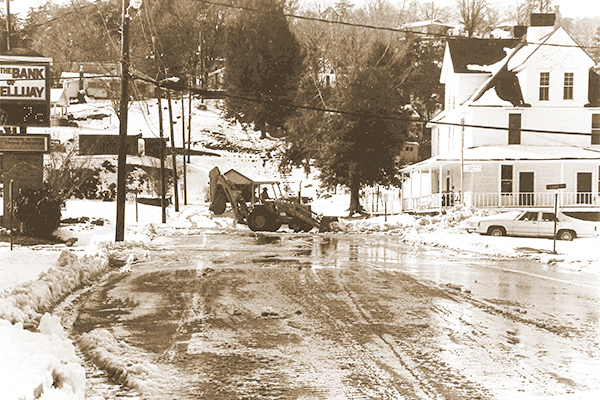
With most of the county unable to leave home or successfully navigate the roads for days, vehicle accidents were minimal after the initial snowfall. However, constantly falling trees, widespread power outages and stranded persons brought plenty of calls for fire and rescue employees. Watkins remembered how crews worked “around the clock” for almost two weeks.
“We’d go home just long enough to make sure the family was good, then get right back to work because there was so much going on,” he said. “I lived about a mile out of town on Chatsworth Highway. We were out of power, but luckily we had a fireplace. I’d go to the house, put more wood on the porch for my family and go back to work.”
An emergency shelter for the county, which was set up at Ellijay First Baptist Church, was among the firefighters’ destinations that week. According to the March 18, 1993, edition of the Times-Courier, Gilmer EMA transported more than 600 stranded people to the emergency shelter, motels or the homes of family or friends.
“We had a great crew of dedicated men and women who stayed and helped take care of the citizens of Gilmer County. We had a couple of military Army trucks back then, which were four-wheel drive, and that was one of the only things that could go for a few days,” said Watkins. “One of the things we were trying to do was get the nurses in and out (of the hospital). A lot of them, once they got there, had to stay and sleep there for a few days.”
There were two known storm-related fatalities in the county, remembered Watkins. An elderly man and woman in the Bucktown area had used a charcoal grill to keep warm and died of carbon monoxide poisoning before fire and rescue could reach their home.
“There’s a lot of different memories, but that’s the saddest (one),” Watkins said. “It took hours to get up there because of so many trees being down. The problem was that we’d try to get to somebody’s house and while we were there, more trees would fall. The ambulances and firetrucks would get stranded.”
Firefighters Gene Hightower and Mark Aaron found themselves in that predicament when when responding to a call about a sick child in Coosawattee River Resort who needed to go to the hospital. The eight-year-old girl with cerebral palsy was running a high temperature, and the two firemen had to reach the house by foot, Hightower remembered.
“We had such a problem getting to people with the firetrucks and ambulances in the blizzard, but we had some rescue vehicles that were four-wheel drive. We were in a Toyota Land Cruiser at the time,” he said. “The house was out in Eagle Mountain, and the snow was so deep we couldn’t get in the gates. There was an access point just past the Eagle Mountain gate, and we had to walk nearly a mile to the house. There were two different roads, but since it had snowed so much, we didn’t know which one to take. At first, we ended up taking one that made a big circle that came back out to where we parked. The next time, we went the opposite direction, up and down hills and across a creek till we finally made it to the house.”
They didn’t have a stretcher or other way to transport the child to an ambulance, so Hightower asked her mother for a heavy quilt that was fashioned into a makeshift stretcher they carried and drug through the snow.
“She was burning up and needed to get cooled off quick,” said Hightower. “Once we finally got back to the vehicle, it wouldn’t go. They sent our only four-wheel drive ambulance out, so we loaded her up, and we all went to the hospital.”
The girl was flown out to an Atlanta hospital, but Hightower and Aaron soon found themselves being admitted to the local hospital, North Georgia Medical Center. Their body temperatures had dropped to the point where hypothermia was a concern.
“They wouldn’t let us leave. They started IV fluids and put heating pads on us trying to get our core temperature up,” Hightower said. “We were bundled up and it didn’t feel that cold, but I guess we’d been out in the snow for too long. We were at the hospital several hours before they let us go.”
Like olden times
Fonteboa’s buddy, Andy McCauley, had driven out to the home of Fonteboa’s family just off Big Creek Road shortly after the snow started coming down Friday night. He and everyone else in the house wound up staying there for several days as conditions worsened.
“I’m pretty sure it was five days later — and there was still a whole lot of snow on the ground then — we were finally able to get out in his truck by following some other tracks in the road,” said Fonteboa, who now runs Southern Customs, an Ellijay auto detailing shop. “It took us almost all day, driving about 10 miles an hour, to get to town where his parents lived.”
While they were “trapped,” the two teens, like many in the county that week, got a taste of what it was like to live in olden times. That included carrying water up from a spring box on the property and using a wood stove to cook and keep warm, Fonteboa recalled.
“When we woke up that Saturday morning, I can remember my parents telling me, ‘We need to get water and wood up to the house now!’ Luckily, we had a spring box, which was the only reason we had water. Most people were having to melt snow just to have water,” he said.
Much of their extended school break was spent cutting trees to even reach the main road less than a half-mile away.
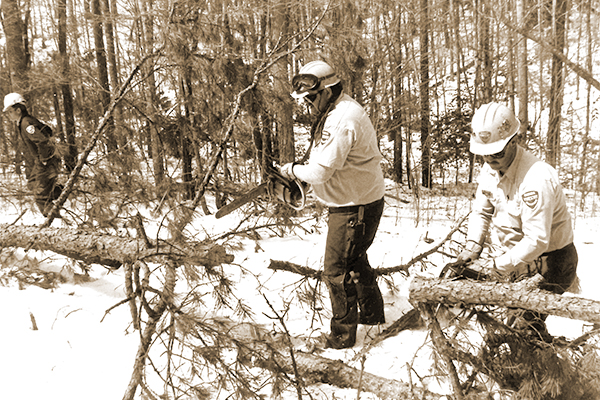
“About 35 trees were down between our little road up to Big Creek,” Fonteboa said. “A neighbor with a tractor, my stepdad and another neighbor all had chainsaws. We started cutting through the trees, sawing our way through them and dragging them out of the way one by one. It took two days of cutting our way out of there.”
Along with firewood and shelf-stable food, chainsaws proved to be among the most valuable commodities in the county, especially for those who were actually able to leave their homes only to find fallen trees blocking the way.
That’s what happened to some local hospital employees, including Janis and Jack Burel. According to the March 18, 1993, newspaper, they were eventually able to make it to work at the hospital in a four-wheel drive, but first had to saw through multiple broken trees after leaving their home in Whitepath.
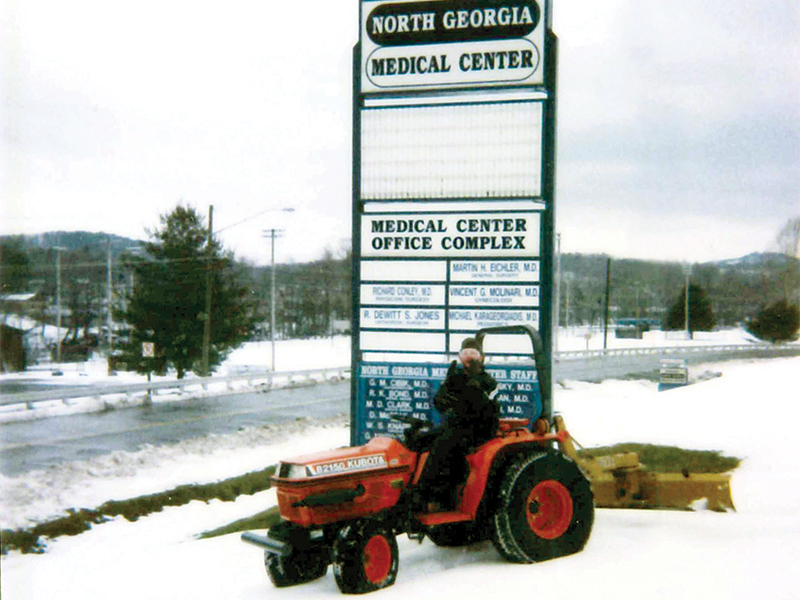
One hospital employee, maintenance director Hoyt Millholland, rode a Kubota tractor from his home in Blue Ridge to the hospital on South Main Street. “He wore a motorcycle suit and helmet to try and keep warm during his 20-mile trek,” said the newspaper.
Millholland’s main concern was that the hospital’s water supply would freeze. When he arrived, he found a valve in the facility’s water tower had indeed frozen, but was able to thaw it out using a heat gun.
Many were unable to reach the grocery stores and, if they did, bare shelves were mostly what was found, recalled Watkins. “It took a while to get all the grocery stores stocked back up. They had to get all the trucks (coming back) in,” he said.
Sheila Davis remembered how, in Cherry Log, neighbors took care of one another the best they could.
“My husband was a trucker and had gotten home the day before the storm hit. Nobody in Cherry Log could move, so we walked,” Davis said. “During the day, our community would meet over on Old Highway 5, and we all talked about what we needed. Whatever extra we had, we would give it to whoever needed it. We shared gasoline for heaters and groceries.”
Davis also remembers her battery-powered TV coming in handy during the long power outage.
“Everybody would come to my house and watch the news,” she said.
A measuring stick for winter storms
Gilmer was among 70-plus Georgia counties that applied for federal disaster aide following the blizzard.
By the time all the snow was gone, it had caused collapsed or damaged roofs on multiple local businesses, homes and chicken houses. Beacon Lumber, NAPA Auto Parts and Holdens’ Grocery were among the local businesses that received extensive roof damage.
It took two weeks or more for all power outages to be restored to Georgia Power and Amicalola EMC customers affected by the blizzard. Power crews also worked around the clock in difficult circumstances to restore service.
According to a report from Amicalola’s then-CEO, Stanley Dean, approximately 98 percent of the AEMC system was without power at the peak of the blizzard. Dean noted that the storm caused nearly $5 million in damage to the power company’s infrastructure.
“I’ve seen numerous snowstorms and blizzards, but I’ve never seen anything that created as much damage as this one did,” a lineman helping to restore power to the AEMC service area told the newspaper.
Rainey remembered how GHS faculty were surprised to learn that power stayed on through it all at the old high school, which was later Gilmer Middle School and is now the Larry Walker Education Center.
“Of all things, that building, which opened in 1955, never lost power. I couldn’t believe it,” he said. “If only we could’ve got people there (for a shelter).”
With March 2023 having almost passed without threat of snow or ice, perhaps north Georgia will again be in the clear for another record-setting blizzard. Many who experienced the memorable ’93 snowjam still hope it was a once-in-a-lifetime event.
“I was just telling some of the (younger) firefighters about it the other day,” said Watkins. “It was miserable, with everybody being stuck where they were at. I hope we don’t ever get it again.”
“I think everybody in north Georgia who lived through it marks every (winter storm) by the Blizzard of ‘93,” said Rainey.
Watkins recalled one measure of a storm’s severity you won’t find in a weather forecast, but it still tells how bad it got the week Gilmer County was overtaken by snow.
“Very seldom will you ever see the Waffle House close, but they did here. They had to. They didn’t have any food,” he said.