
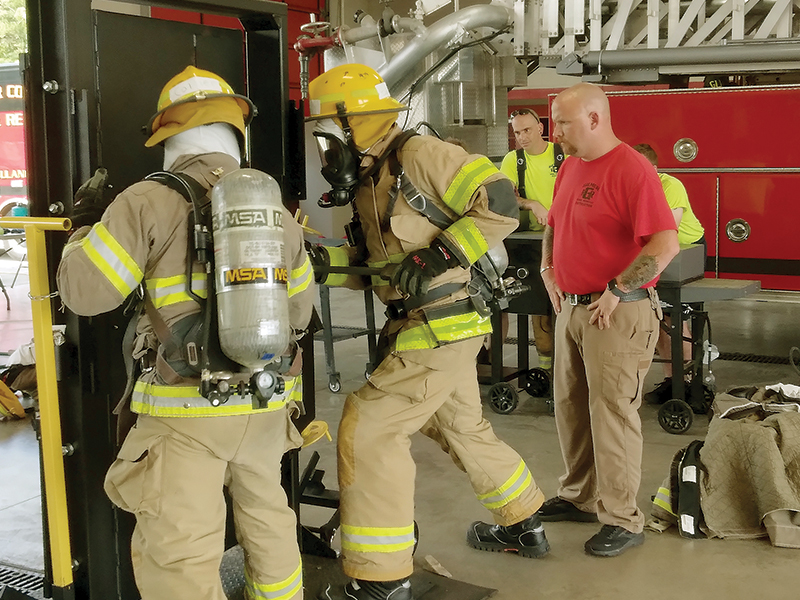
A new class in Gilmer Fire and Rescue’s recruit training academy is learning how to manage suiting up in one of the hottest summers in recent memory before they encounter the heat of an actual fire.
Sessions for Class 23-1, the second group of recruits to undergo the paid training program, began June 26.
“We have a very good group, and they’re still relatively new. We’re right around the four-week mark right now,” said class instructor Battalion Chief C.J. Morris.
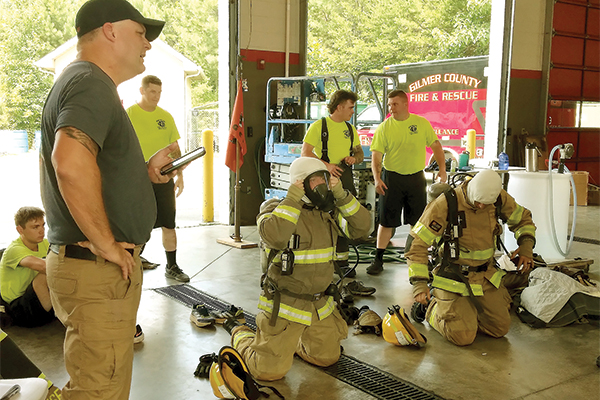
“This group is starting to bond and become a team, which is the ultimate goal of this whole program. We have to operate as a team,” said class instructor Battalion Chief Jason Bryant.
As the heat is a bit more punishing this summer, precautions are being taken to help deal with it as the training progresses, noted Bryant.
“We’re monitoring the heat each day and taking more frequent breaks. At the end of the day, we have to be able to operate in this heat because whenever a call comes in, it comes in. You have to learn how to work in the heat, but also be smart,” he added. “We make sure they drink plenty of water and stay hydrated, and we have fans going.”
Last week, class topics included forceable entry methods and maneuvering through small openings and confined spaces. For that part of the training, fire and rescue personnel used a Denver Drill apparatus, which includes a window and a confined space just beyond it.
Morris explained that the drill is a way to help firefighters learn how to successfully enter and remove an injured or unconscious colleague from a confined space.
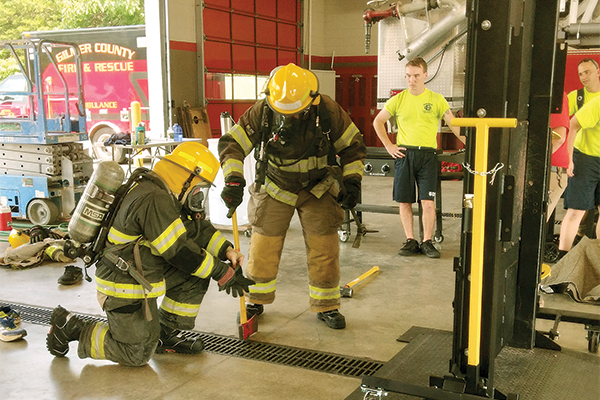
“There was an incident where a fireman in Denver, Colo., got trapped, and they had to enter through a very small space to get to him. It was very hard for them to figure out how to get him out because they’d never come across that before,” he added. “The idea behind it is you have a fireman who’s down, unconscious in full turnout gear, breathing air and stuck inside this little setup we have here. A crew has to go in through the window, package him and get him out using the same window.”
Paired class members also competed in a timed forceable entry exercise last week. The two-man teams first had to complete quick dress, in which they’re expected to put on all protective gear including suit, boots, hat, helmet and air tank in two minutes or less. Then, each recruit quickly secured an ax or pry tool and forced their way into a locked steel door from both sides.
“We use a forceable door simulator, which is like (the types of doors) we usually come across. We also teach them about forcing garage doors, windows, breaching walls and safe room doors,” Morris said. “We have to adapt to things like safe room doors, and we would have to breach a wall to get around something like that.”
It’s not uncommon for firefighters to encounter a locked door when arriving at the scene of an emergency, especially if the resident is not at home, both class instructors confirmed.
“We had a fire just last night where we had to force the front door to get in. We use it all the time,” said Bryant.
“The purpose is to access a structure quickly when we can’t wait on traditional means like a key,” said Morris. “We try to base it on what type of emergency we’re up against. In a medical emergency, you’re usually not going to force open doors or windows unless it’s a severe medical emergency, and we have no other means of getting in. For fires, if we have smoke or flames showing, we’re 100 percent going to force open the door.”
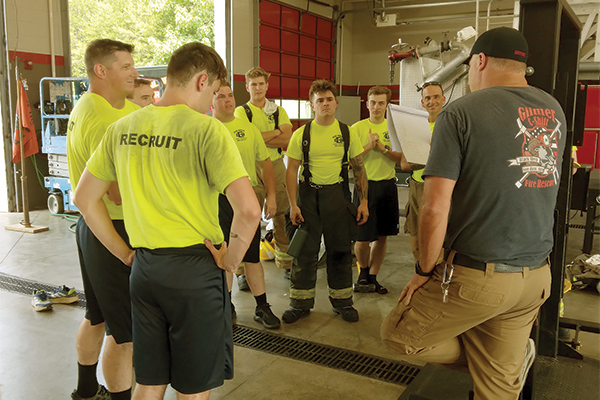
Although deadbolts and other types of locks have to be successfully overcome, firefighters are trained to inflict as little property damage as possible in this type of situation, noted Morris.
“If we go in and get a good stop of the fire, and we’re able to (save) a lot of their property, we want to be able to secure it at the end,” he added. “I teach them to not go in and John Wayne things and break everything. We still have to protect their stuff. That’s our job, and we protect what we can.”
Two teams completed the forceable entry drill in under two-and-a-half minutes, which included doing quick dress and forcing open the locked door from both sides.
“The best time was 2:22. That’s pretty impressive,” Morris said.
The fire department started its second recruit training academy with 13 enrolled. The class size is now down to nine.
“The first couple of weeks are designed to kind of shock you, and people will figure out whether they want to be there or not,” Bryant said.
In June, eight recruits comprised the first class to graduate from the in-house academy. No longer recruits, they now work regular 24-hour shifts as probational firefighters or “probies.” They’re still under supervision from an assigned lieutenant, which usually lasts anywhere from four months to a year, Bryant noted.
“They just have more supervision than someone who’s been around a few years,” he added. “When we think they merit being off probation, we’ll take their probationary shield and give them a full-time firefighter shield.”
The class sessions are starting to tie together what the recruits have already learned, while continually introducing new topics and skills, noted Bryant. This week’s agenda included using ladders and ventilation procedures.
“Now they can do multiple disciplines in one drill instead of just one thing at a time,” Bryant said. “We’ll start working on vehicle extrication in the next couple of weeks, and we’ll be working our way up to live fire, which starts around the end of August. Those are the two big benchmarks. Everybody loves doing the extrication (training), where we cut somebody out of a wrecked car. When they first see live fire, it change everything for them.”
The firefighter portion of the training academy is expected to last into October. After that, recruits will begin the EMT portion.
When they take the exam for their Firefighter 1 certification — one of four emergency response certifications that will be obtained by recruits who complete the program — the very first skill to be tested will be quick dress.
“They start doing that the very first week (of training) because it’s actually a skill check certification. We try to do it every day,” Bryant said.