
Graves in Rose Cemetery date back to 1800s
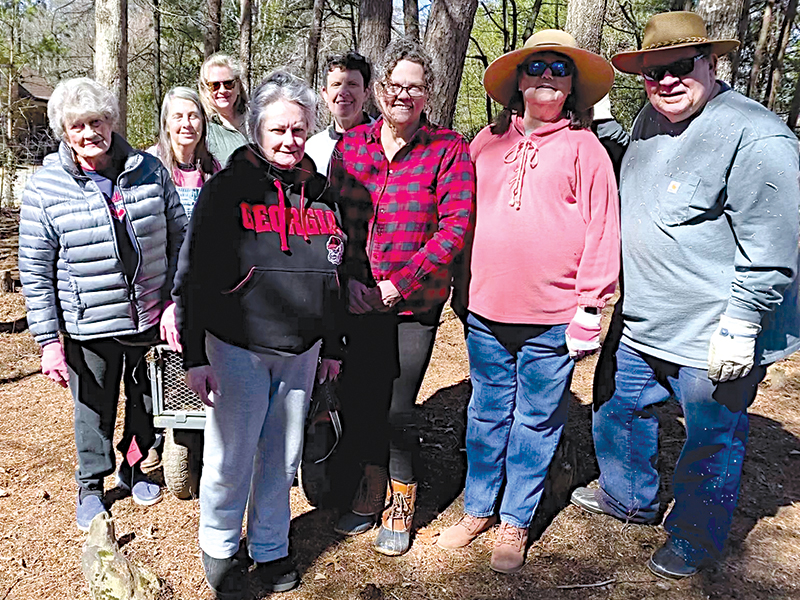
Members of two local history-minded groups are among those working to restore a forgotten cemetery in the Yukon area of the county.
Rose Cemetery, the burial place at Raven Cliff Drive and John Teem Road, is believed to be an African-American cemetery dating back to the 1800s.
Jennifer Anderson, a member of the local Capt. James Kell Daughters of the American Revolution (DAR) chapter and the Gilmer Genealogical Society, said she first learned about the cemetery years ago when she owned property near it. She’d wanted to do some type of cleanup project there, but the amount of work involved and raising a family prevented that.
Anderson, who began the restoration project with fellow DAR and genealogical society member Susan Noles last November, has found support and help from other members of those two organizations. The past few months, a team of almost 20 has been working to clean up and mark the cemetery grounds.
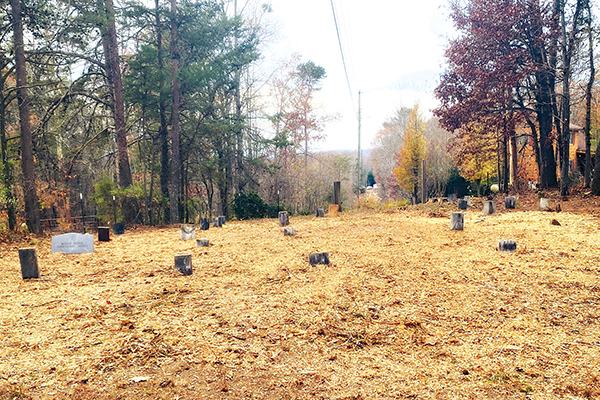
“Until recently, it was overgrown and full of discards including trash, box springs, glass bottles and barbed wire,” noted Barbara Murray, who’s among those helping to restore the cemetery. “(The volunteers) have cleared the property of downed trees, cut trees, mulched and picked up debris left by people who’ve misused the cemetery, which has included broken beer bottles, drink cans, sardine cans, rusted metal and burnt mattress springs.”
“It was just a mess. You could tell that people had burned fires or burned trash (there),” added Anderson. “There was a lot of barbed wire in there that we pulled out.”
Some of the graves are marked, but only with simple, blank stones. Anderson heard the grave markers had been moved over the years, and maybe some aren’t the original stones.
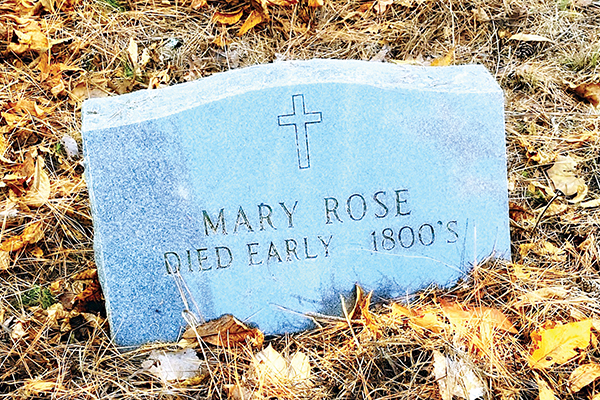
Only one legible headstone has been found on the premises, which reads “Mary Rose, Died Early 1800s.” This led to the site being called Rose Cemetery.
“We don’t know who put (the headstone) there. We don’t know the majority of the names,” said Anderson. “There is one (other) stone that does have writing on it, but it’s deteriorated so bad we’ve not been able to make it all out. We can make out that it’s February, either 1830 or 1880.”
Anderson said the project has required not only a lot of physical work, but also much research, which has included digging through old census and property deed records.
It was learned the cemetery property was in the Cherokee Land Lottery, through which it went to John Davis, of Clark County, who got his deed in 1836, Anderson explained.
“Then we skip down to all the way to 1866, so we’ve got a lapse of 30 years before we found anything else. G.W. Teem owned it (then),” she added. “The next time we see it is in 1873, when Marion Palmer owns it.”
Palmer was a freedman, or former slave, Anderson said.
“He lost it in 1886, and it was sold at the courthouse steps,” she added.
Anderson thinks the land could’ve been a community cemetery for African-American residents in that part of the county. Without the names of the deceased, they don’t know whether or not it was a family cemetery.
“In 1870, right after the Civil War, there were 30 African-Americans (living) in this small community, not Gilmer County as a whole, who might have possibly been using it as a burial place,” Anderson said.
The team of restorers was recently able to have ground-penetrating radar (GPR) done, which helped determine the number and actual locations of the graves. Len Strozier, of Omega Mapping Services, did that radar work, which he described as “performing a sonogram of the ground.”
GPR detects air pockets, where a shroud or casket is located, and Strozier uses the size of those air pockets to determine approximate ages of the interred. So far, 67 graves have been located on the grounds. Of those, five are thought to contain babies or children, about 20 with children from 5-15 years old and the rest adults.
“The graves are in rows and columns. Some had field-stones marking the grave. The bodies, as in most graves, face east to west in accordance with the general Christian theological belief that Jesus told his disciples they would rise to meet him in the east,” noted Murray.
Marion Palmer’s daughter, Texanna, who died at age 12, is thought to be buried there, Anderson said.
“It makes sense that she’s buried there because he owned the property at that time,” she added.
The researchers don’t know what the land has been used for other than a cemetery. Anderson speculated that some of it might have been farmed years ago.
“You can tell, if you walk the property, there’s not any trees that are that old. It was definitely clear cut,” she added.
Nothing else is known about the cemetery’s namesake, Mary Rose, other than what’s engraved on her headstone. Anderson said she will try to find out more about Rose at some point.
Restoring the cemetery is an ongoing project. When done, the volunteers hope that maps and permanent markers will help show the exact placement of the graves for future generations.
Their goals moving forward include linking families to their ancestors buried in the cemetery while making the site a place of beauty in honor of those laid to rest there, Murray noted.
A gate has been installed, and the group is planning to put in some new grave markers now that the ground radar has determined where graves are located, Anderson noted. “We would like to put a nice fence up, and we’ll also be doing a lot of planting of shrubs and flowers and things like that,” she added.
The volunteers have received assistance from other entities that also helped the restoration take shape. Amicalola Electric removed an old power pole and guide wire stakes, while the Gilmer County Road Department removed underbrush outside the cemetery gate. Bernhardt’s Funeral Home will be donating a place marker to show there is a cemetery there, Anderson noted.
“(Almost) nobody knew about this cemetery,” she said. “We’ve had people who live around here stop and say they didn’t even know it was there. The majority of people don’t know it’s there.”
For more details on the restoration of Rose Cemetery or to volunteer in some way for the project, contact Jennifer Anderson or Susan Noles at: Gilmer.nolongerforgotten@gmail.com.