
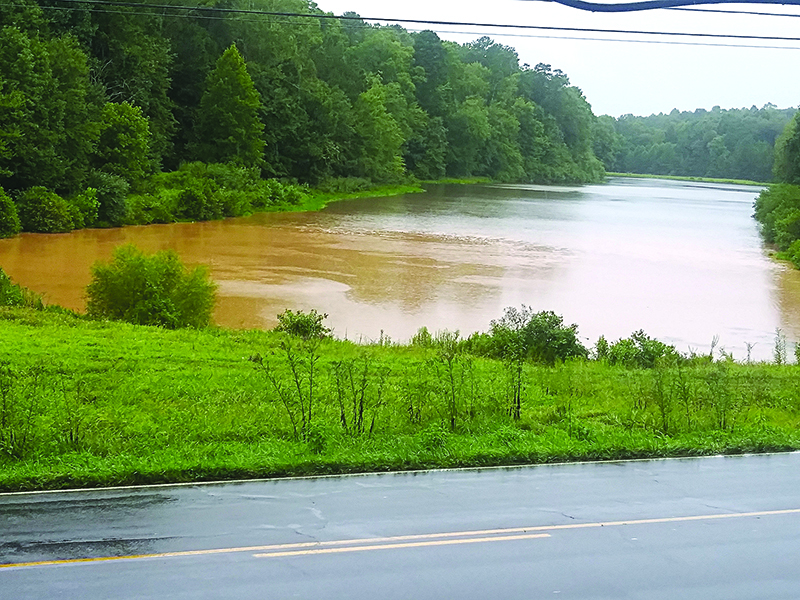
For decades now, the name of Paul Kiker Sr., has been synonymous with introducing the sport of competitive water skiiing and ski jumping to Gilmer County. Through those years, the tournaments he’s sponsored have drawn hundreds — if not thousands — of participants and spectators.
This summer, Kiker had two more water skiing tournaments planned. But he said the runoff of red mud into the end of Lake Paul closest to the Old Highway 5 roundabout construction site after heavy rains has dumped 3 to 4 feet of silt where the boats turn around and forced cancellation of the tournaments.
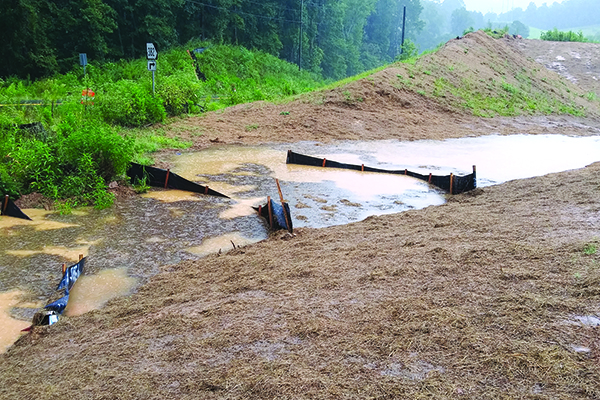
“With the big motors on these boats, it would tear them up trying to turn around down on that end,” he said.
Kiker was asked if anyone from C.W. Matthews Contracting, to whom the roundabout project was let out, ever communicated with him when they began construction.
“No, they did not,” he replied. “But they took a reading in the lake to see how deep it was. I’m not sure if it was the state (Department of Transportation) or C.W. Matthews, the latter I assume. They didn’t contact me, they didn’t say, ‘How can we help? What can we do?’ or anything. Over the last year-and-a-half, it’s just been bad. And I have pictures.”
Kiker said he first noticed the runoff in the project’s early stages along Highway 382 (which abuts Old Highway 5 South) in 2019.
“When they first started work up 382, the water came down through there and went under the road and then on to our property, and then into the creek and the lake,” he detailed. “It was mud flowing down the highway, and that was the first place it started. It’s been that way ever since they started, and nobody seems to care about anything.”
Over the last year-and-a-half, (the silt) has “just been building up.”
“The worst of it’s over now. It’s done now,” he said. “The ditch down the side of (Old Highway 5) in front of Green’s (Country Store complex) was about 4 feet deep before. They filled it up (with silt) to a point it ran over, even in the parking lot, and it ran into that little cafe and all down through there on a couple of occasions. Now they’ve put a culvert in that ditch and covered it up, and that ditch is no longer there. It’s up pretty level with the rest of the parking lot and highway now. But that ditch many times was filled up with silt.”
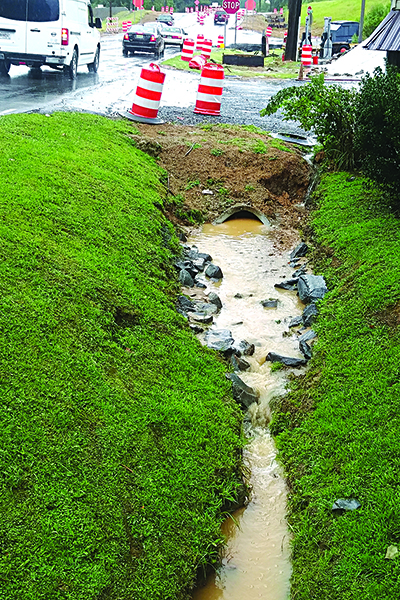
On one occasion when the Green’s parking lot was “6 to 7 inches” deep in mud, Kiker — who lives across the highway – walked up and began taking photos.
“They had bobcats down there carrying the mud away and using a big sweeper to sweep the parking lot,” he said. “They had about five or six men there with shovels, and several pieces of equipment cleaning it up as quick as they could. I was taking pictures and one guy come up to me and said, ‘Can I help you?’ I said, ‘Yes, you can help me. I see you’re cleaning this up here on their property. But what are you going to do about filling up my pond down there?’ And he didn’t say one way or the other. He just sorta ignored the question.”
Kiker shared the photos, and got a visit from an environmental compliance officer with the state Environmental Protection Division.
“I showed him the pictures,” he said of compliance officer Tracy Feltman. “I took him around and showed him, and he said he could find ‘no venue’ where the silt was coming into the lake – it’s the most absurd thing I’ve ever heard in my life. The pictures show it; where is it going to go but into my lake?”
In an email to Kiker from two months ago dated June 21, Feltman said, “On the day of the inspection, I found some minor BMPs (best management practice) issues. However, I could not find a sediment path to the lake. I suggest requesting GDOT taking another lake survey at the end of the project.”
Lake a ‘sedimentation pond’
Ricky Boring, a south Gilmer County resident who has extensive experience as an excavation and logging contractor, said he passes by the roundabout construction site on a daily basis.
“The erosion control was never really put into place, because it didn’t stop it,” he said. “Every time it would rain, you could go down there and just watch it wash red mud down into their lake. I told Paul, ‘Evidently they think your lake is a sediment pond (silt control device) for erosion.’ I took some pictures and given them to Paul, and he said them was some of the best he had. I live in this area, and I’m up and down there every day, and I go by when it’s raining, and I’ve never seen it when it wasn’t running mud.”
Boring echoed Kiker in saying the project is more stable as it nears completion.
“Going down there now, when they’re finishing up the project, they got a lot of it stabilized,” he pointed out. “It ain’t as bad as it was, but they can’t go down now and look at it and say, ‘Oh, it looks good’ when it’s been going on for months and months, and it ain’t been good. If I was out there doing that, they’d put me in jail and shut me down. But they’ve used his lake for a sediment pond … they know what’s going on.”
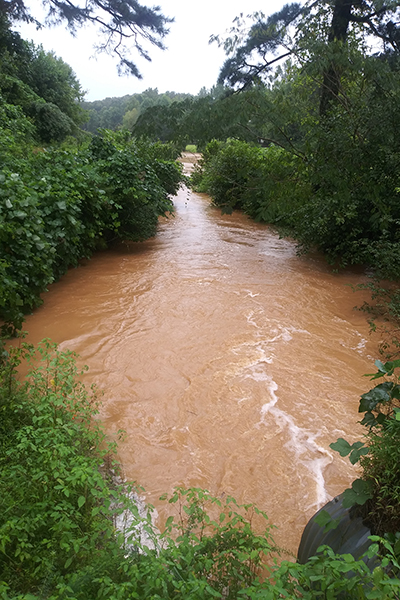
Kiker said he does not want to go to court, but would consider consulting an environmental law firm if action is not taken to address the siltation in his lake.
“At this stage of it, they’ve slowed a lot of it down,” he admitted. “But there’d already been lots and lots of it went in (to the lake). So they’ve been made aware of it.”
Joe Schulman, of the state Department of Transportation’s District 6 Communications Office, returned a phone call to a reporter and issued the following statements:
“Our office nor the contractor was aware of any recent issues at this location and had not been contacted up until we received the pictures from the reporter. Our crew did survey the pond at the beginning of the project, and we are requesting a follow-up survey once that portion of the project is completed to compare the results. GDOT is currently performing an in-depth review of the situation, including reaching out to the contractor to perform a review of the area. We have also contacted the GDOT Environmental Compliance Bureau and Environmental Liaison to request a review of the project to determine if there are any potential issues that need to be addressed concerning this matter. We can provide more information once our office has been able to complete a review of the site and determined how to proceed.”
Schulman was asked if the DOT kept a person trained in soil erosion prevention practices on large construction sites where there is land-disturbing activity in sloped areas. He responded, “The contractor oversees the erosion control during the project.”
When Feltman was contacted by a reporter, he immediately suggested a written request be made for the official report of his visit. After the request for the report was sent Friday, Feltman forwarded the email (copying the reporter on it) to Heather Bentley, an administrative assistant with Georgia EPD. The report was not emailed by the reporter’s stated deadline of noon Monday, nor was it sent later that afternoon. A voice mail to the public relations office of C.W. Matthews Contracting left Friday was not returned by late Monday.
Impact on property owners?
In a January 2019 article in the Times-Courier, a former communications officer with the state DOT, Mohamed Arafa, said the roundabout — on the agency’s drawing board for 20 years — would not only make Old Highway 5 South safer, but keep it moving without a stoplight or stop sign.
“You stop only for the vehicles inside the roundabout,” Arafa said. “It keeps traffic moving, and at the same time, it reduces crashes once people know how to use it. It’s a proven traffic control mechanism, proven to be very, very safe compared to a stop sign or traffic signals.”
Just months before the project broke ground, Arafa stated, “We’re doing some environmental work, meaning studying the impact of the project on the natural environment, as well as the social environment, meaning the impact on the property owners.”
However, Kiker believes there has been an obvious communication breakdown between the state agency and their contractor.
“These big companies know the right thing to do, and yet they don’t do it,” he said.
The last estimate for the cost of the roundabout project, published in August 2018 on the state Department of Transportation website, is just over $10.5 million. The “notice to proceed” with construction date was June 2019, and the completion date is Sept. 26, 2021. The project is at almost 77 percent completion, according to figures on the website last week.
C.W. Matthews Contracting Company was established in 1946, according to the Georgia Secretary of State’s website. The company employs more than 1,000 people, and specializes in highway, street and bridge construction, according to incfact.com. CWM Contracting’s annual revenue is over $500 million, according to the incfact website.