
Hundreds worked almost nonstop 60 years ago

Rather than drive a four- to five-mile gravel “haul road” out of the Carters Dam construction area in its early days, surveyor Bill Moore decided to take a bulldozed dirt road that was steep but looked navigable.
“(The dozer operator) had gone over the side and just let his blade down a little bit, just enough to hold him back,” Moore recalled of the mid-1960s project. “It looked like he had made a nice, smooth road down to the bottom so I said, ‘I betcha we could go down that.’ It was steep, but it didn’t look that steep.”
However, as soon as the Ford pickup eased over the edge, Moore knew he’d made a mistake.
“The back wheels started coming up off the dirt, and the two guys in the truck with me were getting ready to jump out the door,” he recalled. “I would let off the brakes so the back wheels would set down, but then we would pick up speed. I put on the brakes again and the back wheels came up again. So here we are going down the hill, and we had a whole pickup truckload of stakes and axes and everything, and lost it all from the top of the hill to the bottom.
“We made it to the bottom doing about 55 (mph) — the two guys never jumped, but they were getting ready to. I was scared to death!”
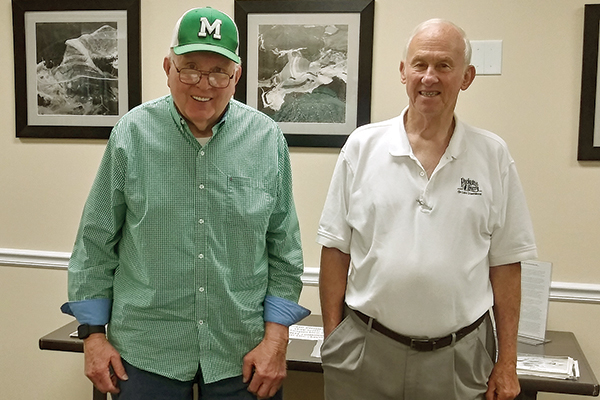
Recently, at a “Building a Dam with Bill Moore” event at the Carters Lake Visitor Center, the U.S. Army Corps of Engineers noted, “The building of a dam is no small task, especially one 400 feet tall made entirely of rock and earth. But those intrepid engineers and workers who tackled the task at Carters Lake built this dam to last … (Moore’s) hands took the plans from paper and laid them on the ground. What a source for firsthand knowledge!”
Two months after graduating from Clemson University, Moore was working as a chief surveyor in the first phases of the dam’s construction. An initial project was building a diversion tunnel for the Coosawattee River.
“I arrived in March 1965 and stayed through 1966,” Moore said. “A contractor arrived on site with 40 Mexican laborers and wanted us and his survey crew to shoot the parameters (using surveying gear) so his men would know where to clear the mountainsides — the eventual borders of the dam — with power saws and bush axes.”
Moore said the dam has a red clay interior — “the only thing holding the water back” — and “zones like a highway curve” with rock added to the dirt, then another zone with more rock and less dirt, until the outward layer of the mass are the rocks seen today holding back the reservoir. The dam is 150 feet wide at the bottom and tapers as it rises to 25 feet wide at the top. Huge lights were used to allow a second shift of workers to toil into the night.
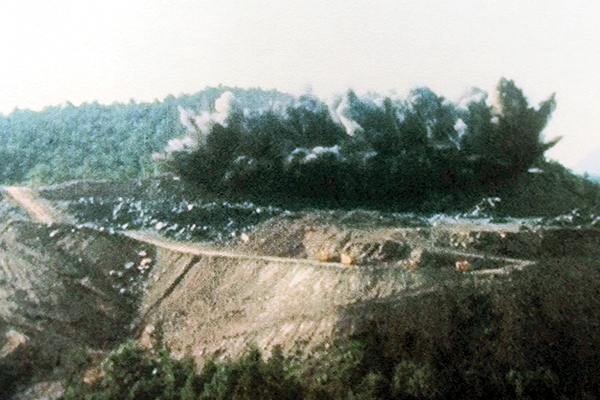
Because there were hundreds of men working amid heavy equipment, accidents happened.
“A dump truck driver was coming down the haul road faster than he should have when he was empty (of rock),” Moore said. “He met a huge D-8 bulldozer who raised his blade just in time to catch the truck and it flipped over. In one of the photos somebody took, a construction worker is standing on the overturned truck with his shotgun standing beside him like he had brought down big game.”
The haul roads used to take rock out of the growing chasm between the two mountains were “changing all the time” due to progress being made on the dam, and Moore’s crew had to survey a new pathway for the big trucks and other heavy equipment often.
“It was almost a full-time job laying out haul roads,” he said.
He is aware of only one fatality that occurred after his time at the dam had ended.
“The Corps had a meeting very early on … and said that for every few million dollars on a project you always lost a life,” Moore remembered. “So they were projecting we would lose seven people on that job. But the only person that was ever killed was when they were excavating the penstocks (to control the flow of water) down at the powerhouse area … this gentleman who was killed walked in right after a blast to inspect to make sure there weren’t any unshot holes (containing explosives), and didn’t notice there was a great big piece of rock above him. It turned loose and came down and crushed him.”
Ronald “Hoss” Walker of Ellijay, who helped build the dam with his late brother, Donald “Duck” Walker, also noted, “We lost one man. It was very dangerous work — steep, rough and lots of rock.”
The brothers served identical hitches in Vietnam and were supposed to get a month off when they returned stateside.
“After a week they (Clement Brothers Construction) called and said, ‘Get back out here and help us build this dam!’ So we did,” he recalled. “They told us when we started (in 1963), ‘We’re working 12 hours a day, seven days a week. If you can’t do that, we don’t need you.’ I liked it.”
Fourth of July
On a Fourth of July around half a century ago, G.I. Maddox — whom Moore called “the barbecue king” and has Highway 76/52 East named in his honor — brought concrete blocks and pieces of tin for cooking hundreds of pieces of chicken for the men.
“There was a crew that was working that morning from 7 to 4 (in the afternoon), and the other crew came in at 4 and worked into the night,” said Moore. “That second crew came in about 2:30 or 3 and ate up all the barbecue before the ones that got off first shift. We thought we were going to have some shootin’ going on! That was the only bad blood I saw while I was there, ‘cause those boys could smell that bird cooking and were looking forward to it.”
Benny and Jo Ann Huggins of the Holly Creek community have been good friends with the Moores for decades. Benny said the Tom and Ann Restaurant was so named because they were the children of G.I. and Miriam Maddox. Moore met his future wife, the late Linda Brooks from Eton, at a doctor’s office. Linda and Jo Ann were good friends.
“Not long after beginning his job at Carter’s Dam, Bill became very ill,” said Jo Ann Huggins. “Since he was new to the area, he was not familiar with any local physicians. When he entered the doctors’ building, he saw the names, Carson, Carey, and Meacham. When the receptionist asked Bill which doctor he wanted to see, he thought, ‘Well, Meacham begins with a ‘M’ the same as Moore, so I will request Meacham.’ As it turned out, the doctor’s nurse was a young, lovely local lady named Linda Brooks. Although he was not feeling well, Bill learned in the course of the conversation that Dr. Meacham’s nurse was not married. She later became the future Mrs. Moore. They were happily married for 43 years until Linda died due to cancer (in 2010).”
The powerhouse
Zollie Bowling attended the “Carters Dam with Bill Moore” event, and called himself a “foreigner” from eastern Kentucky coal mine country. As a young man, he spent four years (1963-67) in the U.S. Navy including sailing time aboard the USS Robert A. Owens, a destroyer.
“That was plenty enough time for me,” he said with a chuckle of working in the destroyer’s engine room.
After exiting the Navy, Bowling worked at a steam plant in Ohio. Then when he visited a hydroelectric plant, he wrangled a job with the Corps of Engineers and trained at Georgia’s Clark Hill Reservoir. Initially, he worked in Alabama before bring transferred to Carters Dam.
“I watched them build the powerhouse, then was the senior operator,” he said. “I was the first one that came that knowed he was going to stay and operate the powerhouse. The dam was done already built — it wasn’t filled with water — but they was working on the powerhouse. Every dam leaked a little bit, and what happened was the rereg dam (re-regulation lower dam) had two sump pumps in there and the sump pump failed and it flooded it out. So they brought me in here to take care of the rereg dam, to watch after it.”
Bowling’s first task each morning was to “walk down four flights of stairs and check to make sure everything was working alright, and that it didn’t flood. Before I left I walked back down there. And if it needed to be operated, I operated it, because it was not remote control.”
Was it dangerous to work in the powerhouse?
“The turbine (to generate power) had a plate on top of it to make it smooth, and it had a head cover that sat down on it,” he recollected. “The welds broke on it one time and the plate came loose and a corner stuck up. It cut the head cover and pretty soon we’re flooding in the powerhouse. That’s not good, and we had all the pumps that we could get in there pumping it out till we could get the head case down, and then the tail casing. It was hectic for a little while.”
Bowling, who spent his career with the Corps of Engineers, said it was all hands on deck “working hard” to ensure the water didn’t get high enough to reach an area where electricity was being produced.
“We had portable pumps going every which way,” he said, adding that a transformer going out could trip a breaker and cause three others to go down and begin spraying water because the unit sensed it was on fire. “You could go to sheer terror sometimes.”
For more information, Facebook pages can be found at U.S. Army Corps of Engineers, Carters Lake; Carters Lake Visitor Center and Hiking Trails; and Carters Lake Recreation Sites in Gilmer County.
Next week: Finding American Indian relics and gold at the dam site.