
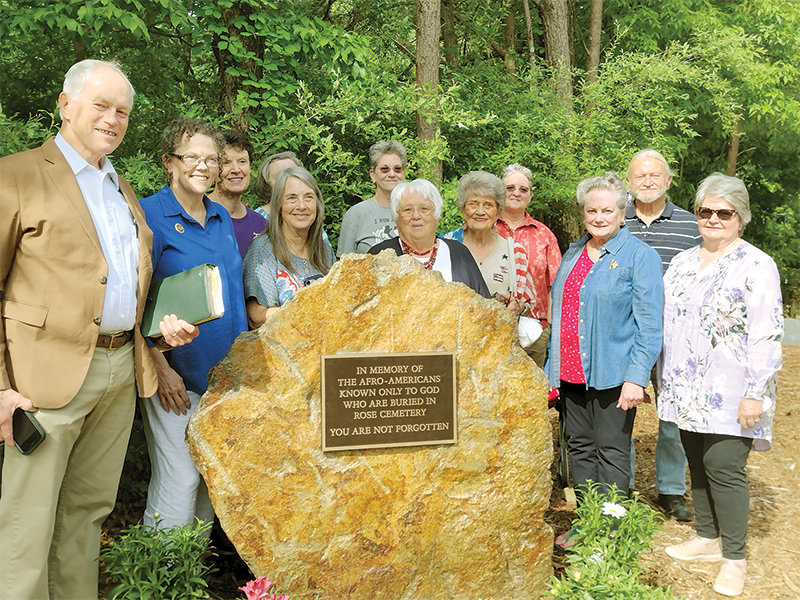
Sixty-seven graves covered by brush and almost forgotten have been found and marked in a refurbished cemetery on Gilmer County’s east side.
Last Friday, 16 community members who helped uncover the old African-American resting place honored the dead by dedicating the shade-covered space as Rose Cemetery.
The two-and-a-half year project of finding and marking the graves began when Jennifer Anderson and her husband, Danny, moved into the Yukon community along John Teem Road, and neighbors told them stories about the black cemetery at its juncture with Ravencliff Road.
At the ceremony, Anderson gave a brief history of the African-American families who lived there.
“Today, we’re here to honor and remember those who are buried in this sacred burial ground that we call Rose Cemetery,” she said. “This cemetery was abandoned and neglected, and as you all know, those who once took care of it left and there aren’t any records.”
 Anderson said the graveyard is so old it sat on a land lot in Cherokee County — totaling 160 acres — before Gilmer County was formed, and it was then split into two 80-acre tracts. In 1876, Marion Palmer owned one of the 80-acre tracts, and Henry Wright owned the other 80 acres. Palmer was a farmer and Wright was a preacher.
“We were told there’s a church down on the creek, but we haven’t found it … there were 30 African-Americans living here in 1870 (according to the census for that year),” she noted. “In 1880, there were 46. So we know this was a little community. Through ground-penetrating radar, we know that there’s 67 graves — four people in caskets and the rest in shrouds; five babies and 10 children or teenagers, and 52 adults.”
Anderson’s close friend and co-researcher Susan Noles knows a good project when she sees it. Noles thanked “every person who has helped us, even if they just thought about it.”
“I appreciate each and every one of you, you just don’t know how much,” she continued. “We’ve got ladies weed eating every two weeks, and they weed the flowers — we just all work together, and I think that’s the biggest thing with our Rose Cemetery, that we’re a community.”
Rick Stirewalt, a local resident and volunteer on the project, said work on the old cemetery had a practical application as well. He explained that before renovations began there were times when sirens and the red-and-blue lights of law enforcement vehicles arrived at the site.
“This was the drug drop,” he said of prior illegal activity. “The weeds were this high (shoulder height). You could sit down in it, and the cops couldn’t see you. We (neighbors) decided one day to weed eat the whole place, and we got about partway up and it couldn’t have been but a few days later when this crowd (those present) showed up and did the rest. So I want to say thank you to all of you for helping us feel more safe.”
Little is known about Mary Rose, for whom the cemetery is named. That doesn’t matter, the Rev. Steve Fields pointed out.
“You’re here honoring the lives of people that existed, (and) we believe the Bible teaches that every single person that is conceived is an important person to God … we’re here to celebrate that their lives were significant,” said Fields, who grew up on the mission field in Africa and pastors Covenant Community Church of Ellijay.
He commended the volunteers for valuing life, since in his experience life is not valued highly in many foreign lands.
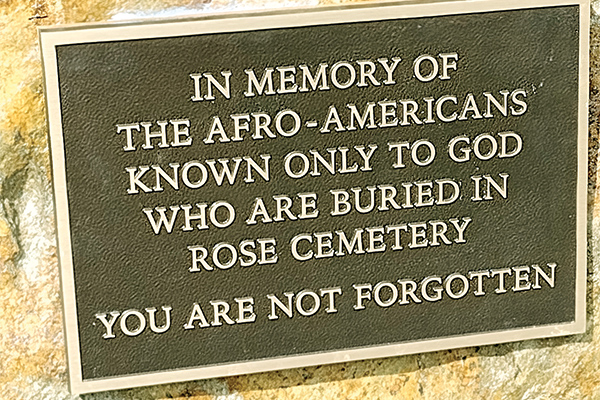
“We’re thankful for people who put in so much effort and care for the resting place of people they don’t even know and hardly know anything about, to honor that they lived and that they served, then died and are buried in this place,” Fields prayed. “We dedicate this plaque today in their memory and in their honor, and to show that we care … thank you for this moment in time when we honor these people that lived in our community.”
“These people deserve to be remembered, they deserve a peaceful resting place,” said Anderson.