
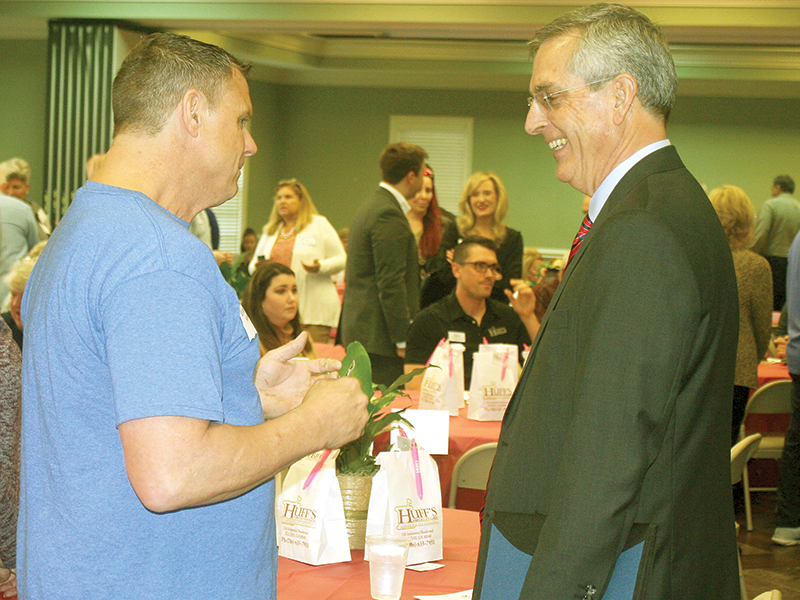
When speaking at a member’s luncheon hosted by the Gilmer Chamber Thursday, March 10, Georgia Secretary of State Brad Raffensperger said he was grateful for an opportunity to “set the record straight” regarding controversy surrounding 2020 presidential election results in Georgia.
Raffensperger, Georgia’s secretary of state since 2019, became the subject of national attention after receiving a January 2021 phone call from President Donald Trump in which Trump claimed various forms of ballot tampering had occurred in Georgia and urged Raffensperger to find enough votes to overturn the election’s outcome.
Despite election fraud claims being dismissed after investigation by multiple agencies including the FBI and GBI, “that myth is still out there,” Raffensperger told the chamber crowd gathered at the Piedmont Community Center.
“It just kind of permeated American society,” he said.
“I wrote a 10-page letter to Congress,” Raffensperger continued. “When I did that, I realized if Congress called me up and said, ‘We’d like you to put your hand on the Bible. You sent this to us. Is this the truth?’ I could say, ‘Yes sir, yes ma’am. That is the truth.’”
Raffensperger said 28,000 Georgia voters skipped the 2020 presidential race altogether.
“They didn’t vote for anyone, yet they voted down the ballot for the county commissioner, state rep. or state senator,” he added.
Among other 2020 election data points he discussed were greatly exaggerated numbers of deceased, underage and felon voters in Georgia.
“People alleged in their lawsuits that 10,350 dead people voted, but here was a total of four dead people who voted in the election,” he said. “They said there was over 2,000 felons that had voted in the election. We found no more than 74. They said there were 66,000 underage voters. There were zero. You have to understand, in Georgia, you can register to vote when you’re 17-and-a-half, (but) you have to be 18 by Election Day.”
Raffensperger gave an example of how a vote can be cast in the name of someone who’s died. “It’s not a felony. It’s a misdemeanor,” he said.
In Dade County, an absentee ballot came to a house no longer occupied by the previous owners, Raffensperger said. “Someone moved into that house. He voted for himself, and he voted for the person that moved,” he added.
On changes brought by the state’s Election Integrity Act of 2021, Raffensperger discussed the importance of provisions that give the state election board power to investigate, suspend and replace local election officials.
“We finally have, for the first time ever, accountability for counties,” he said. “I use the example of little Johnny back in grade school. Little Johnny, when he knew no one was going to check his homework, he sometimes may not do it. Once the teacher says, ‘I’m going to check your homework tomorrow,’ little Johnny started doing it.”
Fulton County’s election management is still under review, Raffensperger noted. “Fulton County got the message because they understand (their) entire board can be replaced. They’re trying to make improvements,” he said.
Raffensperger said the 2021 voter law — which limits the number of ballot drop boxes to one per 100,000 active registered voters and requires drop boxes be moved indoors — didn’t decrease, but instead expanded, early voting.
“We have Monday-Friday for three weeks. That’s 15 days. And two Saturdays. That’s 17. Any county that wants to continue to have Sunday voting can have two days of Sunday voting. That’s up to 19 days. President Biden’s home state of Delaware has 10 days,” he said.
Raffensperger, who’s written a book about the 2020 election controversy, said he’d like to have a town hall, also to set the record straight and answer any questions about the election.
He’s currently among 10 candidates running for Georgia Secretary of State this year. The primary election is May 24, while the general election will be held Nov. 8.