
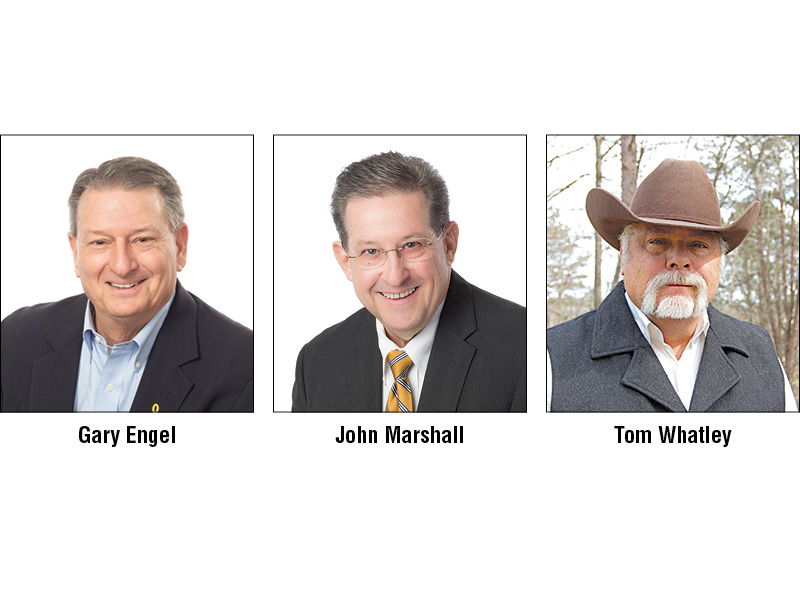
In advance of the
upcoming May 24 general
primary election, the Times-Courier asked candidates running for Gilmer County Post 2 Commissioner four questions. Here is how they answered:
What experience or skills make you qualified to hold the position of Post 2 Commissioner?
Gary Engel: My career and educational background focused on leading and managing large, complex organizations. I am uniquely qualified with essential skills to develop effective solutions.
Some experience and education: Owner Engelheim Vineyards, chairman Georgia Wine and Grape Commodity Commission, member Gilmer County Board of Tax Assessors, vice president King of Kings Lutheran Church, operations director General Dynamics: Led and managed global team of 1,700 personnel, U.S. Army Colonel. Last duty was the operations officer for the Theater Sustainment Command. Executed command and control of over 50,000 soldiers. Master’s Degree - National Security and Strategic Studies, The United States Naval War College.
John Marshall: For over 40 years, I have owned and successfully operated businesses in Gilmer County, giving me a firm grasp on budgeting and financial planning, personnel management and the challenge of remaining simultaneously competitive and profitable.
As an active leader in local civic organizations, including two terms as the chairman of the Gilmer Chamber in 1989 and 2019, I have learned how to build coalitions, unite and collaborate.
Being born and raised in Gilmer County gives me the benefit of a historical perspective of endeavors that have both worked and failed here, to better prepare for a positive future.
Tom Whatley: Commissioner positions are essentially the local legislative branch of Gilmer County. Commissioners work as officials whose voting powers include county policy, spending and taxation rates. I served seven years as vice chair on the Budget Advisory Board in my former county, resulting in a $900 million dollar reduction as I became well-versed in the departmental budgetary process, line item requests and financial investigation. My bachelor of science degree in legal studies, government finance training, 21 years as a police officer/detective and commitment to control on taxes for Gilmer residents gives me the skills required to be your commissioner.
If you are elected, what will be some of your specific goals or focus areas?
Gary Engel: As senior leaders, our primary responsibility is to develop and execute a comprehensive strategic vision for the county. All resources and priorities are developed using this vision. This visioning is a collaborative process with our Gilmer residents. What do we want our county to look like for our children, grandchildren and beyond?
Some specific focus areas to address include reasonable housing, improvement to our roads, infrastructure, recreation services, improved medical capabilities and supporting a positive business environment to create quality jobs for our young people.
John Marshall: Our citizens deserve additional and improved recreational facilities so people of every age can enjoy a healthy lifestyle.
We must continue to expand and diversify our industrial base to provide jobs that will entice our own young people to remain in their hometown, if that is their desire.
We must continually seek new funding sources that are outside of our normal revenue streams that do not directly impact the wallets of our taxpaying citizens.
We must foster an environment for the development of attainable housing that will help local businesses who are struggling to both attract and keep quality employees.
Tom Whatley: My number one focus area will be to stop the overdevelopment in our county. I am in favor of local builders, but not the mega builders from Atlanta who have already verbalized their intent to move into Gilmer County. If anyone tells you that building in Gilmer County will be for local Gilmer residents, its a misnomer. Federal law states that you cannot restrict housing for a select designation.
My next focus area is to keep us safe.
Number three is control of taxes, and to keep the 65 and older tax waiver, then maintain our Second Amendment Sanctuary status.
What, in your opinion, are the three biggest issues currently being faced by Gilmer County?
Gary Engel: We must get ahead of growth with deliberate, proactive planning to address key requirements like infrastructure, negative impact on natural resources, medical capabilities and no additional taxes.
We must reduce the debt of the county. We should never be a slave to the lender and forced to make decisions for that reason. Budget scrutiny, innovative approaches and outside sources of revenue are some initial possible opportunities.
We must find positive solutions to help the private businesses to provide quality, affordable housing for our residents. Quality housing is essential for us to attract quality companies with career jobs.
John Marshall: We have a severe shortage of workers to fill the positions being offered by the employers of our community, including our school system and our public safety agencies. Too many businesses have been forced to curtail their hours and/or services because of a lack of personnel.
Our infrastructure needs improvement and better maintenance, including many of our roads.
There is a dire need for additional housing in our community. Without more housing choices, many individuals, including those who have been raised here, are forced to move elsewhere to live, work and raise their own families.
Tom Whatley: In my opinion, the three biggest issues facing Gilmer are 1.) overdevelopment, 2.) improving our infrastructure, 3.) maintaining our agriculture businesses. I will add that housing is an issue facing Gilmer, too, but the entire United States is facing the same issue. This is not an issue only affecting Gilmer, it’s a cyclical trend that will resolve itself over time.
If you are elected, how do you plan to address rising inflation?
Gary Engel: We must manage to budget, always seeking innovative solutions. There are additional funding sources available to local communities, as well. We need to look at other possibilities such as fees on our natural resources such as mining operations, clear cutting property for other than timber/farming, green space and other possible tools available. Maybe there are opportunities in organizational innovations that may provide some positive impacts. I believe our residents can provide some solutions if we just work at listening. I do not have the answers on everything, but I know how to listen and learn. Together we can grow!
John Marshall: Inflation is largely caused by monetary policy of the federal government and the federal reserve, so the county must respond to rising prices by a reduction in spending, or an increase in revenue. I will always favor keeping spending well within the set budget, even if it means a temporary reduction in services.
Should that become necessary, I will carefully evaluate all budget items and propose reductions that have the least impact on our citizens.
Finally, the county must maintain an adequate financial reserve to be prepared for the adverse effects of future economic cycles.
Tom Whatley: Rising inflation can most successfully be addressed by tightening our belts, meaning to cut excess spending during the inflationary period and even halt new spending, if needed, for the short term. The same process is most effective even in our own homes and lives.