
Cherry Log resident was pro player, instructor, junior tennis leader
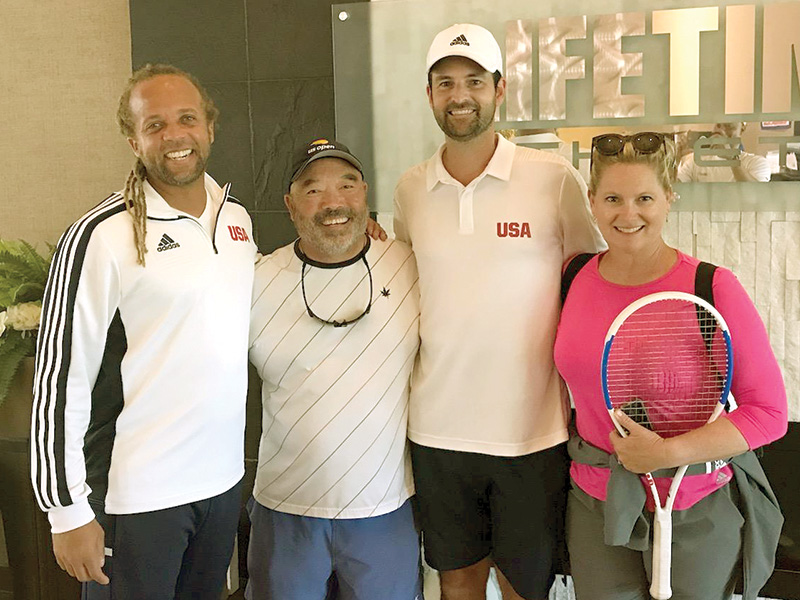
A Cherry Log resident whose dedication to youth sports earned him the nickname “Mr. Junior Tennis” is hall of fame bound.
Bill Ozaki will soon be inducted into the Southern Tennis Hall of Fame. The honor is bestowed by the Southern Tennis Foundation and the U.S. Tennis Association (USTA) Southern Region.

Before making his home in Cherry Log, Ozaki enjoyed a 16-year career as a tennis teaching pro at Hidden Hills Country Club in Stone Mountain. That was followed by a 30-year administrative career with the USTA’s Southern region. In that time, he led the region’s junior department, overseeing and developing youth tennis tournaments, programs and camps.
“Early on, when I was a teaching pro, I taught both kids and adults, pretty much everybody who came along,” Ozaki said. “When I went to work with USTA, all the work I did was with kids, parents and coaches.”
Ozaki’s interest in tennis dates back to his own childhood in Camden County on the Georgia-Florida line. He grew up on a farm in the small town of Woodbine and played about every school sport imaginable.
“It was a great place to grow up, and it reminds me of up here in north Georgia. When I was growing up, we had to play everything season to season (including) football, baseball, track and basketball,” he said. “I squeezed tennis in, too, and I think my dad knew I wasn’t going to be big enough later on to play some of the other sports. Starting in 10th grade, I just played tennis from then on.”
According to USTA Southern, Ozaki is the hall of fame’s first inductee of Asian heritage. The Southern region includes nine states and is the USTA’s biggest region out of 17 nationwide, Ozaki noted.
Ozaki’s dad was a Japanese American who served with the U.S. forces in World War II. During the war, his mother and future step-siblings were in an Arizona internment camp.
“It was an interesting dynamic,” he said. “My dad was born in the states, and he and my mom were married (after the war). He had a farm in south Georgia and grew primarily lettuce and cucumbers. He would drive his produce in a tractor-trailer cross country to California. His father and uncle had been in California at the turn of the century. At that time, in California, a foreign-born person couldn’t own land, but Florida was basically a swamp then. If foreign-born people came there to farm, they let them own the land. There was a whole colony of Japanese people who came to the Eau Gallie, Fla., area who were basically truck farmers.”
Before becoming a teaching pro, Ozaki competed in regional tennis tournaments on the south Georgia-north Florida circuit. As a junior player, he won the 1970 Class A High School Singles Championship. He later played tennis for a couple years at DeKalb College in Atlanta.
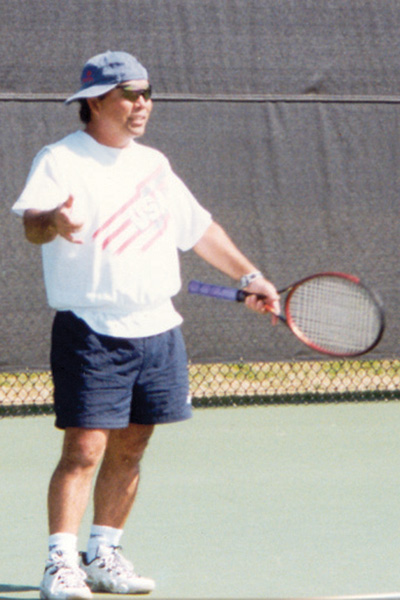
“Back then, there weren’t that many pro tournaments, so you just traveled around and played (where you could). There wasn’t a whole lot of money to be made doing that if you won and, of course, no money to be made if you lost,” he said. “In the Atlanta area, you could make a good living (as a teaching pro) because the two largest adult tennis leagues in the world are in Atlanta.”
According to USTA Southern Hall of Famer Mary Hatfield, a past president of USTA Georgia, Ozaki was “a junior players’ advocate” who gave “attention to inclusion, quality development and teaching of life skills.”
During his time with USTA Southern, the number of tournament players in the region increased almost tenfold, from 5,000 initially to more than 48,000. That’s one reason Hatfield called Ozaki “Mr. Junior Tennis,” according to USTA Southern.
“We had a program called player development, which tried to develop young tennis players for high school, college and professionally,” said Ozaki. “We actually had a number of pros who came out of the Southern (region).”
In 2019, the USTA Southern Junior Cup tournament was renamed the Southern Ozaki Junior Cup. Its junior sportsmanship award is now called the Ozaki-Hastings Junior Sportsmanship Award in honor of Ozaki and USTA colleague Sandy Hastings. Ozaki was also inducted into the USTA Georgia Hall of Fame in 2019.
Nominating Ozaki for Southern Hall of Fame induction, Hastings said “a parent once told me, ‘Bill would not ask a player if they won or lost, but how did they play today.’” He will be officially inducted at a Jan. 14 ceremony in Atlanta.
“There’s so many outstanding people who aren’t in this hall of fame. I’m glad and grateful that they picked me, but I was surprised,” Ozaki said. “I’m honored to be going in because, in the Southern Hall of Fame, they have former pros and others of us who were more administrators. I’m lucky to be going in there with all those people.”
Ozaki and his wife, Bonnie, were part-time Gilmer County residents for almost 20 years before moving here in 2020. He still plays tennis at least once a week and occasionally subs for the Gilmer Tennis Club.
“I still enjoy playing, but I play pretty slowly at my age,” he said.
Today, Ozaki is just as likely to take up a game of pickleball at either the county park and rec courts or Victory Christian Center. He doesn’t see pickleball as a threat to tennis, but instead a less rigorous alternative that can be picked up quickly by most players.
“There are a lot of people who play pickleball who wouldn’t be doing anything else athletically. Tennis is hard. The court’s big, and you have to run a lot. People can use pickleball to get out and get some exercise. To me, anything like that is good for adults or kids,” he said.