
The medicated nasal spray Narcan can mean the difference between life and death for someone in the throes of an opioid overdose.
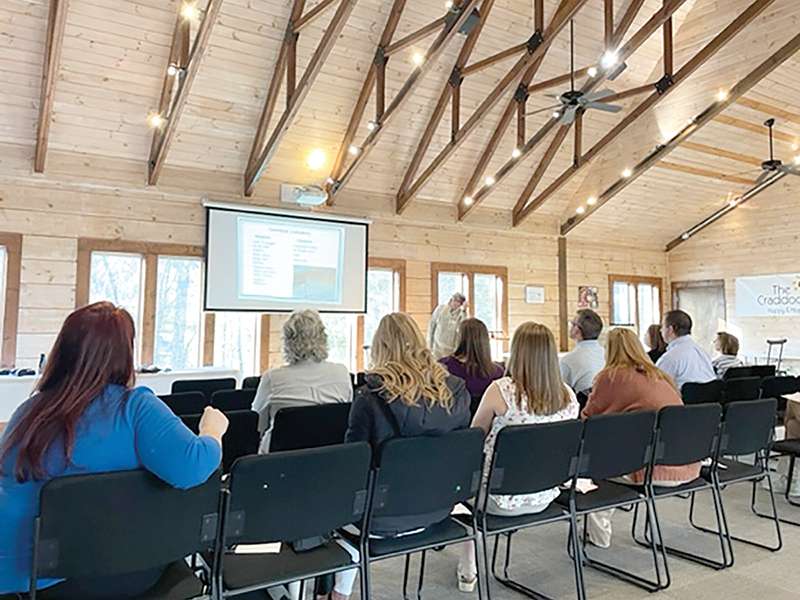
Representatives from several local organizations, including schools and healthcare providers, learned how to use the naloxone-based nasal spray during a recent Narcan training session offered by three local nonprofits.
That training session, held at Cherry Log’s Craddock Center March 24, was sponsored by Gilmer County Family Connection. Instruction was provided by Highland Rivers Health, a behavioral health and substance abuse treatment clinic with an Ellijay office.
The Narcan training was funded by a grant recently received by the local Family Connection chapter. Atlanta’s Morehouse College School of Medicine is leading the Community Education and Training in Opioid Use Reduction (CETOUR) program intended to reduce opioid misuse and abuse.
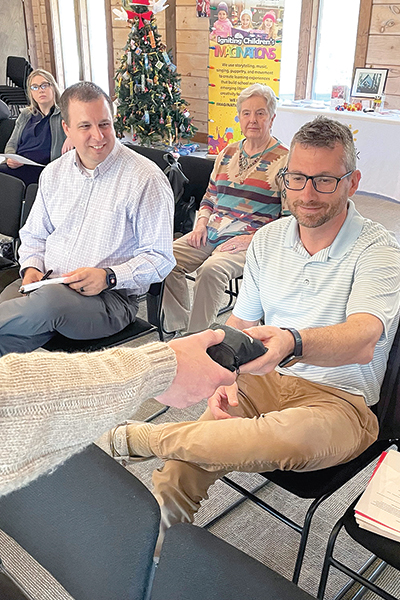
Each participant who attended the training session received at least two Narcan kits, which include a container of the nasal spray, as well as Deterra, which can be used to destroy and properly dispose of unused, unwanted and expired medication.
“They’re given the kit, and there are instructions in it, but they’re also instructed on what it (Narcan) does, how to assemble the device, how to administer it and how it’s incorporated into your basic lifesaving and first aid,” said instructor Ryan Swartz, director of addictive disease operations for Highland Rivers Health, who led the training presentation.
Often called an “antidote” to opioid overdoses, naloxone, the active ingredient in Narcan, has been used to clinically treat overdoses since the 1970s. Take-home naloxone kits have been in circulation since 1996, according to the Centers for Disease Control (CDC).
Opioids comprise a large class of drugs that includes prescription pain medication like Oxycontin, Hydrocodone and Morphine, as well as heroin and the synthetic opioid fentanyl.
The CDC suggests that naloxone kits, like Narcan, should be provided to many corners of the general public including persons close to opioid users, patients in substance treatment programs, convicts upon their release from prison and patients who receive chronic opioid prescriptions.
Among the information Swartz shares in the Narcan training is how to recognize signs of an opioid overdose.
“We talk about them looking cyanotic, (having) blue lips and their pupils. Whether they’re dilated or pinprick, it depends on the drug they took,” he said.
The Narcan spray is administered much like an over-the-counter nasal mist, and each container contains two full doses. It can be used in the event of an overdose of any opioid, including heroin, Swartz said. However, it is ineffective if an overdose of other drugs like alcohol or “benzo” anxiety meds like Xanax has occurred, he noted.
One doesn’t have to be medically certified to use the Narcan spray on someone they believe has overdosed, Swartz said.
“It’s not going to harm (the person receiving it) even if someone has assessed the situation and they’re wrong. It’s basically a lifesaving measure, like trying CPR. Even if you don’t have the certification, it’s better to do something instead of doing nothing,” he added.
Todd Gearhart and Matt Johnson, both assistant principals at Gilmer High School, were among those who attended the Narcan training session. Gearhart said the kits they received were given to the school’s resource police officer.
“It was an informational session for us so we can be aware of what the medication is and how it can be administered. It was great information,” he added.
Kirk Cameron, Craddock Center director, said this was a first-time thing for the cultural enrichment center, which provides a variety of literacy and programs to children and families. He hopes it won’t be the last opportunity for the training to be offered there.
“I think it went well, and we had a good turnout. I’m glad we are able to play a part in getting these kits out to people who can potentially use them. We’re (a) center for child and family enrichment, and we really felt like doing this training helped us in the family enrichment part of our mission,” said Cameron.
Along with Pickens and Fannin, Gilmer is among three north Georgia counties that have been named target areas of the Morehouse-led opioid abuse reduction program.
During a Gilmer Family Connection teleconference last December, Somilez Francis, of the Morehouse School of Medicine, said the statewide number of opioid-related overdose deaths increased by 245 percent from 2010-2017, and, in 2019, Georgia ranked 13th nationally for drug overdose deaths.
Francis said Gilmer, Pickens and Fannin have significantly higher ER visit rates for opioid overdoses, which is why they’re in the CETOUR target area.
“All three counties have been designated by the Georgia Department of Public Health as having the highest vulnerability for opioid overdose, and all three are designated by the HRSA (Health Resources and Services Administration) as health professional shortage areas,” she added.
Swartz said he’s already given the Narcan training twice in Pickens County, and Highland Rivers Health representatives have done the training in other parts of their 13-county service area. At least one more training session funded by the Morehouse grant will probably be done here in Gilmer County, he noted.
Highland Rivers typically sees patients with a shifting variety of substance abuse disorders, one of which is opioid addiction, Swartz confirmed.
“We do see a lot of (opioid abuse), but we also see a lot of multiple drug uses. (It could be) heroin and meth, heroin and benzos or alcohol and heroin,” he said.