
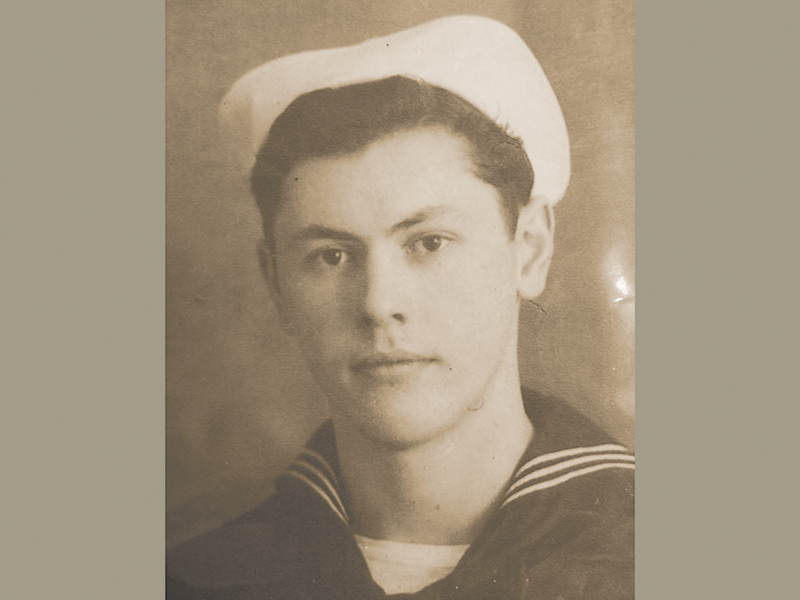
Seventy-eight Christmases ago, Paul Gates had just completed U.S. Navy boot camp. A 1943 graduate of Ellijay High School, he was drafted into the military during World War II. Although he didn’t serve in combat, Gates, 96, said there was still plenty of adventure for a boy who had grown up in the Mountaintown Creek area.
“Uncle Sam said I will need you,” he recalled a few days before Christmas last week. “Even though I was just 18 years old, I was drafted. I was just a kid, and had never been nowhere much.”
Basic training was at Camp Peary, Va.
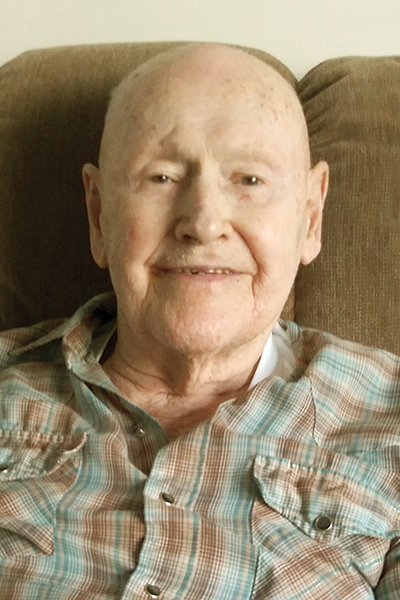
“There was about 30 of us,” he said. “We went through examinations, and they told me I had a choice of branch of service. There were three of us from here in Gilmer County that took the Navy — William Garrett and John Aaron were the other two.”
Gates and his compatriots were able to get back to Ellijay for Christmas in ‘43, but the bus that was supposed to take them back to their duty stations slid off an icy road in North Carolina. Jewel Garrett, William’s sister, was a teacher and drove the new sailors herself over bad roads to Gainesville, where they began their return journey. Navy personnel told Gates he was going to medical school for corpsman training.
“That was the last I saw of William, and John got out because of an injury,” he said. “I was by myself running around New York City from the Brooklyn Naval Yard. It was always, ‘Get your gear and come with me.’ I never knew where I was going or what. So they sent me to the hospital at Brooklyn for a short time. I could go under the Hudson River to Times Square, and there was movies and stuff there. They put me on a ship going down the coast. That was when ships were out in the Atlantic with supplies they were taking to England for the invasion, and German U-boats (submarines) were sinking them.”
Gates shipped out from the Big Apple for Norfolk Naval Yard in Virginia on a storied aircraft carrier, the USS Ranger.
“It was loaded with P-38s (fighter aircraft), every one that they could tie down on the hangar deck and the side decks,” he remembered.” That’s what ended the war over Europe; it was faster than the German planes and shot them down.”
Overseas duty
In early 1944, Gates sailed on a transport ship from Norfolk to Casablanca, Morocco, and then on to Palermo, Sicily, after the North Africa Campaign when Allied forces took the island from the Germans. He worked at the naval hospital there, and also at a first-aid station on the coast above Palermo called Mondello Beach. Corpsmen were normally attached to U.S. Marine units for their medical needs, he pointed out, but all those billets were filled.
“So that’s where I spent my time, in Sicily,” Gates said. “They asked me if I wanted to go to the Yalta Conference (on the Crimean Peninsula, to reorganize postwar Europe). But I was young and wanted to come back home instead of going somewhere else.”
Gates said an interesting part of his medical duties involved working on sailors who had their jaws broken by a “monkey fist.” He was asked to explain.
“It was a lead ball attached to a cord that was thrown from one ship to another ship as they sailed alongside each other; a sailor had to catch the ball when it was thrown,” he said. “A heavier cable was then passed back across and a senior officer would ride across on a ‘chair’ to talk to officers on the other ship.”
Gates was asked if he ever feared a ship he was aboard might be sunk by a German U-boat.
“I just took it as it come, I didn’t worry,” he replied. “I reckon the Lord took care of me.”
Gates said it took 24 days to navigate from Sicily to Baltimore on a “liberty ship” after hostilities ceased, yet it wasn’t always smooth sailing.
“A storm was just off the (U.S.) coast,” he recalled. “We were ‘rolling’ up to a 45-degree angle and water was coming up on the deck. That ship was a-moanin,’ and pots and pans were crashing in the galley even after they were tied down! We made it through, but I heard one of the ships lost their screw (propeller) in the storm.”
Gates spent nearly three years in the Navy, and because of his youth and not having enough points to get out, he was transferred to Guantanamo Bay, Cuba — long before the Communist takeover and Cuban Missile Crisis. Although many U.S. ships wintered there when the island’s leadership was friendly to America, there wasn’t a lot for him to do.
Back to Ellijay
Eventually he returned to the family farm on Gates Chapel Road. Gates got some training at North Georgia Trade School in Clarkesville, then worked for the Chrysler and Plymouth dealership in Ellijay owned by Ed Kiker. He did
“on-the-job training” as a mechanic because he didn’t have the tools to do body work. Later, he went to work at the International tractor and truck dealership in town. In 1955, he went to work at Lockheed in Marietta, putting in 30 years before retiring.
Gates was asked if he learned any life lessons from his time in the military and through decades of work.
“I grew up in a hurry, and did what they told me to do,” he reflected. “But I was ready to get out of the service. Parts of it are like a dream to me.”
Paul Gates was married to Mary Elizabeth “Betty” Keener for 54-1/2 years; she passed away in 2003. They had two children, the late Tommy Gates, and a daughter, Jody Holmes Henry.